

PURE AND SINCERE HEARTS
Introduction
After the creation poem of Genesis 1, we get a second version of the creation, especially of the Earth Man (Adam, drawn from ‘adamah’, earth) in a down-to-earth story. The human person breathes with the same life-giving breath (spirit, ruah) as God, at least in the sense that he or she has to breathe at the same rhythm as God. Then, the human person is placed in a royal garden called paradise, to cultivate it.
Divided too, were the hearts of the Pharisees, as Jesus points out in the Gospel; their interior attitude did not correspond to their outward practices. The question of pure/impure was very important for the early Church, as it was one of the strongest traditions of the Jews and a point of contention for them. Hence, the Christians coming from Jewry asked themselves whether they could eat from the same table with non-Jews. According to Mark, in the light of creation that sees all foods as created good and pure, in the kingdom the rules about food are abolished.
Opening Prayer
Father, God of the ever-new covenant,
you have tied us to yourself
with leading strings of everlasting love;
the words you speak to us are spirit and life.
May your Spirit make us look at the commandments
not as a set of observances.
May they move us to serve you
not in a slavish way, but as your sons and daughters
who love you and whom you have set free
through your Son, Jesus Christ, our Lord. Amen!
1 Reading GENESIS 2:4b-9, 15-17
At the time when the LORD God made the earth and the heavens — while as yet there was no field shrub on earth and no grass of the field had sprouted, for the LORD God had sent no rain upon the earth and there was no man to till the soil, but a stream was welling up out of the earth and was watering all the surface of the ground — the LORD God formed man out of the clay of the ground and blew into his nostrils the breath of life, and so man became a living being. Then the LORD God planted a garden in Eden, in the east, and he placed there the man whom he had formed. Out of the ground the LORD God made various trees grow that were delightful to look at and good for food, with the tree of life in the middle of the garden and the tree of the knowledge of good and evil. The LORD God then took the man and settled him in the garden of Eden, to cultivate and care for it. The LORD God gave man this order: “You are free to eat from any of the trees of the garden except the tree of knowledge of good and evil. From that tree you shall not eat; the moment you eat from it you are surely doomed to die.”
Responsorial PSALM 104:1-2a, 27-28, 29bc-30
R. (1a) O bless the Lord, my soul!
Bless the LORD, O my soul!
O LORD, my God, you are great indeed!
You are clothed with majesty and glory,
robed in light as with a cloak. R.
All creatures look to you
to give them food in due time.
When you give it to them, they gather it;
when you open your hand, they are filled with good things. R.
If you take away their breath, they perish
and return to their dust.
When you send forth your spirit, they are created,
and you renew the face of the earth. R.
Alleluia Cf. JOHN 17:17b, 17a
R. Alleluia, alleluia.
Your word, O Lord, is truth:
consecrate us in the truth.
R. Alleluia, alleluia.
Gospel MARK 7:14-23
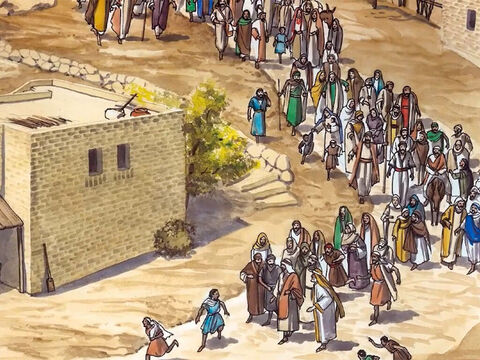
Jesus summoned the crowd again and said to them, “Hear me, all of you, and understand. Nothing that enters one from outside can defile that person; but the things that come out from within are what defile.” When he got home away from the crowd his disciples questioned him about the parable. He said to them, “Are even you likewise without understanding? Do you not realize that everything that goes into a person from outside cannot defile, since it enters not the heart but the stomach and passes out into the latrine?” (Thus he declared all foods clean.) “But what comes out of the man, that is what defiles him. From within the man, from his heart, come evil thoughts, unchastity, theft, murder, adultery, greed, malice, deceit, licentiousness, envy, blasphemy, arrogance, folly. All these evils come from within and they defile.”
Commentary
We believe in a forgiving God
Where does evil come from, and is there a solution to eliminate it from our lives? While addressing the issue of impurities arising from neglecting traditional rituals, Jesus focuses on the human heart, the abode of all good and bad choices. The religious leaders taught the people to observe the laws and traditions to avoid the punishment of God and to please him.
Ritual purity was meant to protect the chosen people of God from contact with anything associated with pagans – non-Jews or unclean animals. The creation story in the book of Genesis tells us that God created everything, and he saw that everything he created was good. But later, humans interpreted some people and some animals as unclean, and physical contact with them would make one impure.
Do our religious observances, prayers, and even attending Mass arise out of fear of God’s punishment? If we go to Mass to fulfil the days of obligation, how are we different from the religious scholars of Jesus’ time?
Jesus points out the source of true defilement — evil desires which come from inside a person’s thoughts and intentions. When Cain was jealous of his brother Abel, God warned him to guard his heart: “Sin is couching at the door; its desire is for you, but you must master it” (Genesis 4:7). Do we allow sinful desires to couch at our doors? Not to succumb to sinful desires or thoughts, there is no better option than to seek refuge in God. Jesus in the desert, Jesus in prayer teaches us to spend time with the Father, to confront the forces of evil. The Lord waits for us to transform and purify our hearts through his Holy Spirit, who dwells within us. Do we believe in the power of God’s love to transform our hearts?
Saint Thomas Aquinas wrote that virtue is the transformation of instinct or passion. Courage and hope, for example, are transformations of the aggressive instinct; love is the transformation of desire. What comes out of a person depends on how one transforms one’s experience. Our faith is a transformation of our experience of God’s love and our response to the world, others, and God.
Thus my relationship with Jesus helps me to transform that bad stuff into good, curses into blessings and sufferings into prayer.
Intentions
– For families plagued by quarrels and division, that the Lord may bless them with peace, we pray:
– For all the Churches that invoke the name of Christ, that they may accept the invitation of our Lord to eat with him from the table of unity and love, we pray:
– That the Spirit may keep lawmakers today distinguishing between good and evil, we pray:
Prayer over the Gifts
Lord our God,
we bring before you our readiness
to respond to your love.
We ask you that these gifts of bread and wine
may become the body and blood
of your Son, Jesus Christ,
that with him we may be dedicated to you
with our whole mind and heart,
and that we may be capable
of communicating your love and justice
to all those around us.
Grant us this through Christ, our Lord. Amen!
Prayer after Communion
Lord our God,
your Son, Jesus, has shared himself with us
in this Eucharistic celebration.
Purify our hearts and intentions,
that we may also share in his attitude
of openness to your will
and to the needs of people.
May we thus, fulfill more than the law
and serve you as your sons and daughters,
in whom you recognize Jesus Christ,
your Son and our Lord for ever. Amen!
Blessing
Commandments are not just observances that guarantee our salvation. They are a response to all God has given us. We ask God not what we are obliged to do, but what he expects us to do to respond to his love. May Almighty God bless you, the Father, and the Son, and the Holy Spirit. Amen!