

MARKED WITH THE CROSS
Introduction
Our first reading expresses the desire for mutual understanding, respect and tolerance: ”If we could only speak all the same language!” The author uses the occasion to ridicule the proud Babylon that destroyed nations and cultures. “Babal” means “to confuse” in Assyrian. Babylonians deserved a monument for confusing people.
Being a disciple of Jesus implies journeying with Jesus on the way of the cross. Christians, followers of Christ, are people marked with the cross. We make the sign of the cross not merely symbolically when we pray but also in real life, whether we like it or not. We have to learn to accept the cross with Jesus.
Opening Prayer
God of power and love,
in your mercy, you sent us your Son
to liberate us by his cross
from our selfishness
and from fear and sin and death.
Make us grow in the mentality of Jesus
and fill us with the strength of his Spirit,
that we may bear life’s burdens with him
and with him also take the pains
to live for others and to bring them hope and joy.
May we thus, go the way of Jesus Christ, our Lord. Amen!
1 Reading – GENESIS 11:1-9
The whole world spoke the same language, using the same words. While the people were migrating in the east, they came upon a valley in the land of Shinar and settled there. They said to one another, “Come, let us mold bricks and harden them with fire.” They used bricks for stone, and bitumen for mortar. Then they said, “Come, let us build ourselves a city and a tower with its top in the sky, and so make a name for ourselves; otherwise we shall be scattered all over the earth.” The LORD came down to see the city and the tower that they had built. Then the LORD said: “If now, while they are one people, all speaking the same language, they have started to do this, nothing will later stop them from doing whatever they presume to do. Let us then go down and there confuse their language, so that one will not understand what another says.” Thus the LORD scattered them from there all over the earth, and they stopped building the city. That is why it was called Babel, because there the LORD confused the speech of all the world. It was from that place that he scattered them all over the earth.
Responsorial PSALM 33:10-11, 12-13, 14-15
R. (12) Blessed the people the Lord has chosen to be his own.
The LORD brings to nought the plans of nations;
he foils the designs of peoples.
But the plan of the LORD stands forever;
the design of his heart, through all generations. R.
Blessed the nation whose God is the LORD,
the people he has chosen for his own inheritance.
From heaven the LORD looks down;
he sees all mankind. R.
From his fixed throne he beholds
all who dwell on the earth,
He who fashioned the heart of each,
he who knows all their works. R.
Alleluia JOHN 15:15b
R. Alleluia, alleluia.
I call you my friends, says the Lord,
for I have made known to you all that the Father has told me.
R. Alleluia, alleluia.
Gospel MARK 8:34—9:1
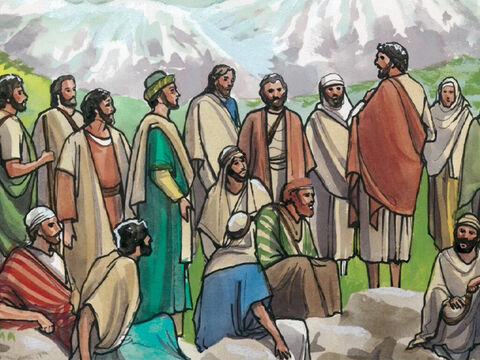
Jesus summoned the crowd with his disciples and said to them, “Whoever wishes to come after me must deny himself, take up his cross, and follow me. For whoever wishes to save his life will lose it, but whoever loses his life for my sake and that of the Gospel will save it. What profit is there for one to gain the whole world and forfeit his life? What could one give in exchange for his life? Whoever is ashamed of me and of my words in this faithless and sinful generation, the Son of Man will be ashamed of when he comes in his Father’s glory with the holy angels.” He also said to them, “Amen, I say to you, there are some standing here who will not taste death until they see that the Kingdom of God has come in power.”
Commentary
God does not deny nor reject us.
Evangelist Mark emphasises to his community that following Jesus would also mean to accept the way of the Cross. While writing the Gospel, the event of the crucifixion of Jesus that had happened over 20 years ago was still vivid in his mind. Cross was a symbol of torture and shame. The believing disciples began to grasp the meaning of the Cross only after the crucifixion of their Master.
Over the centuries, ‘Cross’ has become spiritualised and today, we use it to refer to all the difficulties and inconveniences that confront us. In the time of Jesus, and of Mark, this word had only one meaning – torture and death. Death by crucifixion was reserved for enemies of the state. Crucifixion was the most shameful, excruciatingly painful and prolonged death imaginable.
At the time when Mark wrote his Gospel, the word “Cross” was relevant to the disciples who were being persecuted under the Roman rule. By writing this passage about the requirement of “taking up the Cross”, Mark was warning his community in Rome to be prepared to be brutally killed for their faith in Jesus.
Mark reminds the disciples about the possibility of loss of life which would happen gradually. Jesus had asked his disciples to deny their selfish selves, to give way to the needs of their brothers: to deny oneself to give life to one’s brethren.
Losing one’s life would also mean the experience of denying one’s ego, denying one’s selfishness. This death of the ego and death of selfishness are basic conditions for the life that Jesus offers. In Jesus’ mind, this denial of the self would be the absolute necessary condition for becoming genuinely human.
Care should be taken not to mistake the meaning of Jesus’ saying that “If anyone is ashamed of me and of my words… the Son of Man also be ashamed of him when he comes in the Glory of his Father.” Jesus is certainly not revengeful. Peter had denied Jesus not just once, but thrice. Yet, Jesus did not reject him, instead made him the head of the apostles.
Jesus calls us to love our enemies, to be ready for the cross, to give up everything for the poor. Failing to do that is to deny Jesus, yet still he waits for our return.
Intentions
– For the People of God, the Church, that Christ may become more visible in its commitment to serve God and people, in its loving concern for the poor and its continuous conversion to the Gospel, we pray:
– For all Christians, who claim to follow Christ, that they may live up without fear to the demands of the Gospel and bear witness to the crucified Lord, we pray:
– For those who suffer in their bodies and their hearts, that they may realize that they are one with the Lord in his passion and death, we pray:
Prayer over the Gifts
Lord, our God,
we bring these humble gifts before you.
In these sign of bread and wine,
Jesus, your Son will give himself to us.
May he give us the strength
to go with courage on our journey through life,
also when it becomes a way of the cross,
that we may follow him all the way
to you, our loving God for ever. Amen!
Prayer after Communion
Father,
we have been one with Jesus at his table;
may we also be united with him
on his way to you and to people.
May we follow him wherever he leads us,
in dark days as well as in days of joy
and send us wherever people need us,
to bring them your liberating word
and your helping hand,
also when it costs us pain and effort.
We ask this in the name of Jesus, the Lord. Amen!
Blessing
We have not to ask for crosses. In the Garden of Gethsemane, Jesus asked that the cross be taken away from him. But we have to accept it when our faith and love and the circumstances of life demand it. May God strengthen you and bless you, the Father, and the Son, and the Holy Spirit. Amen!