

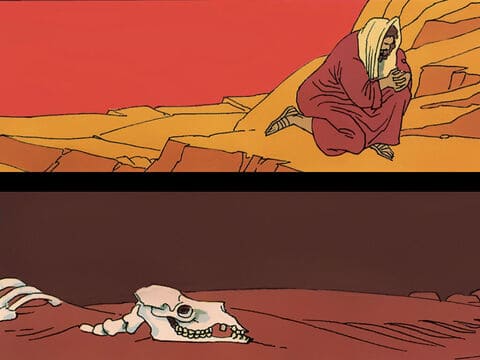
WHY FAST?
Introduction
People in the Old Testament ask: “What is the use of fasting?” God seems not to be near when they fast. The prophet tells them because real fasting consists in justice and love. Since God has made a covenant with his people, that covenant comprises also of justice and love from one person to the other. In the Gospel, the disciples of John, who fasted, were asking the disciples of Jesus why these didn’t fast. In the other parts of the Gospel, Jesus gives an answer similar to that of the prophet, but now Jesus said that because he has come and is with his disciples, they should rejoice rather than fast.
Opening Prayer
Lord of the Covenant,
we don’t have not to fear your judgment
if like you, we become rich in mercy
and full of compassion to our neighbour.
May we not only know that you ask us,
to practice with sincere hearts
sharing our food with the hungry
and to loosen the bonds of injustice,
that through us your light may shine
and your healing spread far and wide.
Be with us in your goodness.
We ask this through Christ, our Lord. Amen!
1 Reading – ISAIAH 58:1-9a
Thus says the Lord GOD: Cry out full-throated and unsparingly, lift up your voice like a trumpet blast; Tell my people their wickedness, and the house of Jacob their sins. They seek me day after day, and desire to know my ways, Like a nation that has done what is just and not abandoned the law of their God; They ask me to declare what is due them, pleased to gain access to God. “”Why do we fast, and you do not see it? afflict ourselves, and you take no note of it?”” Lo, on your fast day you carry out your own pursuits, and drive all your laborers. Yes, your fast ends in quarreling and fighting, striking with wicked claw. Would that today you might fast so as to make your voice heard on high! Is this the manner of fasting I wish, of keeping a day of penance: That a man bow his head like a reed and lie in sackcloth and ashes? Do you call this a fast, a day acceptable to the LORD? This, rather, is the fasting that I wish: releasing those bound unjustly, untying the thongs of the yoke; Setting free the oppressed, breaking every yoke; Sharing your bread with the hungry, sheltering the oppressed and the homeless; Clothing the naked when you see them, and not turning your back on your own. Then your light shall break forth like the dawn, and your wound shall quickly be healed; Your vindication shall go before you, and the glory of the LORD shall be your rear guard. Then you shall call, and the LORD will answer, you shall cry for help, and he will say: Here I am!
Responsorial PSALM 51:3-4, 5-6ab, 18-19
R. (19b) A heart contrite and humbled, O God, you will not spurn.
Have mercy on me, O God, in your goodness;
in the greatness of your compassion wipe out my offense.
Thoroughly wash me from my guilt
and of my sin cleanse me. R.
For I acknowledge my offense,
and my sin is before me always:
“Against you only have I sinned,
and done what is evil in your sight.” R.
For you are not pleased with sacrifices;
should I offer a burnt offering, you would not accept it.
My sacrifice, O God, is a contrite spirit;
a heart contrite and humbled, O God, you will not spurn. R.
Verse Before the Gospel – Cf. Amos 5:14
Glory and praise to you, oh Christ!
Seek good and not evil so that you may live,
and the Lord will be with you.
Glory and praise to you, oh Christ!
Gospel MATTHEW 9:14-15
The disciples of John approached Jesus and said, “Why do we and the Pharisees fast much, but your disciples do not fast?” Jesus answered them, “Can the wedding guests mourn as long as the bridegroom is with them? The days will come when the bridegroom is taken away from them, and then they will fast.”
Commentary
Our fasting should help feed the hungry.
John the Baptist had an ascetic life and perhaps followed the austere lifestyle of the Qumran community, which had its life in the desert, away from the contaminations of the outside world. They spent their time studying the scriptures, intensely preparing for the coming of the Messiah through rigorous disciplines of body and spirit by fasting and penance. Evidently, the Baptist’s followers picked up the lifestyle of their master. The Gospels have recorded that some disciples of John the Baptist later became the disciples of Jesus. Consequently, the disciples of both John the Baptist and Jesus must have been friends and knew what was happening in each camp.
Now the Baptist camp was apparently a little envious of the more relaxed lifestyle of Jesus’ disciples. Maybe there was even a bit of self-righteousness in this question, implying that it was high time for Jesus to make his followers shape up and follow the standard practices of such religious groups.
We should not forget that the Gospel of Matthew, which was written over 40 years after the death of Jesus, was trying to address specific issues that the Community of Matthew was facing. The Judaisers in the early Church were making life complicated for the young community of believers by introducing all the rules, regulations and traditions of the Jewish religion. Matthew wants to clarify to his community that fasting or other traditional religious practices have value but not at the expense of faith in Jesus and his teachings. He teaches us to be people of joy and – joy of being friends of the bridegroom – the friends of Jesus.
We tend to complicate what could be straightforward. Jesus taught us to love God and Love God’s people. Anything that goes against the commandment of love and charity is not from God. The prophet Micah puts it this way: “Do what is fair and just to your neighbour, be compassionate and loyal in your love.”
Matthew chose to address a more important point than the issue of fasting. His principal concern, however, was the life of the community during the period between the crucifixion of Jesus and the expected second coming of Jesus. Jesus – the bridegroom is absent in this era in which his community was living. The physical presence of Jesus – was no more there. This interim time would be one when disciples would, indeed, “hunger and thirst for justice” – a time of longing for the Kingdom of heaven.
Now, two thousand years have passed since the bridegroom has been taken away. And the world is under the grip of destruction of war. Millions of people are displaced and are forced to flee their land. Their fasting is imposed and unwanted, a stark reminder of the sin of the world. The Church calls on us to protect the displaced, the refugees, those on the streets.
Intentions
– For the Church that she be concerned that no one is trampled upon or exploited, we pray:
– For the leaders of nations, that they may bring justice to their people and care for the poor, we pray:
– For all of us, that we may have eyes, ears and hearts for people in need and those who try to hide that they are distressed and poverty-stricken, we pray:
Prayer over the Gifts
God of mercy and compassion,
you have invited us at the table of your Son,
that we may learn from him
to share our food and ourselves
with everyone in need.
Do not allow us ever to forget
how good you have been to us
and how you let Jesus raise us up
from our selfish greed.
Let his love grow and shine among us,
for he is our Lord for ever. Amen!
Prayer after Communion
Merciful God,
we are seeking you
and we want to be close to you.
Accept our thanks that you let us find you
in the lively, challenging word of Jesus
and in his presence among us
as our food and drink of life and joy.
Make us bring him especially
to people who suffer and are in need.
Let this be the way that we find healing and compassion,
through Christ, our Lord. Amen!
Blessing
Jesus wants to stay with us as the source of our life and our joy. May we recognize his presence among us in the weak and the victims of injustice. May God bless you for this task, the Father, and the Son, and the Holy Spirit. Amen!