

A SENSE OF MISSION
Introduction
Today’s gospel presents three persons to us.
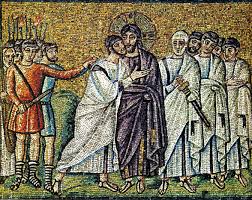
The first is a man preoccupied with himself, his own interests and needs, his selfish satisfaction. He is not a free person; he is not open to Christ, for he serves money and greed. He will betray Jesus. This man is Judas.
Then there is a second man, a good person, open to Christ, but weak. He tries to hide his frailty with impetuous, self-reliant bravery. He cracks in the hour of the test. He will deny Jesus. This person is Peter.
The third person is Jesus. He is totally unselfish, completely open to God and to everyone. He is the perfect servant, the person-for-others, described again today in the first reading in the words of the second song of God’s servant. And because he was the perfect servant he could save us all.
Reading: Isaiah 49:1-6
Hear me, O islands,
listen, O distant peoples.
The LORD called me from birth,
from my mother’s womb he gave me my name.
He made of me a sharp-edged sword
and concealed me in the shadow of his arm.
He made me a polished arrow,
in his quiver he hid me.
You are my servant, he said to me,
Israel, through whom I show my glory.
Though I thought I had toiled in vain,
and for nothing, uselessly, spent my strength,
Yet my reward is with the LORD,
my recompense is with my God.
For now the LORD has spoken
who formed me as his servant from the womb,
That Jacob may be brought back to him
and Israel gathered to him;
And I am made glorious in the sight of the LORD,
and my God is now my strength!
It is too little, he says, for you to be my servant,
to raise up the tribes of Jacob,
and restore the survivors of Israel;
I will make you a light to the nations,
that my salvation may reach to the ends of the earth.
Responsorial Psalm 71:1-2, 3-4a, 5ab-6ab, 15 and 17
R. (see 15ab) I will sing of your salvation.
In you, O LORD, I take refuge;
let me never be put to shame.
In your justice rescue me, and deliver me;
incline your ear to me, and save me.
R. I will sing of your salvation.
Be my rock of refuge,
a stronghold to give me safety,
for you are my rock and my fortress.
O my God, rescue me from the hand of the wicked.
R. I will sing of your salvation.
For you are my hope, O Lord;
my trust, O God, from my youth.
On you I depend from birth;
from my mother’s womb you are my strength.
R. I will sing of your salvation.
My mouth shall declare your justice,
day by day your salvation.
O God, you have taught me from my youth,
and till the present I proclaim your wondrous deeds.
R. I will sing of your salvation.
Verse before the Gospel:
Hail to you, our King, obedient to the Father;
you were led to your crucifixion like a gentle lamb to the slaughter.
Gospel: John 13:21-33, 36-38
Reclining at table with his disciples, Jesus was deeply troubled and testified,
“Amen, amen, I say to you, one of you will betray me.”
The disciples looked at one another, at a loss as to whom he meant.
One of his disciples, the one whom Jesus loved,
was reclining at Jesus’ side.
So Simon Peter nodded to him to find out whom he meant.
He leaned back against Jesus’ chest and said to him,
“Master, who is it?”
Jesus answered,
“It is the one to whom I hand the morsel after I have dipped it.”
So he dipped the morsel and took it and handed it to Judas,
son of Simon the Iscariot.
After Judas took the morsel, Satan entered him.
So Jesus said to him, “What you are going to do, do quickly.”
Now none of those reclining at table realized why he said this to him.
Some thought that since Judas kept the money bag, Jesus had told him,
“Buy what we need for the feast,”
or to give something to the poor.
So Judas took the morsel and left at once. And it was night.
When he had left, Jesus said,
“Now is the Son of Man glorified, and God is glorified in him.
If God is glorified in him, God will also glorify him in himself,
and he will glorify him at once.
My children, I will be with you only a little while longer.
You will look for me, and as I told the Jews,
‘Where I go you cannot come,’ so now I say it to you.”
Simon Peter said to him, “Master, where are you going?”
Jesus answered him,
“Where I am going, you cannot follow me now,
though you will follow later.”
Peter said to him,
“Master, why can I not follow you now?
I will lay down my life for you.”
Jesus answered, “Will you lay down your life for me?
Amen, amen, I say to you, the cock will not crow
before you deny me three times.”
Commentary:
Judas receives bread from the very hand of the Son of God, and lo and behold, it is not the Spirit of Christ that enters him, but Satan! How is this possible? The only explanation possible is the state of mind and the intention with which Judas joins the assembly. He is still a disciple, externally. But, internally, he has already betrayed the Master. The moment he resolved to betray Jesus, he had parted ways with him.
Could it be possible that similar dynamics happen in our Eucharistic assembly and reception of the Body of Christ? Indeed. The internal disposition with which we approach the sacrament matters. Paul has offered a clear warning on this (see 1 Cor 11:27-29). That is why the priest says a prayer, just before he receives the Body of Christ, and as people pray “Agnus Dei”: “May the receiving of your Body and Blood, Lord Jesus Christ, not bring me to judgment and condemnation, but through your loving mercy be for me protection in mind and body, and a healing remedy.”
============================================
On the last evening of his earthly life, Jesus had supper with his disciples. John speaks of a small group with Christ at the centre; beside him is the beloved disciple, beyond him Peter and Judas. Words and gestures seem muted. Jesus justly offers the traitor a bit of hospitality and friendship but the soul of Judas is already dark and leaves the room at night. The same darkness of negativity hovers over the head of the apostle Peter, the leader of the group, and apparently seems very confident. Who among us is not fragile and capable of betraying his own faith?
Blessing
One of the saddest experiences in life is to see one’s love and trust misunderstood, denied, or even betrayed. This was the lot of Jesus. He suffered from it, yet accepted it in order to undo our disloyalties and betrayals. This is why his own love and loyalty to the Father and to us went as far as it can go: death. And this is how he won for us the courage to love without counting the cost and to be faithful to the end. May God fill us with his blessings: the Father, and the Son, and the Holy Spirit. Amen!