

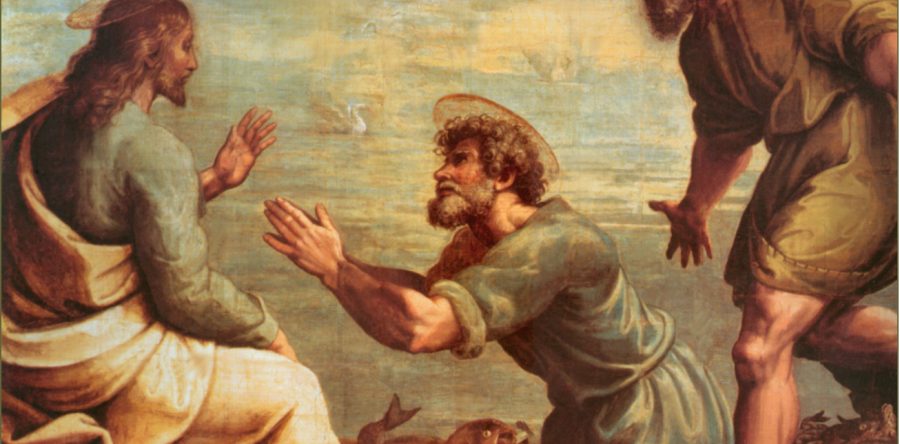
You have the words of eternal life
1. Are You on My Side?
2. We Have Made a Choice
3. Though Not Perfect, It Is Beautiful Inside
Introduction
1. Are You on My Side?
After Vatican II many were affected by the deeper insights in the Gospel and our faith which the Spirit had given to his Church: most were the result of deeper study or simply rediscoveries of neglected truths. To most people the renewal after the Council was like a deep breath of fresh air; but some went away sadly from the Church. They could not take it; there was no room for growth in their faith. Today Jesus asks us too: Can you grow in your faith? Do you choose me and my Church or do you stick to your own ideas? He invites us: choose me, grow in my life and my love.
2. We Have Made a Choice
Ever since we were baptized we belong to Christ as our Lord and Saviour and brother. Have we ever made our baptismal choice a conscious, personal option for Christ? Our presence here at the Eucharist implies that we have done so. Do we confirm that choice by our everyday Christian living, in our dealings with those around us in love and justice and forgiveness? When our faith is put to the test do we renew our choice and say: “Lord, to whom else shall we go? You are the Lord of my life.”
3. Though Not Perfect, It Is Beautiful Inside
Why do we stay in the Church though we see glaring defects in its structures and members? For me personally I’d like to answer: because I also see its numerous qualities and beauty. The Church brings me its message of life and especially, I see the Lord present in it. It is my Church because I find my Lord there. He is present there in the Eucharist, he is present there in the community. And I know it is a Church on the way and so it cannot yet be perfect. For me the Church does not have to be perfect, for it is a Church of people and leaders who struggle and try, and so the Lord is there.
First Reading: God’s People Choose the Lord
God’s people is conscious that it owes its freedom and its country to God’s liberating love. The Hebrews choose to link their destiny to that of God and to serve him loyally.
1 Reading Joshua 24:1-2a, 15-17, 18b
Joshua gathered together all the tribes of Israel at Shechem,
summoning their elders, their leaders,
their judges, and their officers.
When they stood in ranks before God,
Joshua addressed all the people:
“If it does not please you to serve the LORD,
decide today whom you will serve,
the gods your fathers served beyond the River
or the gods of the Amorites in whose country you are now dwelling.
As for me and my household, we will serve the LORD.”
But the people answered,
“Far be it from us to forsake the LORD
for the service of other gods.
For it was the LORD, our God,
who brought us and our fathers up out of the land of Egypt,
out of a state of slavery.
He performed those great miracles before our very eyes
and protected us along our entire journey
and among the peoples through whom we passed.
Therefore we also will serve the LORD, for he is our God.”
Responsorial Psalm 34:2-3, 16-17, 18-19, 20-21
R. (9a) Taste and see the goodness of the Lord.
I will bless the LORD at all times;
his praise shall be ever in my mouth.
Let my soul glory in the LORD;
the lowly will hear me and be glad.
R. Taste and see the goodness of the Lord.
The LORD has eyes for the just,
and ears for their cry.
The LORD confronts the evildoers,
to destroy remembrance of them from the earth.
R. Taste and see the goodness of the Lord.
When the just cry out, the LORD hears them,
and from all their distress he rescues them.
The is close to the broken-hearted;
and those who are crushed in spirit he saves.
R. Taste and see the goodness of the Lord.
Many are the troubles of the just one,
but out of them all the LORD delivers him;
he watches over all his bones;
not one of them shall be broken.
R. Taste and see the goodness of the Lord.
Second Reading: The Covenant of Marriage
In marriage, the partners choose one another for lifelong love and fidelity and give themselves to one another as Christ gave himself for the Church.
2 Reading Ephesians 5:21-32
Brothers and sisters:
Be subordinate to one another out of reverence for Christ.
Wives should be subordinate to their husbands as to the Lord.
For the husband is head of his wife
just as Christ is head of the church,
he himself the saviour of the body.
As the church is subordinate to Christ,
so wives should be subordinate to their husbands in everything.
Husbands, love your wives,
even as Christ loved the church
and handed himself over for her to sanctify her,
cleansing her by the bath of water with the word,
that he might present to himself the church in splendour,
without spot or wrinkle or any such thing,
that she might be holy and without blemish.
So also husbands should love their wives as their own bodies.
He who loves his wife loves himself.
For no one hates his own flesh
but rather nourishes and cherishes it,
even as Christ does the church,
because we are members of his body.
For this reason a man shall leave his father and his mother
and be joined to his wife,
and the two shall become one flesh.
This is a great mystery,
but I speak in reference to Christ and the church.
Alleluia John 6:63c, 68c
R. Alleluia, alleluia.
Your words, Lord, are Spirit and life;
you have the words of everlasting life.
R. Alleluia, alleluia.
Gospel: Do You Choose Me?
The upsetting words of Jesus place a choice before the disciples. Many leave. Peter, apparently speaking in the name of all the apostles, expresses his firm faith in the Lord.
Gospel John 6:60-69
Many of Jesus’ disciples who were listening said,
“This saying is hard; who can accept it?”
Since Jesus knew that his disciples were murmuring about this,
he said to them, “Does this shock you?
What if you were to see the Son of Man ascending
to where he was before?
It is the spirit that gives life,
while the flesh is of no avail.
The words I have spoken to you are Spirit and life.
But there are some of you who do not believe.”
Jesus knew from the beginning the ones who would not believe
and the one who would betray him.
And he said,
“For this reason I have told you that no one can come to me
unless it is granted him by my Father.”
As a result of this,
many of his disciples returned to their former way of life
and no longer accompanied him.
Jesus then said to the Twelve, “Do you also want to leave?”
Simon Peter answered him, “Master, to whom shall we go?
You have the words of eternal life.
We have come to believe
and are convinced that you are the Holy One of God.”
Commentary
Here is what the Catechism of the Catholic Church has to say about this ‘hard saying’. “The first announcement of the Eucharist divided the disciples, just as the announcement of the Passion scandalized them: ‘This is a hard saying; who can listen to it?’ (Jn 6:60) The Eucharist and the Cross are stumbling blocks. It is the same mystery and it never ceases to be an occasion of division. ‘Will you also go away?’ (Jn 6:67): the Lord’s question echoes through the ages, as a loving invitation to discover that only he has ‘the words of eternal life’ (Jn 6:68) and that to receive in faith the gift of his Eucharist is to receive the Lord himself.” (n. 1336 of the Catechism of the Catholic Church).
Blessing
We experience in life
that we have to make a lot of choices.
When it is an important matter
our first consideration should always be
what does God want me to do.
In the light of the Gospel,
what decision should I take?
The choice is not always easy or clear.
May God give you light and courage,
and may he love and bless you:
the Father, and the Son, and the Holy Spirit. R/ Amen.
Let us go and make every act of life
a choice for the Lord.
R/ Thanks be to God.