

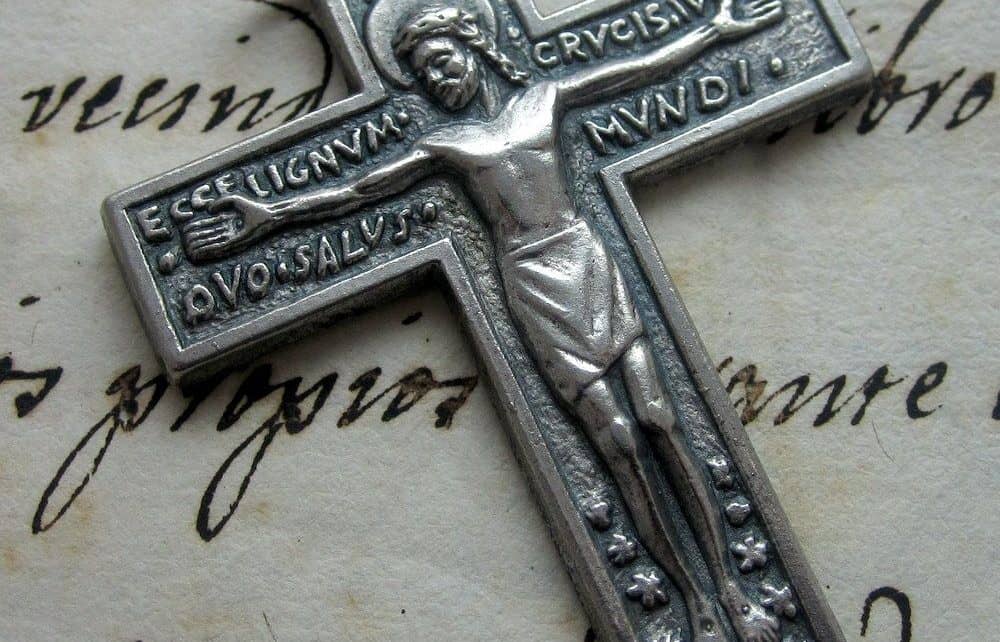
The Cross Brings Life
Introduction by the Celebrant
Jesus keeps reminding us in the gospels that being his disciple is something not to be taken lightly, for to be a disciple means to be one who follows the master. So the disciple has to face the cross, just as Jesus had to face it and take it up. To him it brought the victory of life over death, of grace over sin, of final resurrection and happiness. Jesus was willing to pay the price for it. He asks us, his disciples: Can you take up your cross after me? What answer do we give him in this Eucharist?
First Reading: Saved by Faith in the Sign of Salvation
Tired and discouraged from their long journey and stay in the desert, the Hebrews lost faith in God and began to revolt. God punished them, but saved those who looked up in faith to a sign of salvation.
1 Reading Numbers 21:4b-9
With their patience worn out by the journey,
the people complained against God and Moses,
“Why have you brought us up from Egypt to die in this desert,
where there is no food or water?
We are disgusted with this wretched food!”
In punishment the LORD sent among the people seraph serpents,
which bit the people so that many of them died.
Then the people came to Moses and said,
“We have sinned in complaining against the LORD and you.
Pray the LORD to take the serpents from us.”
So Moses prayed for the people, and the LORD said to Moses,
“Make a seraph and mount it on a pole,
and if any who have been bitten look at it, they will live.”
Moses accordingly made a bronze serpent and mounted it on a pole,
and whenever anyone who had been bitten by a serpent
looked at the bronze serpent, he lived.
Responsorial Psalm 78:1bc-2, 34-35, 36-37, 38
R. (see 7b) Do not forget the works of the Lord!
Hearken, my people, to my teaching;
incline your ears to the words of my mouth.
I will open my mouth in a parable,
I will utter mysteries from of old.
R. Do not forget the works of the Lord!
While he slew them they sought him
and inquired after God again,
Remembering that God was their rock
and the Most High God, their redeemer.
R. Do not forget the works of the Lord!
But they flattered him with their mouths
and lied to him with their tongues,
Though their hearts were not steadfast toward him,
nor were they faithful to his covenant.
R. Do not forget the works of the Lord!
But he, being merciful, forgave their sin
and destroyed them not;
Often he turned back his anger
and let none of his wrath be roused.
R. Do not forget the works of the Lord!
Second Reading: The Humiliated Christ is Glorified
Jesus, God’s Son, humbled himself by becoming someone like us and even more so by dying for us on the cross. This is why he is now our glorious Lord.
2 Reading Philippians 2:6-11
Brothers and sisters:
Christ Jesus, though he was in the form of God,
did not regard equality with God something to be grasped.
Rather, he emptied himself,
taking the form of a slave,
coming in human likeness;
and found human in appearance,
he humbled himself,
becoming obedient to death,
even death on a cross.
Because of this, God greatly exalted him
and bestowed on him the name
that is above every name,
that at the name of Jesus
every knee should bend,
of those in heaven and on earth and under the earth,
and every tongue confess that
Jesus Christ is Lord,
to the glory of God the Father.
Alleluia
R. Alleluia, alleluia.
We adore you, O Christ, and we bless you,
because by your Cross you have redeemed the world.
R. Alleluia, alleluia.
Gospel: Jesus’ Saving Death Gives Life
Because he loved us, God sent his Son into the world as man. By his death, Jesus brought us forgiveness and life.
Gospel John 3:13-17
Jesus said to Nicodemus:
“No one has gone up to heaven
except the one who has come down from heaven, the Son of Man.
And just as Moses lifted up the serpent in the desert,
so must the Son of Man be lifted up,
so that everyone who believes in him may have eternal life.”
For God so loved the world that he gave his only Son,
so that everyone who believes in him might not perish
but might have eternal life.
For God did not send his Son into the world to condemn the world,
but that the world might be saved through him.
Commentary
The feast of the Exaltation of the Cross marks the dedication of the Church of the Holy Sepulchre in 335 CE. On this feast, we are called upon to meditate on the salvific mystery of the Cross. The Israelites who were bitten by poisonous snakes looked up to the metal image of the fiery serpent on the standard and lived. Similarly, anyone bitten by the poisonous snakes of sin, who looks up to the living Christ on the Cross, shall not die, but live. It is God’s will that everyone shall be saved. But we have the freedom of choice to look toward the Cross or away from it. And like the Israelites of old, the choice is ours; so are the consequences.
Take a few minutes today to look at a cross and meditate on it. Keep gazing. What do you find there? Who is there? What happens to you as you keep gazing?
Blessing
We ourselves have been marked
with the sign of the cross
as people saved by a serving Lord.
On account of the cross,
we have to learn to forgive,
to bear one another’s burdens
and to accept the realities of life
as people of hope and trust,
with the blessing of almighty God,
the Father, and the Son, and the Holy Spirit. R/ Amen.
Let us go in the peace of Christ. R/ Thanks be to God.