

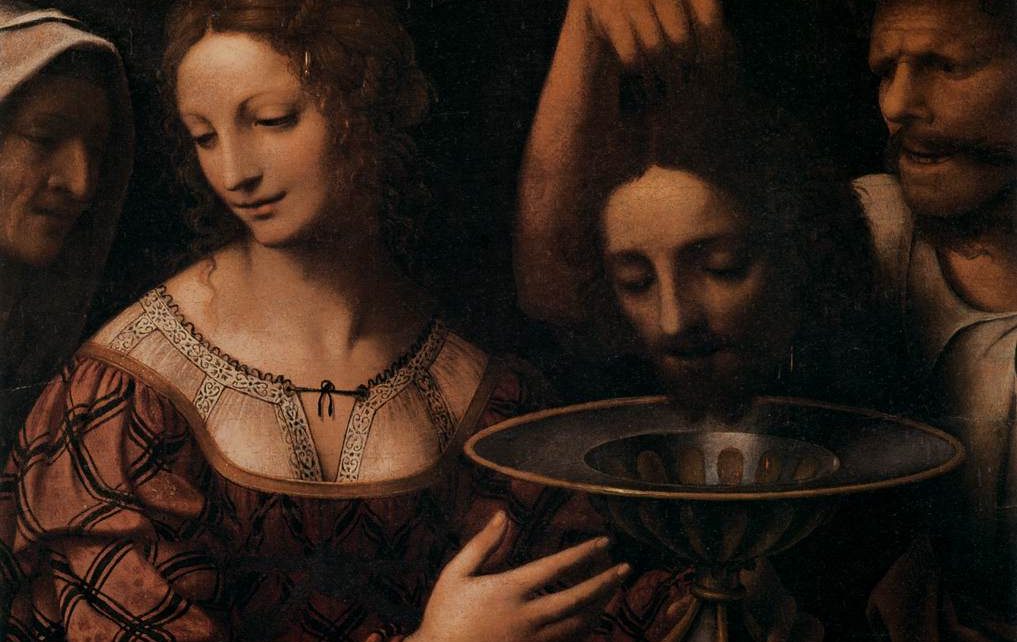
John: The Old Prophet And, Jesus: The New
Introduction
The letter to the Hebrews today gives the Christian community a set of moral exhortations. Perseverance in the faith means especially perseverance in love, the basis of all morality.
With the death of the Baptist ends the life of the last prophet of God of the Old Testament, who, as the hinge between the Old and the New Testaments, had prepared the way for the Lord’s coming. He died as a suffering servant of God, a new Elijah, who stood up to kings and infamous queens.
1 Reading: Hebrews 13:1-8
Let brotherly love continue.
Do not neglect hospitality,
for through it some have unknowingly entertained angels.
Be mindful of prisoners as if sharing their imprisonment,
and of the ill-treated as of yourselves,
for you also are in the body.
Let marriage be honored among all
and the marriage bed be kept undefiled,
for God will judge the immoral and adulterers.
Let your life be free from love of money
but be content with what you have,
for he has said, I will never forsake you or abandon you.
Thus we may say with confidence:
The Lord is my helper,
and I will not be afraid.
What can anyone do to me?
Remember your leaders who spoke the word of God to you.
Consider the outcome of their way of life and imitate their faith.
Jesus Christ is the same yesterday, today, and forever.
Responsorial Psalm: Ps 27:1, 3, 5, 8b-9abc
R. (1a) The Lord is my light and my salvation.
The LORD is my light and my salvation;
whom should I fear?
The LORD is my life’s refuge;
of whom should I be afraid?
R. The Lord is my light and my salvation.
Though an army encamp against me,
my heart will not fear;
Though war be waged upon me,
even then will I trust.
R. The Lord is my light and my salvation.
For he will hide me in his abode
in the day of trouble;
He will conceal me in the shelter of his tent,
he will set me high upon a rock.
R. The Lord is my light and my salvation.
Your presence, O LORD, I seek.
Hide not your face from me;
do not in anger repel your servant.
You are my helper: cast me not off.
R. The Lord is my light and my salvation.
Alleluia: See Luke 8:15
R. Alleluia, alleluia.
Blessed are they who have kept the word with a generous heart,
and yield a harvest through perseverance.
R. Alleluia, alleluia.
Gospel: Mark 6:14-29
King Herod heard about Jesus, for his fame had become widespread,
and people were saying,
“John the Baptist has been raised from the dead;
That is why mighty powers are at work in him.”
Others were saying, “He is Elijah”;
still others, “He is a prophet like any of the prophets.”
But when Herod learned of it, he said,
“It is John whom I beheaded. He has been raised up.”
Herod was the one who had John arrested and bound in prison
on account of Herodias,
the wife of his brother Philip, whom he had married.
John had said to Herod,
“It is not lawful for you to have your brother’s wife.”
Herodias harbored a grudge against him
and wanted to kill him but was unable to do so.
Herod feared John, knowing him to be a righteous and holy man,
and kept him in custody.
When he heard him speak he was very much perplexed,
yet he liked to listen to him.
Herodias had an opportunity one day when Herod, on his birthday,
gave a banquet for his courtiers, his military officers,
and the leading men of Galilee.
His own daughter came in and performed a dance
that delighted Herod and his guests.
The king said to the girl,
“Ask of me whatever you wish and I will grant it to you.”
He even swore many things to her,
“I will grant you whatever you ask of me,
even to half of my kingdom.”
She went out and said to her mother,
“What shall I ask for?”
Her mother replied, “The head of John the Baptist.”
The girl hurried back to the king’s presence and made her request,
“I want you to give me at once on a platter
the head of John the Baptist.”
The king was deeply distressed,
but because of his oaths and the guests
he did not wish to break his word to her.
So he promptly dispatched an executioner
with orders to bring back his head.
He went off and beheaded him in the prison.
He brought in the head on a platter
and gave it to the girl.
The girl in turn gave it to her mother.
When his disciples heard about it,
they came and took his body and laid it in a tomb.
Commentary
Many people find it difficult to accept change in their religious fife. We tend to insulate our faith from the swirling changes that meet us in our daily fife. But certain things will never change, and Hebrews today list some of them. “Jesus Christ is the same yesterday and today and forever.” Christ is the very core of our faith life— true God and true man. Born as a man and now exalted as Lord at God’s right hand, he is the fife giver risen from the dead. In the reading, Hebrews lists some of those essential features that must always characterize our fife: love of neighbor, hospitality, concern for the disadvantaged, respect for marriage and the sacred.
These words of exhortation are as valid and timeless today as when they were first penned. Dedication to the sacredness of marriage cost John the Baptist his fife, as is seen in today’s Gospel. This principle has not changed, but our modem attitudes have. Behaviours that were at one time condemned are accepted today in the name of tolerance. There is where we fall short and may have to retrieve our principles. And yet, at the same time, we have to remain open to change. For example, limbo was at one time a safe haven for infants who died without baptism. Today it is a theory that has been set aside in favour of our belief in an all-good God.
We pray for the strength to avoid an attitude toward our belief that is too dismissive or whimsical. At the same time, we pray for the ability to welcome authentic change as part of our belief in a faith that is fully alive.
Blessing
Like John the Baptist, we can and should show others the road to Christ and prepare the way for his full coming only if we ourselves take his Gospel seriously, if the Lord becomes visible in us, his goodness, his compassion, his love. May almighty God bless you, the Father, and the Son, and the Holy Spirit. Amen!