

The Temple Is For People
Introduction
After the creation of inanimate beings comes the creation of living beings: fish, birds, land animals, and the crowning achievement, man and woman, made in God’s image and likeness. They are special, for they are also put in charge of the whole of creation, for the task of working for the integrity of creation is heavy with responsibilities.
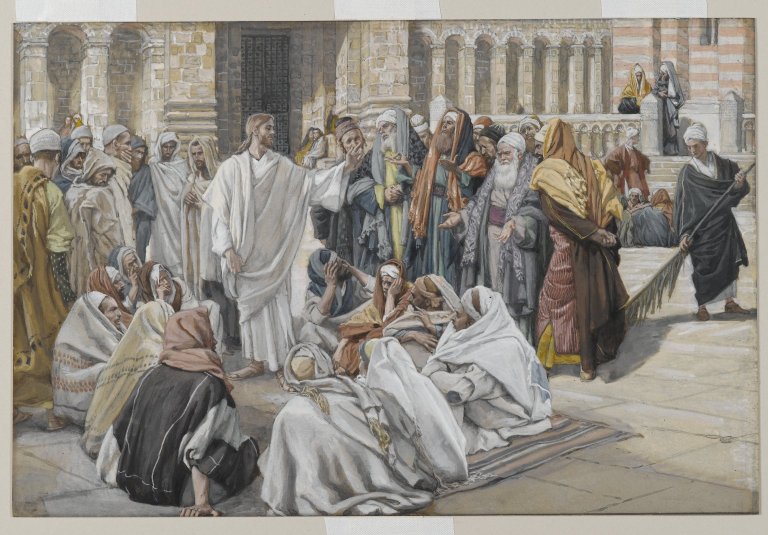
After a period of initial fervor, the teaching of the Pharisees began to imply that people were to be sacrificed for the sake of the temple, that religious traditions (made by people and juridical) were more important than God’s laws, which are supposed to be interior to people and express a personal relationship. Jesus takes them to task for it. For the temple of the Lord is there for people, not people for the temple.
1 Reading: Genesis 1:20—2:4a
God said,
“Let the water teem with an abundance of living creatures,
and on the earth let birds fly beneath the dome of the sky.”
and so it happened:
God created the great sea monsters
and all kinds of swimming creatures with which the water teems,
and all kinds of winged birds.
God saw how good it was, and God blessed them, saying,
“Be fertile, multiply, and fill the water of the seas;
and let the birds multiply on the earth.”
Evening came, and morning followed–the fifth day.
Then God said,
“Let the earth bring forth all kinds of living creatures:
cattle, creeping things, and wild animals of all kinds.”
and so it happened:
God made all kinds of wild animals, all kinds of cattle,
and all kinds of creeping things of the earth.
God saw how good it was.
Then God said:
“Let us make man in our image, after our likeness.
Let them have dominion over the fish of the sea,
the birds of the air, and the cattle,
and over all the wild animals
and all the creatures that crawl on the ground.”
God created man in his image;
in the divine image he created him;
male and female he created them.
God blessed them, saying:
“Be fertile and multiply;
fill the earth and subdue it.
Have dominion over the fish of the sea, the birds of the air,
and all the living things that move on the earth.”
God also said:
“See, I give you every seed-bearing plant all over the earth
and every tree that has seed-bearing fruit on it to be your food;
and to all the animals of the land, all the birds of the air,
and all the living creatures that crawl on the ground,
I give all the green plants for food.”
And so it happened.
God looked at everything he had made, and he found it very good.
Evening came, and morning followed–the sixth day.
Thus the heavens and the earth and all their array were completed.
Since on the seventh day God was finished with the work he had been doing,
he rested on the seventh day from all the work he had undertaken.
So God blessed the seventh day and made it holy,
because on it he rested from all the work he had done in creation.
Such is the story of the heavens and the earth at their creation.
Responsorial Psalm: Ps 8:4-5, 6-7, 8-9
R. (2ab) O Lord, our God, how wonderful your name in all the earth!
When I behold your heavens, the work of your fingers,
the moon and the stars which you set in place—
What is man that you should be mindful of him,
or the son of man that you should care for him?
R. O Lord, our God, how wonderful your name in all the earth!
You have made him little less than the angels,
and crowned him with glory and honor.
You have given him rule over the works of your hands,
putting all things under his feet.
R. O Lord, our God, how wonderful your name in all the earth!
All sheep and oxen,
yes, and the beasts of the field,
The birds of the air, the fishes of the sea,
and whatever swims the paths of the seas.
R. O Lord, our God, how wonderful your name in all the earth!
Alleluia: Ps 119:36, 29b
R. Alleluia, alleluia.
Incline my heart, O God, to your decrees;
And favor me with your law.
R. Alleluia, alleluia.
Gospel: Mark 7:1-13
When the Pharisees with some scribes who had come from Jerusalem
gathered around Jesus,
they observed that some of his disciples ate their meals
with unclean, that is, unwashed, hands.
(For the Pharisees and, in fact, all Jews,
do not eat without carefully washing their hands,
keeping the tradition of the elders.
And on coming from the marketplace
they do not eat without purifying themselves.
And there are many other things that they have traditionally observed,
the purification of cups and jugs and kettles and beds.)
So the Pharisees and scribes questioned him,
“Why do your disciples not follow the tradition of the elders
but instead eat a meal with unclean hands?”
He responded,
“Well did Isaiah prophesy about you hypocrites,
as it is written:
This people honours me with their lips,
but their hearts are far from me;
in vain do they worship me,
teaching as doctrines human precepts.
You disregard God’s commandment but cling to human tradition.”
He went on to say,
“How well you have set aside the commandment of God
in order to uphold your tradition!
For Moses said,
Honour your father and your mother,
and Whoever curses father or mother shall die.
Yet you say,
‘If someone says to father or mother,
“Any support you might have had from me is qorban”‘
(meaning, dedicated to God),
you allow him to do nothing more for his father or mother.
You nullify the word of God
in favour of your tradition that you have handed on.
And you do many such things.”
Commentary
The crowning point in the creation narrative is the creation of man and woman. They are created in God’s likeness, which is reflected in their dominion over the rest of the created order. They subdue the earth and have authority over all living things. There is no indication that the animals served as food for them; rather their diet is vegetarian. What is clearly seen is the stature of these humans towering over all other created things. The rule of conduct for the human pair is derived primarily from their relationship to God.
The Jewish norms that Jesus criticizes in today’s Gospel reflect what can easily happen in religious experience. The observance of rules and regulations becomes the mark of true religion. Jesus indicates that the washing of hands is not necessarily indicative of a true religious spirit. Likewise, neglecting to financially support one’s parents in order to satisfy the requirement to contribute money to the temple was misguided and disrespectful.
Certainly, the human couple stands at the pinnacle of creation. Their dominion over the earth connotes a respect for the created order, not simply the observance of secondary legal precepts. We too can become legalistic in our religious practice. The great danger is that we lose sight of the forest for the trees.
Blessing
As grateful children of God, let us put our hearts in seeking in the commandments not our will but the will of God, so that we do not ask what God orders us to do but simply how we can respond to his love and show that love to the people around us. May God bless you all: the Father, and the Son, and the Holy Spirit. Amen!