

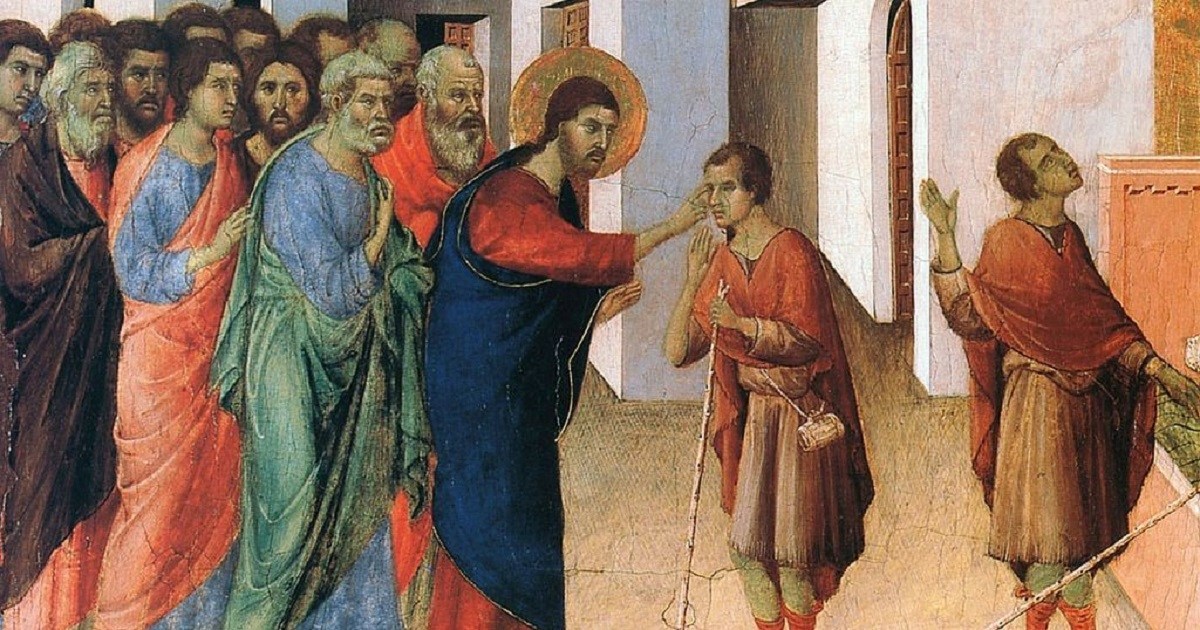
Lord That I May See
Introduction
The deluge ends. God and people are reconciled again. The dove returns with an olive branch in its beak. Noah thanks the Lord.
As a sign that he came to heal, that is, to make whole again, to bring forgiveness and life to the whole person, Jesus restores the sight of the blind, makes the deaf hear again, even raises the dead back to life. He does not only bring good news of hope and healing, he is that good news, he embodies it in himself and shares it with people in word and deed.
1 Reading: Genesis 8:6-13, 20-22
At the end of forty days Noah opened the hatch he had made in the ark,
and he sent out a raven,
to see if the waters had lessened on the earth.
It flew back and forth until the waters dried off from the earth.
Then he sent out a dove,
to see if the waters had lessened on the earth.
But the dove could find no place to alight and perch,
and it returned to him in the ark,
for there was water all over the earth.
Putting out his hand, he caught the dove
and drew it back to him inside the ark.
He waited seven days more and again sent the dove out from the ark.
In the evening the dove came back to him,
and there in its bill was a plucked-off olive leaf!
So Noah knew that the waters had lessened on the earth.
He waited still another seven days
and then released the dove once more;
and this time it did not come back.
In the six hundred and first year of Noah’s life,
in the first month, on the first day of the month,
the water began to dry up on the earth.
Noah then removed the covering of the ark
and saw that the surface of the ground was drying up.
Noah built an altar to the LORD,
and choosing from every clean animal and every clean bird,
he offered burnt offerings on the altar.
When the LORD smelled the sweet odor, he said to himself:
“Never again will I doom the earth because of man
since the desires of man’s heart are evil from the start;
nor will I ever again strike down all living beings, as I have done.
As long as the earth lasts, seedtime and harvest, cold and heat,
Summer and winter, and day and night shall not cease.”
Responsorial Psalm: PS 116:12-13, 14-15, 18-19
R. (17a) To you, Lord, I will offer a sacrifice of praise. or: R. Alleluia.
How shall I make a return to the LORD
for all the good he has done for me?
The cup of salvation I will take up,
and I will call upon the name of the LORD. R.
My vows to the LORD I will pay
in the presence of all his people.
Precious in the eyes of the LORD
is the death of his faithful ones. R.
My vows to the LORD I will pay
in the presence of all his people,
In the courts of the house of the LORD,
in your midst, O Jerusalem. R.
Alleluia, alleluia.
May the Father of our Lord Jesus Christ
enlighten the eyes of our hearts,
that we may know what is the hope
that belongs to his call.
R. Alleluia, alleluia.
Gospel: Mark 8:22-26
When Jesus and his disciples arrived at Bethsaida,
people brought to him a blind man and begged Jesus to touch him.
He took the blind man by the hand and led him outside the village.
Putting spittle on his eyes he laid his hands on the man and asked,
“Do you see anything?”
Looking up the man replied, “I see people looking like trees and walking.”
Then he laid hands on the man’s eyes a second time and he saw clearly;
his sight was restored and he could see everything distinctly.
Then he sent him home and said, “Do not even go into the village.”
Commentary
In ancient mythologies, there are numerous flood stories. It is quite likely that one of these universal flood accounts was incorporated into the Genesis narrative as a striking example of sin’s consequences. The main point is clear enough. Human evil was widespread, a fact that God could not simply overlook. In today’s reading an uninterrupted rain of forty days covers the earth. At the end, the raven and the dove are sent forth to see if dry land had emerged. The raven returns, having found no place to perch. Then the dove first returns with a plucked olive leaf, indicating that the waters have begun to recede. On its second mission, the dove does not return at all, and Noah realizes that the punishment for sin has come to an end. He offers a sacrifice to God, who then declares he will never again submerge the world with a flood.
The two journeys of the dove from the ark parallel the blind man’s journey to sight in today’s Gospel. The dove first brings back a leaf, indicating that the flood waters are receding, although they are not completely gone. Later the dove does not return, indicating that the flood waters have receded enough that dry land has returned. The blind man, ministered to by Jesus, at first sees only indistinctly, so that people resemble trees. His sight is imperfect but is returning. Jesus again touches the man’s eyes and he sees perfectly.
Our journeys to our goals come in stages. An unemployed person may find work that does not offer the desired salary. But it may well lead to something better. A slow cure for an illness is still a cure and offers the hope of ultimate healing. An offer to keep trying. God loves a grateful heart, even gratitude for small blessings.
Blessing
Sometimes we see only dimly or not at all the good things God gives us and the good people he puts on our way. May we see them and may almighty God bless you, the Father, and the Son, and the Holy Spirit. Amen!