

Jesus Our Light
Introduction
In two days, we read about this group of people called (or who call themselves) “ELDERS”. The reading from Daniel is one of those texts that elicits relief, and whenever it is read, the congregation responds loudly, “Thanks be to God.” Like Jesus of yesterday’s Gospel so like Daniel in the First reading of today. Let me go back a bit. Jesus knew quite well that those elders that left one-by-one have been swimming in impiety for years. The good movies capture the scene of dropping the stones (dropping of all human condemnations). But, if one may ask, what were the two accuser-elder-judges doing in Joakim’s private “swimming pool”, particularly made for the woman (the wife)? Why and how were they within “Out of Bounds”? Yes, their intentions were clear, but I would have started with those questions, if I were Daniel, and drag the judgement. However, sin knows no bounds and devoid of shame. That’s the first thing the devils does: makes the sinner shameless. Live in darkness. But the Light of Jesus, we celebrate at Easter, proclaimed at the Vigil, has come to light our way, and lead to us to life everlasting. Let us follow him! Let us walk in the light!
1 Reading: Daniel 13:1-9, 15-17, 19-30, 33-62
In Babylon there lived a man named Joakim, who married a very beautiful and God-fearing woman, Susanna, the daughter of Hilkiah; her pious parents had trained their daughter according to the law of Moses. Joakim was very rich; he had a garden near his house, and the Jews had recourse to him often because he was the most respected of them all. That year, two elders of the people were appointed judges, of whom the Lord said, “Wickedness has come out of Babylon: from the elders who were to govern the people as judges.” These men, to whom all brought their cases, frequented the house of Joakim. When the people left at noon, Susanna used to enter her husband’s garden for a walk. When the old men saw her enter every day for her walk, they began to lust for her. They suppressed their consciences; they would not allow their eyes to look to heaven, and did not keep in mind just judgments.
One day, while they were waiting for the right moment, she entered the garden as usual, with two maids only. She decided to bathe, for the weather was warm. Nobody else was there except the two elders, who had hidden themselves and were watching her. “Bring me oil and soap,” she said to the maids, “and shut the garden doors while I bathe.” As soon as the maids had left, the two old men got up and hurried to her. “Look,” they said, “the garden doors are shut, and no one can see us; give in to our desire, and lie with us.
If you refuse, we will testify against you that you dismissed your maids because a young man was here with you.” “I am completely trapped,” Susanna groaned. “If I yield, it will be my death; if I refuse, I cannot escape your power. Yet it is better for me to fall into your power without guilt than to sin before the Lord.” Then Susanna shrieked, and the old men also shouted at her, as one of them ran to open the garden doors. When the people in the house heard the cries from the garden, they rushed in by the side gate to see what had happened to her. At the accusations by the old men, the servants felt very much ashamed, for never had any such thing been said about Susanna. When the people came to her husband Joakim the next day, the two wicked elders also came, fully determined to put Susanna to death. Before all the people they ordered: “Send for Susanna, the daughter of Hilkiah, the wife of Joakim.” When she was sent for, she came with her parents, children and all her relatives. All her relatives and the onlookers were weeping.
In the midst of the people the two elders rose up and laid their hands on her head.
Through tears she looked up to heaven, for she trusted in the Lord wholeheartedly.
The elders made this accusation: “As we were walking in the garden alone, this woman entered with two girls and shut the doors of the garden, dismissing the girls. A young man, who was hidden there, came and lay with her. When we, in a corner of the garden, saw this crime, we ran toward them. We saw them lying together, but the man we could not hold, because he was stronger than we; he opened the doors and ran off. Then we seized her and asked who the young man was, but she refused to tell us. We testify to this.” The assembly believed them, since they were elders and judges of the people,
and they condemned her to death. But Susanna cried aloud: “O eternal God, you know what is hidden and are aware of all things before they come to be: you know that they have testified falsely against me. Here I am about to die, though I have done none of the things with which these wicked men have charged me.”
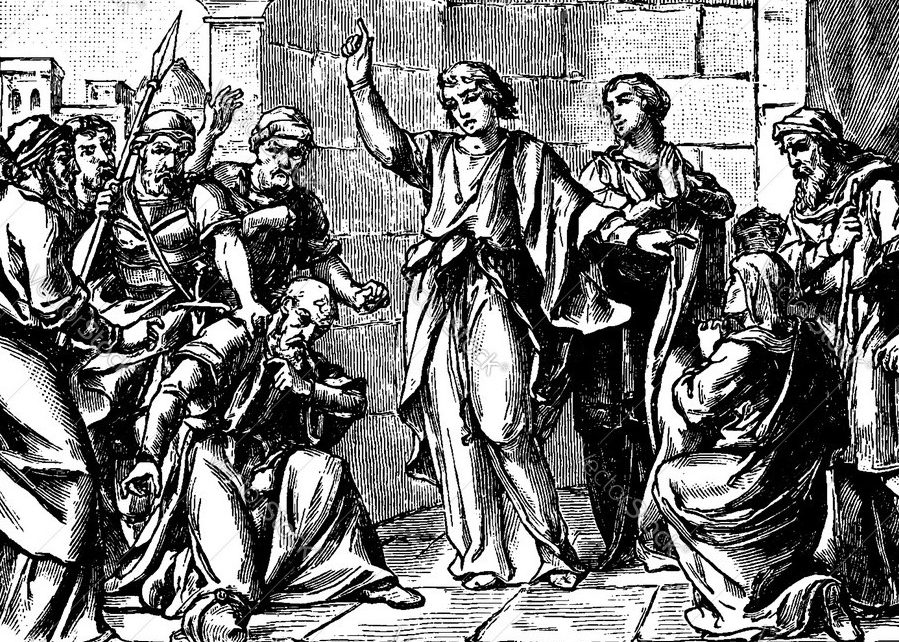
The Lord heard her prayer. As she was being led to execution, God stirred up the holy spirit of a young boy named Daniel, and he cried aloud: “I will have no part in the death of this woman.” All the people turned and asked him, “What is this you are saying?” He stood in their midst and continued, “Are you such fools, O children of Israel! To condemn a woman of Israel without examination and without clear evidence? Return to court, for they have testified falsely against her.” Then all the people returned in haste.
To Daniel the elders said, “Come, sit with us and inform us, since God has given you the prestige of old age.” But he replied, “Separate these two far from each other that I may examine them.”
After they were separated one from the other, he called one of them and said: “How you have grown evil with age! Now have your past sins come to term: passing unjust sentences, condemning the innocent, and freeing the guilty, although the Lord says,
‘The innocent and the just you shall not put to death.’ Now, then, if you were a witness,
tell me under what tree you saw them together.” “Under a mastic tree,” he answered.
Daniel replied, “Your fine lie has cost you your head, for the angel of God shall receive the sentence from him and split you in two.” Putting him to one side, he ordered the other one to be brought. Daniel said to him, “Offspring of Canaan, not of Judah, beauty has seduced you, lust has subverted your conscience. This is how you acted with the daughters of Israel, and in their fear they yielded to you; but a daughter of Judah did not tolerate your wickedness. Now, then, tell me under what tree you surprised them together.” “Under an oak,” he said. Daniel replied, “Your fine lie has cost you also your head, for the angel of God waits with a sword to cut you in two so as to make an end of you both.” The whole assembly cried aloud, blessing God who saves those who hope in him. They rose up against the two elders, for by their own words Daniel had convicted them of perjury. According to the law of Moses, they inflicted on them the penalty they had plotted to impose on their neighbour: they put them to death. Thus was innocent blood spared that day.
Responsorial Psalm: Ps 23:1-3a, 3b-4, 5, 6
R. (4ab) Even though I walk in the dark valley I fear no evil; for you are at my side.
The LORD is my shepherd; I shall not want.
In verdant pastures he gives me repose;
Beside restful waters he leads me;
he refreshes my soul.
R. Even though I walk in the dark valley I fear no evil; for you are at my side.
He guides me in right paths
for his name’s sake.
Even though I walk in the dark valley
I fear no evil; for you are at my side
With your rod and your staff
that give me courage.
R. Even though I walk in the dark valley I fear no evil; for you are at my side.
You spread the table before me
in the sight of my foes;
You anoint my head with oil;
my cup overflows.
R. Even though I walk in the dark valley I fear no evil; for you are at my side.
Only goodness and kindness follow me
all the days of my life;
And I shall dwell in the house of the LORD
for years to come.
R. Even though I walk in the dark valley I fear no evil; for you are at my side.
Verse Before the Gospel: Ezekiel 33:11
I take no pleasure in the death of the wicked man, says the Lord,
but rather in his conversion, that he may live.
Gospel: John 8:12-20
Jesus spoke to them again, saying,
“I am the light of the world.
Whoever follows me will not walk in darkness,
but will have the light of life.”
So the Pharisees said to him,
“You testify on your own behalf,
so your testimony cannot be verified.”
Jesus answered and said to them,
“Even if I do testify on my own behalf, my testimony can be verified,
because I know where I came from and where I am going.
But you do not know where I come from or where I am going.
You judge by appearances, but I do not judge anyone.
And even if I should judge, my judgment is valid,
because I am not alone,
but it is I and the Father who sent me.
Even in your law it is written
that the testimony of two men can be verified.
I testify on my behalf and so does the Father who sent me.”
So they said to him, “Where is your father?”
Jesus answered, “You know neither me nor my Father.
If you knew me, you would know my Father also.”
He spoke these words
while teaching in the treasury in the temple area.
But no one arrested him, because his hour had not yet come.
Commentary
The stories of both Susanna (first reading today) and the adulterous woman (Gospel yesterday), are powerful expressions of justice and divine mercy. The narratives and their teaching remain perennially strong. The false accusations made against Susanna are overturned by the prophetic insight of the young Daniel. Her accusers are found guilty of slander, and she is completely exonerated.
Comparatively, the story of the sinful woman of yesterday’s Gospel leaves no doubt about her guilt or the malice of her accusers. The question posed to Jesus was more entrapment than a hoped-for sentence of death, since evidence indicates that the Jews in Roman times had no authority to render a death sentence. Jesus rescinds from the question of guilt or innocence. Was there a guiltless person in his audience who was in a position to move against the woman? One by one they take their leave. Left alone with the woman, Jesus sends her away in peace and exhorts her to sin no more.
Forgiveness lies at the very center of Christ’s mission. For this he came into the world, to lift the sentence that lay upon us. It is this sense of forgiveness that permeates the whole of his mission, and he clearly indicates that his followers are to be like- minded. Forgive not seven times but seventy times seven.
As Holy Week approaches, we are again reminded of the price of our exoneration. Regardless of the sin, forgiveness is ours for the asking. We are now called to extend that same spirit to others, as ‘Christ our Light’, a great Easter theme, has come to beam the light of God’s redemptive love on us.
Blessing
God our Father wants us to live. May we gratefully accept life from him as a gift and an assignment. Amen.
Our Lord Jesus Christ died for us that we might live. May we live with him a life worthy of the sons and daughters of God. Amen.
The life-giving Spirit inspires us to go the way of Christ as people living for others. May he make us always available and open to anyone in need. Amen.
And may the God of life, the Father, and the Son, and the Holy Spirit, bless you and keep you in his love. Amen!