

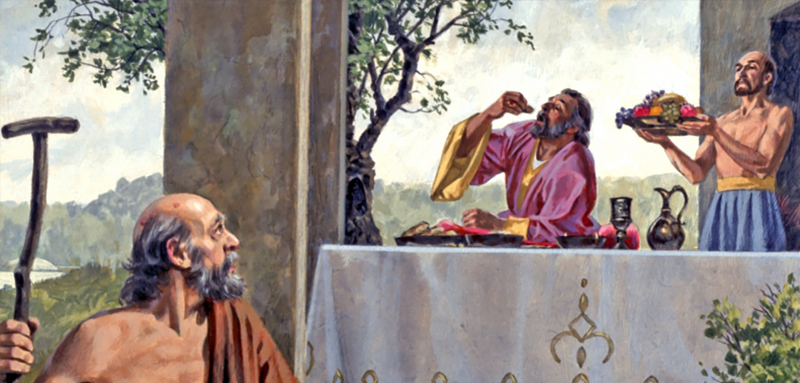
Look Around You – Try A little Kindness
1. Open Your Eyes
2. Bridging the Gap between Rich and Poor
Introduction
1. Open Your Eyes
How come that we are so little aware of the misery—poverty, discrimination, injustice—around us? Is it because we have not learned to see, or that we prefer not to see? It is said of God in the Old Testament that he saw the misery of his people, and, seeing it, he liberated them. Jesus saw the misery of the people around him and he did all he could to free them. Let us ask the Lord here with us that we may learn to see our own afflictions and those of the people around us. Then we can, with God’s help, do something to remedy them.
2. Bridging the Gap between Rich and Poor
We know that in our country Nigeria and elsewhere—in fact, in large parts of the world—there is a wide gap between the rich and the poor. Many ask themselves, hopefully we too, “What can I do about all this misery? My means are very limited, and I cannot carry the burden of the world.” But we know what the gospel asks of us. If all contribute, each in his or her own place, their share toward solving the problems of poverty, need, and suffering, how much better our whole world would become and how much nearer the kingdom! We need no angel to come and tell us. Listen to the message of the Lord himself.
First Reading: The Rich Will Be Made Poor
The prophet Amos rings out God’s indignation over the insensitive rich. They enjoy life without any concern for the poor. God cannot accept that any person or community would tolerate such inequality and indifference.
1 Reading: Amos 6:1a, 4-7
Thus says the LORD the God of hosts: Woe to the complacent in Zion! Lying upon beds of ivory, stretched comfortably on their couches, they eat lambs taken from the flock, and calves from the stall! Improvising to the music of the harp, like David, they devise their own accompaniment. They drink wine from bowls and anoint themselves with the best oils; yet they are not made ill by the collapse of Joseph! Therefore, now they shall be the first to go into exile, and their wanton revelry shall be done away with.
Responsorial Psalm: Ps 146:7, 8-9, 9-10
R. (1b) Praise the Lord, my soul! or: R. Alleluia.
Blessed he who keeps faith forever,
secures justice for the oppressed,
gives food to the hungry.
The LORD sets captives free. R.
The LORD gives sight to the blind.
The LORD raises up those who were bowed down.
The LORD loves the just.
The LORD protects strangers. R.
The fatherless and the widow he sustains,
but the way of the wicked he thwarts.
The LORD shall reign forever;
your God, O Zion, through all generations. Alleluia. R.
Second Reading: Witnessing to Christ with Our Lives
Christians, especially leaders in the community, must bear witness to the Father and to Jesus by their Christian living. For they owe to God their salvation in Jesus Christ.
2 Reading: 1 Timothy 6:11-16
But you, man of God, pursue righteousness, devotion, faith, love, patience, and gentleness. Compete well for the faith. Lay hold of eternal life, to which you were called when you made the noble confession in the presence of many witnesses. I charge you before God, who gives life to all things, and before Christ Jesus, who gave testimony under Pontius Pilate for the noble confession, to keep the commandment without stain or reproach until the appearance of our Lord Jesus Christ that the blessed and only ruler will make manifest at the proper time, the King of kings and Lord of lords, who alone has immortality, who dwells in unapproachable light, and whom no human being has seen or can see. To him be honour and eternal power. Amen.
Alleluia: Cf. 2 Corinthians 8:9
R. Alleluia, alleluia.
Though our Lord Jesus Christ was rich, he became poor,
so that by his poverty you might become rich.
R. Alleluia, alleluia.
Gospel: God Will Make the Poor Rich
The rich man of the parable is unconcerned about the poor man. But God’s justice reverses the situation: the poor will become rich before God, the selfish will lose everything.
Gospel: Luke 16:19-31
 Jesus said to the Pharisees: “There was a rich man who dressed in purple garments and fine linen and dined sumptuously each day. And lying at his door was a poor man named Lazarus, covered with sores, who would gladly have eaten his fill of the scraps that fell from the rich man’s table. Dogs even used to come and lick his sores. When the poor man died, he was carried away by angels to the bosom of Abraham. The rich man also died and was buried, and from the netherworld, where he was in torment, he raised his eyes and saw Abraham far off and Lazarus at his side. And he cried out, ‘Father Abraham, have pity on me. Send Lazarus to dip the tip of his finger in water and cool my tongue, for I am suffering torment in these flames.’ Abraham replied, ‘My child, remember that you received what was good during your lifetime while Lazarus likewise received what was bad; but now he is comforted here, whereas you are tormented. Moreover, between us and you a great chasm is established to prevent anyone from crossing who might wish to go from our side to yours or from your side to ours.’ He said, ‘Then I beg you, father, send him to my father’s house, for I have five brothers, so that he may warn them, lest they too come to this place of torment.’ But Abraham replied, ‘They have Moses and the prophets. Let them listen to them.’ He said, ‘Oh no, father Abraham, but if someone from the dead goes to them, they will repent.’ Then Abraham said, ‘If they will not listen to Moses and the prophets, neither will they be persuaded if someone should rise from the dead.'”
Commentary
The story of Dives does not tell us whether he had good or bad feelings. Neither does it tell us whether Lazarus was a very good person. It is not true that the rich are always bad and the poor always good. As Dorothy Day would say: “We love the poor not because they are good; we love them because they are poor.” It is possible for a rich man to be good and for a poor one not so good; but what we are told here is that Dives “did not see”; he didn’t realize that Lazarus was sitting at his door and he was hungry. More than a lack of generosity, the problem seems to be blindness. Dives was so happy enjoying his wealth that he had not noticed there was a human being next to him who was hungry. Some theologians call this “guilty innocence”; in other words, not knowing or opting to ignore a need in order to avoid taking action, makes us just as guilty as if we had intentionally behaved wrongly toward others. This act reminds us of the notion in morality called “culpable ignorance”.
However, “guilty innocence” is the same action of which Amos accuses the rich people of his time. They are so comfortable in their wealth, they don’t realize that neglecting the world around them will bring upon them great personal and political catastrophes. There are people who say they don’t hurt anyone, but they don’t offer to help and do good either. In God’s book, ignoring the one close to us, is as bad as hurting him or her, because ignoring someone is denying their existence and person; is acting as if the person did not exist, or was dead. What happens on a greater scale with the poor and the rich could also happen in our daily lives with those around us.
If we ignore the desires, questions, dreams, and interests of our children, we could be denying their existence and their future. If we do not tend to the concerns, joys, and difficulties of our spouses, we could be killing them slowly in life. If we are not sensitive to the needs of the people around us, in our work or community, we may be doing as much harm to them as if we were intentionally seeking out to hurt them.
All these things, we are warned about in today’s readings, have consequences. Those who are so self-centered, only thinking about themselves and their things, and blind and deaf to those around them, are risking their future. It may be that tomorrow, the family and the community will be deaf to their needs or that they are irreparably damaging their relationship with their loved ones. The loss, as in the case of Israel or Dives, can be catastrophic. A formed Christian conscience pricks the faithful on both acts of commission as well as omission. The Church is wise to lay this in the catechism book and recited daily in the Confiteor, prominently, during the Penitential Act during the Mass.
Blessing
In this Eucharistic celebration
the Lord has enriched us with his word
and with the gift of himself.
His bread of life tasted better
because it was shared.
We are now ready to enrich one another
and to make our happiness greater
by sharing it,
with the blessing of almighty God,
the Father, and the Son, and the Holy Spirit. R/ Amen.
Go in peace to love and serve the Lord
in one another. R/ Thanks be to God.