

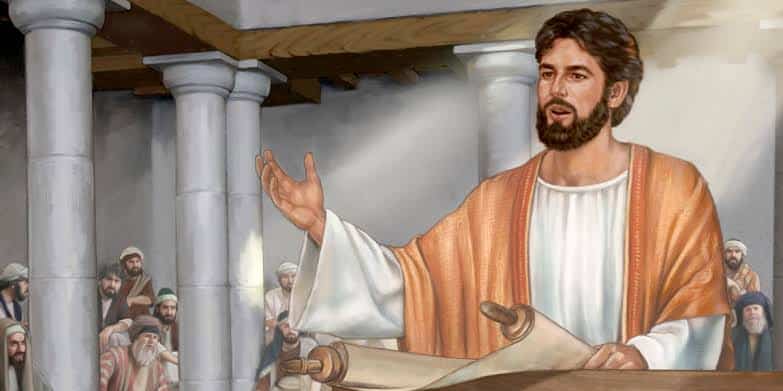
Jesus—God´s Word Fulfilled
Introduction
Speaking in the synagogue of Nazareth, Jesus says that God’s word is fulfilled today, that he proclaims and is the good news of joy to everyone.
Similarly, Jesus proclaims to us today in our Eucharistic assemblies the good news of God’s liberating love, and he is himself that good news, for he is present among us. This Eucharist is for us here today the moment of grace. The Spirit of Jesus rests on us now and gives us the capacity to speak and to be his message of hope, joy and love to our neighbour.
1 Reading: 1 John 4:19–5:4
Beloved, we love God because he first loved us. If anyone says, “I love God,” but hates his brother, he is a liar; for whoever does not love a brother whom he has seen cannot love God whom he has not seen. This is the commandment we have from him: Whoever loves God must also love his brother. Everyone who believes that Jesus is the Christ is begotten by God, and everyone who loves the Father loves also the one begotten by him. In this way we know that we love the children of God when we love God and obey his commandments. For the love of God is this, that we keep his commandments. And his commandments are not burdensome, for whoever is begotten by God conquers the world. And the victory that conquers the world is our faith.
Responsorial Psalm: Ps 72:1-2, 14 and 15bc, 17
R. (cf. 11) Lord, every nation on earth will adore you.
O God, with your judgment endow the king,
and with your justice, the king’s son;
He shall govern your people with justice
and your afflicted ones with judgment. R.
From fraud and violence he shall redeem them,
and precious shall their blood be in his sight.
May they be prayed for continually;
day by day shall they bless him. R.
May his name be blessed forever;
as long as the sun his name shall remain.
In him shall all the tribes of the earth be blessed;
all the nations shall proclaim his happiness. R.
Alleluia: Luke 4:18
R. Alleluia, alleluia.
The Lord has sent me to bring glad tidings to the poor
and to proclaim liberty to captives.
R. Alleluia, alleluia.
Gospel: Luke 4:14-22
Jesus returned to Galilee in the power of the Spirit, and news of him spread throughout the whole region. He taught in their synagogues and was praised by all. He came to Nazareth, where he had grown up, and went according to his custom into the synagogue on the Sabbath day. He stood up to read and was handed a scroll of the prophet Isaiah. He unrolled the scroll and found the passage where it was written: The Spirit of the Lord is upon me, because he has anointed me to bring glad tidings to the poor. He has sent me to proclaim liberty to captives and recovery of sight to the blind, to let the oppressed go free, and to proclaim a year acceptable to the Lord. Rolling up the scroll, he handed it back to the attendant and sat down, and the eyes of all in the synagogue looked intently at him. He said to them, “Today this Scripture passage is fulfilled in your hearing.” And all spoke highly of him and were amazed at the gracious words that came from his mouth.
Commentary
Upon returning to his home town of Nazareth and reading from Isaiah in the synagogue on the Sabbath, Jesus defines his mission. Those who are expecting an earthly monarch will have to look elsewhere. Jesus identifies himself with a God-directed mission to the poor and to those physically or socially handicapped. The promise of Isaiah, Christ asserts, is fulfilled in him. As the letter of John insists, the one who hates his brother or sister is far from God. Moreover, the One who comes as our teacher and guide must himself offer an example of unqualified love. It is this love to which Jesus points in this early synagogue visit.
While the reaction of his audience is initially one of admiration, it takes little time for the people of Nazareth to reject him. He becomes the prophet without honour in his own country. In the face of his extraordinary claims, the mood of his audience changes. Claims that do not meet people’s expectations are more easily rejected than tested.
The calendar of Christian saints is replete with people rejected because of their honest gospel stand. One thinks of Archbishop Oscar Romero of El Salvador who was shot for speaking on behalf of the voiceless under a military dictatorship. It is often easier to be silent than to take a strong unequivocal position. One thinks also of St. Clare of Assisi, who wanted to give her life wholly to the gospel after the manner of her mentor and friend, Francis, but was strongly opposed by her own family.
In the face of important moral decisions, we may find reason to remain silent and undistinguished. But the Spirit emboldens us and moves us toward the hard decision. In today’s responsorial, the psalmist prays for the king in words that could be applied to all of us. “Give the king your justice, O God.” And to each one of us as well.
Blessing
We will make the message of our Lord Jesus Christ good news of hope and joy only if the Spirit of truth and love speaks in our words and if then we commit ourselves to what we say, with the blessing of almighty God, the Father, and the Son, and the Holy Spirit. Amen!