

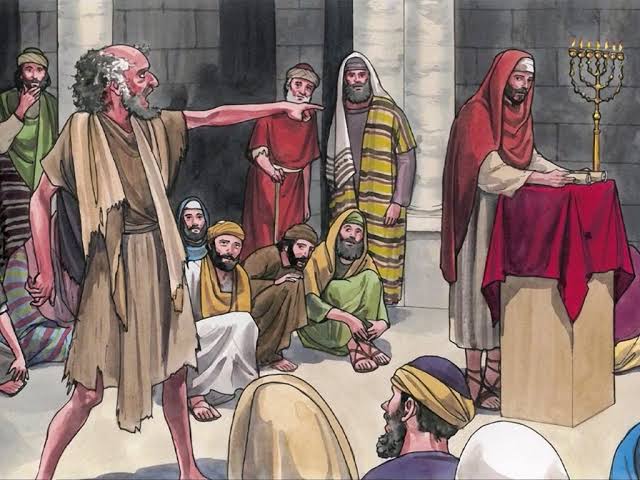
I Know Who You Are–The Holy One Of God!
Introduction
Extraordinary vocations are, at times, described in the bible in terms of barrenness, which, through prayer and faith in God’s power, produces life. It underlines God’s gratuitous grace, God’s power and also the difficulty, the struggle of faith, to lead to redemption. Samuel, then became the fruit of prayer and faith in God’s power.
In the Gospel, Mark shows the power of God at work in Jesus, the Messiah. It is a power that is contested by the powers of evil that must struggle and come to grip with opposition and suffering, but which will ultimately win – through struggle and contradiction. Such is also the power of God today in the world, the power of God in answer to our faith and prayer.
1 Reading: 1 Samuel 1:9-20
Hannah rose after a meal at Shiloh, and presented herself before the LORD; at the time, Eli the priest was sitting on a chair near the doorpost of the LORD’s temple. In her bitterness she prayed to the LORD, weeping copiously, and she made a vow, promising: “O LORD of hosts, if you look with pity on the misery of your handmaid, if you remember me and do not forget me, if you give your handmaid a male child, I will give him to the LORD for as long as he lives; neither wine nor liquor shall he drink, and no razor shall ever touch his head.” As she remained long at prayer before the LORD, Eli watched her mouth, for Hannah was praying silently; though her lips were moving, her voice could not be heard. Eli, thinking her drunk, said to her, “How long will you make a drunken show of yourself? Sober up from your wine!” “It isn’t that, my lord,” Hannah answered. “I am an unhappy woman. I have had neither wine nor liquor; I was only pouring out my troubles to the LORD. Do not think your handmaid a never-do-well; my prayer has been prompted by my deep sorrow and misery.” Eli said, “Go in peace, and may the God of Israel grant you what you have asked of him.” She replied, “Think kindly of your maidservant,” and left. She went to her quarters, ate and drank with her husband, and no longer appeared downcast. Early the next morning they worshiped before the LORD, and then returned to their home in Ramah. When Elkanah had relations with his wife Hannah, the LORD remembered her. She conceived, and at the end of her term bore a son whom she called Samuel, since she had asked the LORD for him.
Responsorial Psalm 1 Samuel 2:1, 4-5, 6-7, 8abcd
R. (cf. 1) My heart exults in the Lord, my Saviour.
“My heart exults in the LORD,
my horn is exalted in my God.
I have swallowed up my enemies;
I rejoice in my victory.” R.
“The bows of the mighty are broken,
while the tottering gird on strength.
The well-fed hire themselves out for bread,
while the hungry batten on spoil.
The barren wife bears seven sons,
while the mother of many languishes.” R.
“The LORD puts to death and gives life;
he casts down to the nether world;
he raises up again.
The LORD makes poor and makes rich;
he humbles, he also exalts.” R.
“He raises the needy from the dust;
from the dung heap he lifts up the poor,
To seat them with nobles
and make a glorious throne their heritage.” R.
Alleluia cf. 1 Thessalonians 2:13
R. Alleluia, alleluia.
Receive the word of God, not as the word of men,
but as it truly is, the word of God.
R. Alleluia, alleluia.
Gospel Mark 1:21-28
Jesus came to Capernaum with his followers, and on the Sabbath he entered the synagogue and taught. The people were astonished at his teaching, for he taught them as one having authority and not as the scribes. In their synagogue was a man with an unclean spirit; he cried out, “What have you to do with us, Jesus of Nazareth? Have you come to destroy us? I know who you are–the Holy One of God!” Jesus rebuked him and said, “Quiet! Come out of him!” The unclean spirit convulsed him and with a loud cry came out of him. All were amazed and asked one another, “What is this? A new teaching with authority. He commands even the unclean spirits and they obey him.” His fame spread everywhere throughout the whole region of Galilee.
Commentary
When Eli sees Hannah praying with great emotion at the temple, he mistakenly assumes she’s drunk and reprimands her. Unfortunately, there are too many Eli incidents in life. Under any circumstances, it is difficult to take unwarranted criticism from another. But when that criticism comes from a person in authority, especially a religious person, it is even more difficult to accept. All Christians, religious authorities especially, should think before they criticize, since circumstances may not always be as they seem.
It is interesting in the Gospels to note how circumspect Jesus is in his speech. He never descends to vindictive speech. He is a model of temperate speech and of spiritual outreach. When he is faced with blatant evil, he deals with it resolutely. When faced with a sinful woman, he refuses to accuse her and sends her on her way with a word of counsel.
Hannah eventually has a son, and he is well worth the wait. He is the upright and dedicated Samuel. Eli’s original insult of Hannah, when he assumed she had been drinking, is long past. His final words to her are those of blessing and encouragement. But that original insult, based on a misunderstanding, still gives us pause. A lack of charity is often considered a minor infraction. But it bears remembering that it can do considerable harm. However, pray always, Jesus would later say, and never give up (cf. Luke 18:1).
Blessing
Jesus was teaching with authority. Why? Because he fully believed in what he said and backed up his teaching with signs. Perhaps the greatest sign was that he lived what he taught. May we too, live as we believe, with the blessing of Almighty God, the Father, and the Son, and the Holy Spirit. Amen!