

Prayer Means—Opening The Roof Above
Introduction
The reading from Samuel is a good example of the strife that results when new times demand new institutions. The tribal structure of Israel had a hard time to defend the people, the territory, and the charismatic religious leadership against better organized neighbouring peoples. They too, would need more centralized structures and institutions. But some would hardly accept the needed reform. A king would be disappointing – as later experience proved – as a political and religious leader. This does not contradict the fact that profound changes were needed, but changes are always hard to take.
Miracles are called “signs” in the Bible. They are, like the cure of the paralytic, visible manifestations that something has happened inside the person. The paralytic can walk. He can stand up and move as a human being, as a person who is forgiven and can get up from the paralysis of sin. Could not we, too, give “signs” to the people around us by raising them above their miseries, that God is alive in us?
1 Reading 1 Samuel 8:4-7, 10-22a
All the elders of Israel came in a body to Samuel at Ramah and said to him, “Now that you are old, and your sons do not follow your example, appoint a king over us, as other nations have, to judge us.” Samuel was displeased when they asked for a king to judge them. He prayed to the LORD, however, who said in answer: “Grant the people’s every request. It is not you they reject, they are rejecting me as their king.” Samuel delivered the message of the LORD in full to those who were asking him for a king. He told them: “The rights of the king who will rule you will be as follows: He will take your sons and assign them to his chariots and horses, and they will run before his chariot. He will also appoint from among them his commanders of groups of a thousand and of a hundred soldiers. He will set them to do his plowing and his harvesting, and to make his implements of war and the equipment of his chariots. He will use your daughters as ointment makers, as cooks, and as bakers. He will take the best of your fields, vineyards, and olive groves, and give them to his officials. He will tithe your crops and your vineyards, and give the revenue to his eunuchs and his slaves. He will take your male and female servants, as well as your best oxen and your asses, and use them to do his work. He will tithe your flocks and you yourselves will become his slaves. When this takes place, you will complain against the king whom you have chosen, but on that day the LORD will not answer you.” The people, however, refused to listen to Samuel’s warning and said, “Not so! There must be a king over us. We too must be like other nations, with a king to rule us and to lead us in warfare and fight our battles.” When Samuel had listened to all the people had to say, he repeated it to the LORD, who then said to him, “Grant their request and appoint a king to rule them.”
Responsorial Psalm Ps 89:16-17, 18-19
R. (2) For ever I will sing the goodness of the Lord.
Blessed the people who know the joyful shout;
in the light of your countenance, O LORD, they walk.
At your name they rejoice all the day,
and through your justice they are exalted. R.
For you are the splendour of their strength,
and by your favour our horn is exalted.
For to the LORD belongs our shield,
and to the Holy One of Israel, our King. R.
Alleluia Luke 7:16
R. Alleluia, alleluia.
A great prophet has arisen in our midst
and God has visited his people.
R. Alleluia, alleluia.
Gospel Mark 2:1-12
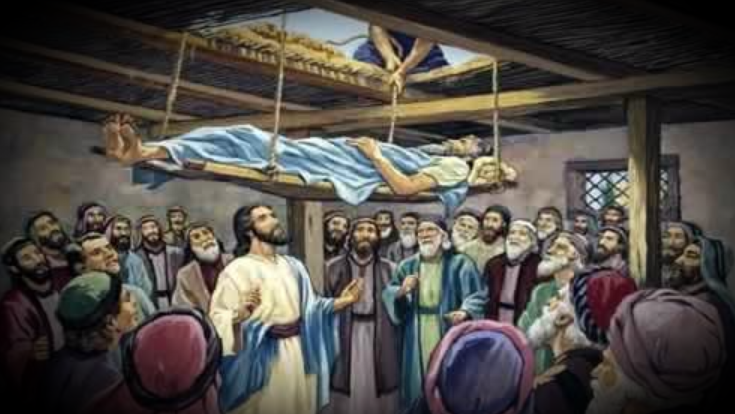
When Jesus returned to Capernaum after some days, it became known that he was at home. Many gathered together so that there was no longer room for them, not even around the door, and he preached the word to them. They came bringing to him a paralytic carried by four men. Unable to get near Jesus because of the crowd, they opened up the roof above him. After they had broken through, they let down the mat on which the paralytic was lying. When Jesus saw their faith, he said to him, “Child, your sins are forgiven.” Now some of the scribes were sitting there asking themselves, “Why does this man speak that way? He is blaspheming. Who but God alone can forgive sins?” Jesus immediately knew in his mind what they were thinking to themselves, so he said, “Why are you thinking such things in your hearts? Which is easier, to say to the paralytic, ‘Your sins are forgiven,’ or to say, ‘Rise, pick up your mat and walk’? But that you may know that the Son of Man has authority to forgive sins on earth” –he said to the paralytic, “I say to you, rise, pick up your mat, and go home.” He rose, picked up his mat at once, and went away in the sight of everyone. They were all astounded and glorified God, saying, “We have never seen anything like this.”
Commentary
No form of government is perfect. But most of us would say that, even with its imperfections, democracy is our preferred form of rule. At times we learn that our elected officials have feet of clay. Fela Kuti calls our type “demo-crazy”. Demonstration of craze. Exhibition of all forms of madness. But we would still be reluctant to abandon the system.
In today’s first reading from Samuel, the people ask the prophet for a king. God acquiesces to their request, albeit reluctantly, since kingship will certainly prove to be a mixed blessing. The speech of Samuel is part of the antimonarchical strain in the Book of Samuel in pointing up the negative aspects of kingship. Confiscation of property, conscription, tithing—these are some of the less pleasant features of a future kingship. But nonetheless a king will be given to the people, even though the step represents an encroachment on the rights of Yahweh.
Jesus avoids at every turn any notion of a human kingship. It is emphatically not the purpose he is called to fulfill. He was so unlike a royal messiah that any chances of his being seen as a kingly figure were minimal. As the emissary of the Father, he forgives sin and cures disease. The episode in the Gospel of today is a great call to prayer, intensive prayer. Try a little more. Give more quality hours. Don’t lose heart. God listens. When the need arises, “tear the roof open”. In our own lives, there should be no confusion of allegiances. We cannot equivocate on the demands that God makes of us. In balancing the demands of God and Caesar, there is no doubt where our first allegiance lies. Yet we know full well that in living our daily lives we are at countless turns faced with the “rule of Caesar.” The good order of society depends on it. We are not free to disregard taxes—though we may work to reduce them. The ordinances of public safety bind us in conscience. In the great majority of issues, the Christian is a good citizen. But when our conscience prods us to raise our voice in objection, we should not fail to do so.
Blessing
Let us try with all that is in us to put back on their feet those paralyzed by their own fears, limitations and condemnations and to accompany them on their journey to God and to one another, with the blessing of Almighty God, the Father, and the Son, and the Holy Spirit. Amen!
- St Anthony (Abbot) – Pray For Us!