

God Calls Even The Weak
Introduction
God has his own plans and standards, which are often at variance with our human wisdom. For example, he calls sinners – limited, deficient people – and they are good enough for him to do God’s work, even to be entrusted with a special mission. Saul is taken from an insignificant tribe of God’s people. He responds at first, but fails later.
Matthew is a typical sinner, a tax collector, one who was not only exploiting his own people but a traitor to them as a collaborator with the Romans. But he responds to Jesus’ call and becomes an apostle and martyr, faithful to the end. From where has Jesus called you and to where are you going?
1 Reading: 1 Samuel 9:1-4, 17-19; 10:1
There was a stalwart man from Benjamin named Kish, who was the son of Abiel, son of Zeror, son of Becorath, son of Aphiah, a Benjaminite. He had a son named Saul, who was a handsome young man. There was no other child of Israel more handsome than Saul; he stood head and shoulders above the people. Now the asses of Saul’s father, Kish, had wandered off. Kish said to his son Saul, “Take one of the servants with you and go out and hunt for the asses.” Accordingly they went through the hill country of Ephraim, and through the land of Shalishah. Not finding them there, they continued through the land of Shaalim without success. They also went through the land of Benjamin, but they failed to find the animals. When Samuel caught sight of Saul, the LORD assured him, “This is the man of whom I told you; he is to govern my people.” Saul met Samuel in the gateway and said, “Please tell me where the seer lives.” Samuel answered Saul: “I am the seer. Go up ahead of me to the high place and eat with me today. In the morning, before dismissing you, I will tell you whatever you wish.” Then, from a flask he had with him, Samuel poured oil on Saul’s head; he also kissed him, saying: “The LORD anoints you commander over his heritage. You are to govern the LORD’s people Israel, and to save them from the grasp of their enemies roundabout. “This will be the sign for you that the LORD has anointed you commander over his heritage.”
Responsorial Psalm Ps 21:2-3, 4-5, 6-7
R. (2a) Lord, in your strength the king is glad.
O LORD, in your strength the king is glad;
in your victory how greatly he rejoices!
You have granted him his heart’s desire;
you refused not the wish of his lips. R.
For you welcomed him with goodly blessings,
you placed on his head a crown of pure gold.
He asked life of you: you gave him
length of days forever and ever. R.
Great is his glory in your victory;
majesty and splendor you conferred upon him.
For you made him a blessing forever;
you gladdened him with the joy of your face. R.
Alleluia Luke 4:18
R. Alleluia, alleluia.
The Lord sent me to bring glad tidings to the poor
and to proclaim liberty to captives.
R. Alleluia, alleluia.
Gospel Mark 2:13-17
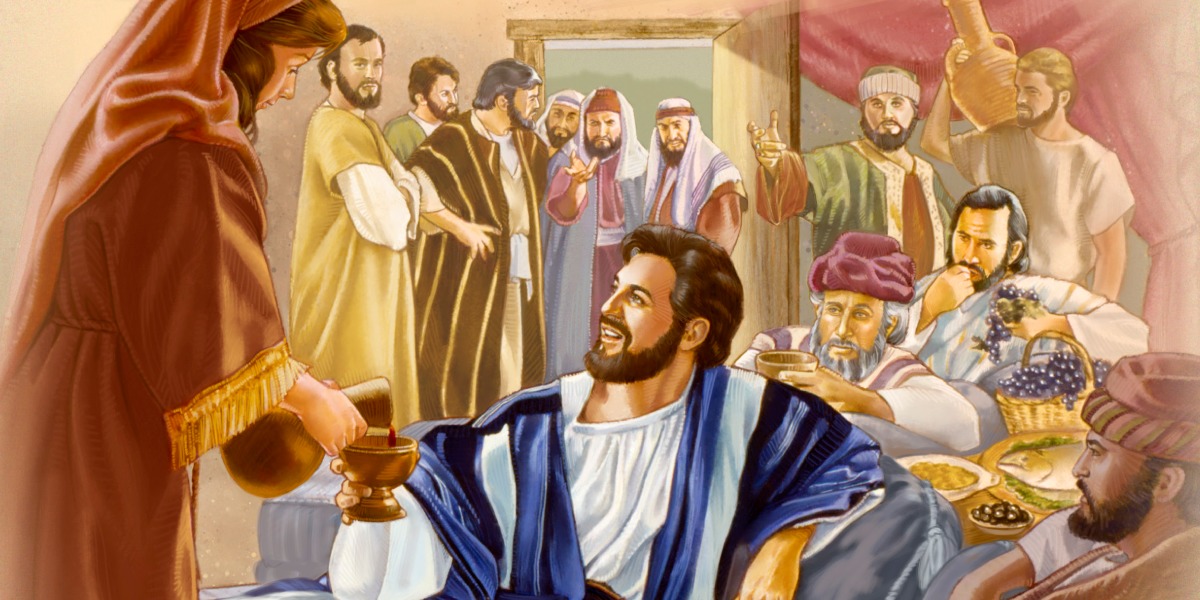
Jesus went out along the sea. All the crowd came to him and he taught them. As he passed by, he saw Levi, son of Alphaeus, sitting at the customs post. Jesus said to him, “Follow me.” And he got up and followed Jesus. While he was at table in his house, many tax collectors and sinners sat with Jesus and his disciples; for there were many who followed him. Some scribes who were Pharisees saw that Jesus was eating with sinners and tax collectors and said to his disciples, “Why does he eat with tax collectors and sinners?” Jesus heard this and said to them, “Those who are well do not need a physician, but the sick do. I did not come to call the righteous but sinners.”
Commentary
“Looks aren’t everything” is a common axiom. This is certainly the case with Saul. He is a man of remarkably good looks who is anointed by Samuel, at God’s direction, as Israel’s first king. In his life, he shows some remarkable traits. For example, he never shirks from his duty to defend his people from alien forces. Yet, in many ways he is not a faithful Yahwist. He turns violently on the young David, a member of his court, whom he sees as a threat to his own sovereignty and therefore a person to be eliminated. His repeated attempts do away with David are recorded in the First Book of Samuel. When Saul’s son, Jonathan, becomes David’s cherished friend, Saul is infuriated. It is only when Saul and Jonathan die in battle that the way is paved for David’s ascendancy.
Saul, the anointed of God, is rejected as king. He is the son of disappointment. Such is not that unusual in life. It very often happens that a highly regarded person ends up as something less than expected. This can be a very painful experience. It reminds us that our primary hope must be placed in God, with the hope that the human components will work toward a positive outcome.
When Jesus calls Levi to follow him, he has a certain result in mind, a certain hope for Levi. Levi also has to move forward in faith, hoping to do the right thing. It is the same with us. We may not be sure of the outcome of a course of action, but, if the cause is right, we know that it is worth the effort. As the old saying goes, “It is better to have loved and lost than never to have loved at all.”
Blessing
How daring of Jesus, how sure of himself! Jesus chooses one whom all consider a public sinner and makes him his apostle, to build his Church on him, similar also on some other apostles, who will show signs of great weakness. God trusts us. Let us also trust him and ask for the blessing of the Father, and the Son, and the Holy Spirit. Amen!