

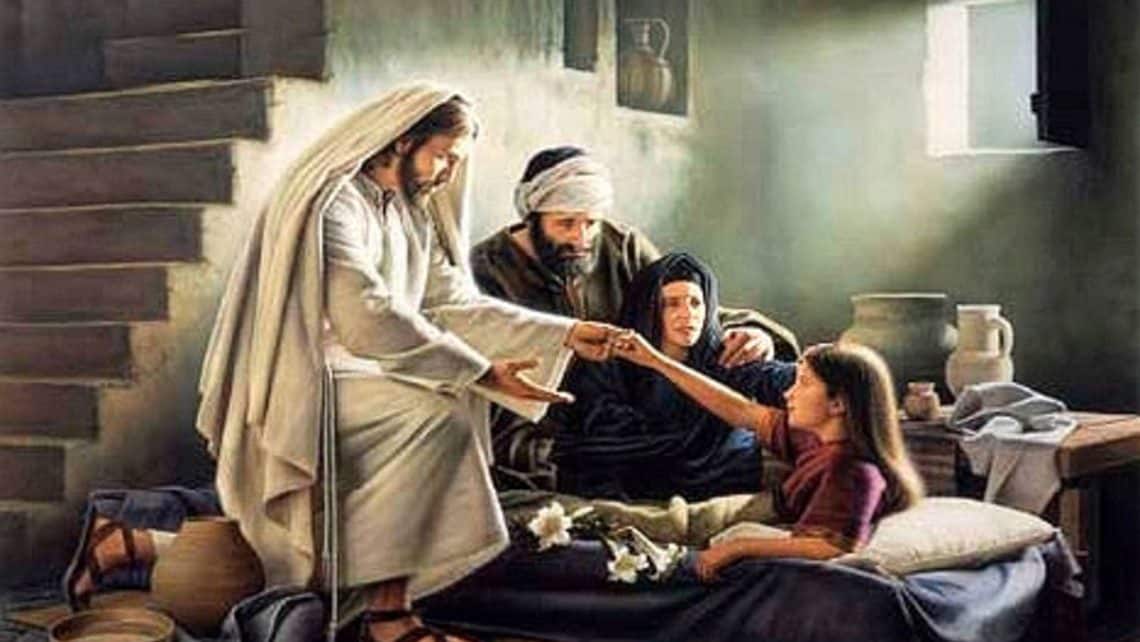
Little Girl, I Say To You, Arise
Introduction
Absalom is defeated and killed. The victory of the king’s army turns into a party of mourning, for notwithstanding Absalom’s rebellion, David still loved him very much.
Jesus uses his power to do good and to give an objective lesson on faith to his disciples and to the people. It is a power that gives health and life. When the woman touches Jesus with a sort of magic belief in his power, he insists on faith; so he does when, as a sign of his own resurrection, he brings Jairus’ daughter back to life. Should power in us not mean also a power that lifts up, a power of resurrection?
1 Reading: 2 Samuel 18:9-10, 14b, 24-25a, 30–19:3
Absalom unexpectedly came up against David’s servants. He was mounted on a mule, and, as the mule passed under the branches of a large terebinth, his hair caught fast in the tree. He hung between heaven and earth while the mule he had been riding ran off. Someone saw this and reported to Joab that he had seen Absalom hanging from a terebinth. And taking three pikes in hand, he thrust for the heart of Absalom, still hanging from the tree alive. Now David was sitting between the two gates, and a lookout went up to the roof of the gate above the city wall, where he looked about and saw a man running all alone. The lookout shouted to inform the king, who said, “If he is alone, he has good news to report.” The king said, “Step aside and remain in attendance here.” So he stepped aside and remained there. When the Cushite messenger came in, he said, “Let my lord the king receive the good news that this day the LORD has taken your part, freeing you from the grasp of all who rebelled against you.” But the king asked the Cushite, “Is young Absalom safe?” The Cushite replied, “May the enemies of my lord the king and all who rebel against you with evil intent be as that young man!” The king was shaken, and went up to the room over the city gate to weep. He said as he wept, “My son Absalom! My son, my son Absalom! If only I had died instead of you, Absalom, my son, my son!” Joab was told that the king was weeping and mourning for Absalom; and that day’s victory was turned into mourning for the whole army when they heard that the king was grieving for his son.
Responsorial Psalm PS 86:1-2, 3-4, 5-6
R. (1a) Listen, Lord, and answer me.
Incline your ear, O LORD; answer me,
for I am afflicted and poor.
Keep my life, for I am devoted to you;
save your servant who trusts in you.
You are my God. R.
Have mercy on me, O Lord,
for to you I call all the day.
Gladden the soul of your servant,
for to you, O Lord, I lift up my soul. R.
For you, O Lord, are good and forgiving,
abounding in kindness to all who call upon you.
Hearken, O LORD, to my prayer
and attend to the sound of my pleading. R.
Alleluia Matthew 8:17
R. Alleluia, alleluia.
Christ took away our infirmities
and bore our diseases.
R. Alleluia, alleluia.
Gospel Mark 5:21-43
When Jesus had crossed again in the boat to the other side, a large crowd gathered around him, and he stayed close to the sea. One of the synagogue officials, named Jairus, came forward. Seeing him he fell at his feet and pleaded earnestly with him, saying, “My daughter is at the point of death. Please, come lay your hands on her that she may get well and live.” He went off with him and a large crowd followed him. There was a woman afflicted with haemorrhages for twelve years. She had suffered greatly at the hands of many doctors and had spent all that she had. Yet she was not helped but only grew worse. She had heard about Jesus and came up behind him in the crowd and touched his cloak. She said, “If I but touch his clothes, I shall be cured.” Immediately her flow of blood dried up. She felt in her body that she was healed of her affliction. Jesus, aware at once that power had gone out from him, turned around in the crowd and asked, “Who has touched my clothes?” But his disciples said to him, “You see how the crowd is pressing upon you, and yet you ask, Who touched me?” And he looked around to see who had done it. The woman, realizing what had happened to her, approached in fear and trembling. She fell down before Jesus and told him the whole truth. He said to her, “Daughter, your faith has saved you. Go in peace and be cured of your affliction.” While he was still speaking, people from the synagogue official’s house arrived and said, “Your daughter has died; why trouble the teacher any longer?” Disregarding the message that was reported, Jesus said to the synagogue official, “Do not be afraid; just have faith.” He did not allow anyone to accompany him inside except Peter, James, and John, the brother of James. When they arrived at the house of the synagogue official, he caught sight of a commotion, people weeping and wailing loudly. So he went in and said to them, “Why this commotion and weeping? The child is not dead but asleep.” And they ridiculed him. Then he put them all out. He took along the child’s father and mother and those who were with him and entered the room where the child was. He took the child by the hand and said to her, “Talitha koum,” which means, “Little girl, I say to you, arise!” The girl, a child of twelve, arose immediately and walked around. At that they were utterly astounded. He gave strict orders that no one should know this and said that she should be given something to eat.
Commentary
With his great gifts of leadership and governance, David remains an outstanding biblical personality. But when it comes to the guidance of his own family, he falls far behind. Today in the first reading, David’s son Absalom meets his end, and his father’s grief is profound. But unfortunately this grief is too little too late.
Absalom has a blood sister who is sexually assaulted by their half-brother Amnon, David’s eldest son by another woman. Absalom is enraged and vows vengeance against Amnon. In confronting this terrible conflict between his own sons, David chooses a no confrontational path. He does nothing to right the evil deed that Amnon has committed, since this guilty son is still privileged in his eyes. Absalom’s anger turns against his father David. He goes into exile and remains distant from his father. Prevailed upon to return home, Absalom waits months for his father to receive him. Absalom then incites his father’s opponents to revolt, the only insurrection that David has to deal with during his long reign. In today’s reading, Absalom dies in battle, in a freakish accident. When his father receives the news, he is inconsolable. “O, Absalom, my son, my son,” he cries. But the damage by then is irreparable.
In today’s Gospel, Jairus approaches Jesus and pleads for his gravely ill daughter. Fully sympathetic, Jesus restores her health and returns her to her father. When faced with family ties in great strain, Jesus is never indifferent.
Strife among family members is still with us. Divorce, for instance, has become very common in our society. There is suffering on all sides, but the children suffer the most. They are caught between mother and father, both physically and psychologically. How often we see the child torn between parents or drawn to select one over the other. We realize ever more clearly the importance of the engagement period, the realization of what a lifelong commitment means, and the immense responsibilities taken on by those who enter into marriage.
Blessing
“Power had gone out from him,” says the Gospel today of Jesus. It was a power that healed and brought back to life. If we have power, may we use it always to raise people up, never to put them down. And may Almighty God bless you, the Father, and the Son, and the Holy Spirit. Amen!