

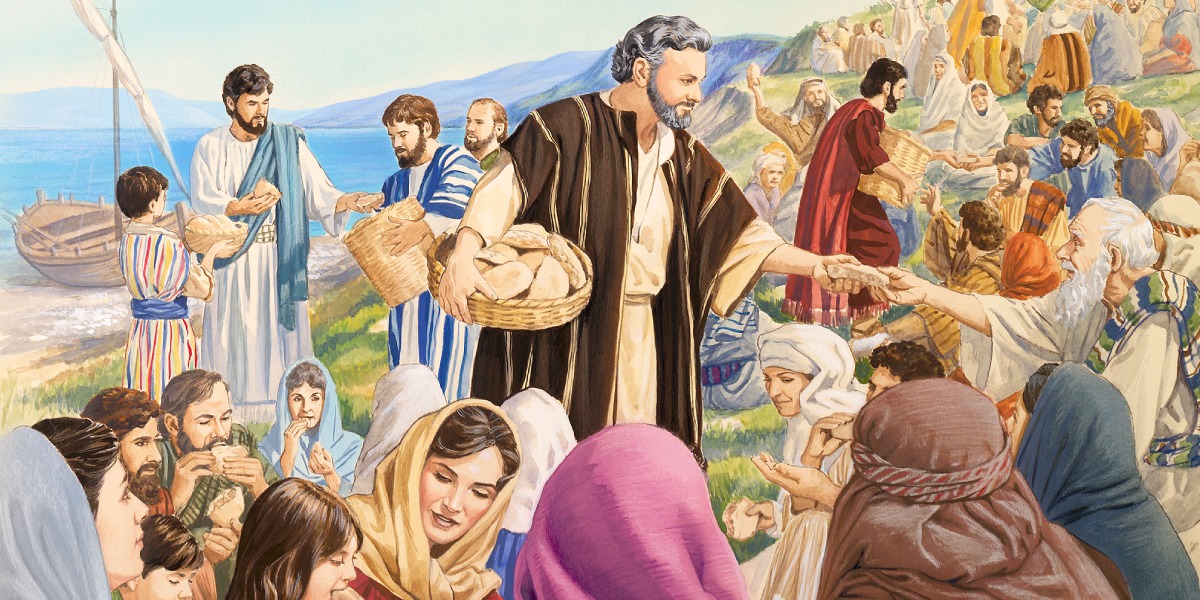
Filled with Pity–He Gave Bread to the Hungry
Introduction
The first reading describes the efforts of king Jeroboam to strengthen the political separation of the northern tribes of Israel by adding to it a religious separation.
Jesus, on the other hand, brings people together and gives them something to eat when they are hungry, as a sign of his mercy, his efforts toward unity and of the food of the Eucharist. Let us seek this unity and this food.
1 Reading: 1 Kings12:26-32; 13:33-34
Jeroboam thought to himself: “The kingdom will return to David’s house. If now this people go up to offer sacrifices in the temple of the LORD in Jerusalem, the hearts of this people will return to their master, Rehoboam, king of Judah, and they will kill me.” After taking counsel, the king made two calves of gold and said to the people: “You have been going up to Jerusalem long enough. Here is your God, O Israel, who brought you up from the land of Egypt.” And he put one in Bethel, the other in Dan. This led to sin, because the people frequented those calves in Bethel and in Dan. He also built temples on the high places and made priests from among the people who were not Levites. Jeroboam established a feast in the eighth month on the fifteenth day of the month to duplicate in Bethel the pilgrimage feast of Judah, with sacrifices to the calves he had made; and he stationed in Bethel priests of the high places he had built. Jeroboam did not give up his evil ways after this, but again made priests for the high places from among the common people. Whoever desired it was consecrated and became a priest of the high places. This was a sin on the part of the house of Jeroboam for which it was to be cut off and destroyed from the earth.
Responsorial Psalm: PS 106:6-7ab, 19-20, 21-22
R. (4a) Remember us, O Lord, as you favor your people.
We have sinned, we and our fathers;
we have committed crimes; we have done wrong.
Our fathers in Egypt
considered not your wonders. R.
They made a calf in Horeb
and adored a molten image;
They exchanged their glory
for the image of a grass-eating bullock. R.
They forgot the God who had saved them,
who had done great deeds in Egypt,
Wondrous deeds in the land of Ham,
terrible things at the Red Sea. R.
Alleluia Matthew 4:4b
R. Alleluia, alleluia.
One does not live on bread alone,
but on every word that comes forth from the mouth of God.
R. Alleluia, alleluia.
Gospel Mark 8:1-10
In those days when there again was a great crowd without anything to eat, Jesus summoned the disciples and said, “My heart is moved with pity for the crowd, because they have been with me now for three days and have nothing to eat. If I send them away hungry to their homes, they will collapse on the way, and some of them have come a great distance.” His disciples answered him, “Where can anyone get enough bread to satisfy them here in this deserted place?” Still he asked them, “How many loaves do you have?” They replied, “Seven.” He ordered the crowd to sit down on the ground. Then, taking the seven loaves he gave thanks, broke them, and gave them to his disciples to distribute, and they distributed them to the crowd. They also had a few fish. He said the blessing over them and ordered them distributed also. They ate and were satisfied. They picked up the fragments left over–seven baskets. There were about four thousand people. He dismissed the crowd and got into the boat with his disciples and came to the region of Dalmanutha.
Commentary
Jeroboam is the first king of the northern kingdom. Territorially, he is at a distinct advantage, with eleven of the tribes. But in not having Jerusalem and Judah, he lacks a center of Hebrew life, the temple and its cult. How can he hold the hearts of the people if they cannot journey to Jerusalem, their spiritual home? He would have to provide an appropriate alternative.
He proceeds to set up two new sanctuaries, each with its own calf of gold. The calves are images of Yahweh himself. “Here are your gods, O Israel, who brought you up out of the land of Egypt.” It was an idolatrous act, forbidden by the Decalogue.
Jeroboam fed his people on deception. Jesus feeds people with the truth. In reading the Bible, we are impressed by the extent to which it is a human book, with more than its share of contrasts and contradictions. Jesus had no intention of sending four thousand people away hungry. With Jesus providing, they ate until they were filled.
But the evangelist makes it clear that we are no less privileged. Notice the action of Jesus. Taking the seven loaves, he gave thanks, broke the bread, and gave it to the people. Clearly the formula is Eucharistic, and the sense is clear. We are no less blessed than that hungry crowd. Throughout life we are fed with the Eucharistic bread. That is Mark’s message for us in that wondrous feeding. In Eucharist we give thanks for that sacred banquet, our key to eternal life.
Blessing
When we pray the Our Father, we ask the Lord to give us our daily bread. That is not only the food of every day, and the Eucharist, but all we need from day to day. May God give you this and bless you, the Father, and the Son, and the Holy Spirit. Amen!