

Commandments: Sign Of Freedom And Love
Introduction
What is the meaning of the commandments to us? To some, they are the summary and summit of all morality; to others, narrow and outmoded rules; still to others, obstacles to the freedom of the gospel.
To Israel, they were the expression of fidelity to God and to the whole people as part of God’s covenant. They were the road to freedom from all forms of slavery: to other gods, to selfishness, to exploitation of one person by another. They were the sign of belonging to God and God’s nearness. And they were witnesses that love of God and love of neighbour cannot be separated.
In Christ, all this is fulfilled, and more. The commandments remain, but they become a basic step not to salvation by observances but to seeking communion with God in Christ and communion with our neighbour, and they are animated by love.
1 Reading: Deuteronomy 4:1, 5-9
Moses spoke to the people and said: “Now, Israel, hear the statutes and decrees which I am teaching you to observe, that you may live, and may enter in and take possession of the land which the LORD, the God of your fathers, is giving you. Therefore, I teach you the statutes and decrees as the LORD, my God, has commanded me, that you may observe them in the land you are entering to occupy. Observe them carefully, for thus will you give evidence of your wisdom and intelligence to the nations, who will hear of all these statutes and say, ‘This great nation is truly a wise and intelligent people.’ For what great nation is there that has gods so close to it as the LORD, our God, is to us whenever we call upon him? Or what great nation has statutes and decrees that are as just as this whole law which I am setting before you today? “However, take care and be earnestly on your guard not to forget the things which your own eyes have seen, nor let them slip from your memory as long as you live, but teach them to your children and to your children’s children.”
Responsorial Psalm 147:12-13, 15-16, 19-20
R. (12a) Praise the Lord, Jerusalem.
Glorify the LORD, O Jerusalem;
praise your God, O Zion.
For he has strengthened the bars of your gates;
he has blessed your children within you. R.
He sends forth his command to the earth;
swiftly runs his word!
He spreads snow like wool;
frost he strews like ashes. R.
He has proclaimed his word to Jacob,
his statutes and his ordinances to Israel.
He has not done thus for any other nation;
his ordinances he has not made known to them. R.
Acclamation: John 6:63C, 68C
Your words, Lord, are Spirit and life;
you have the words of everlasting life.
Gospel: Matthew 5:17-19
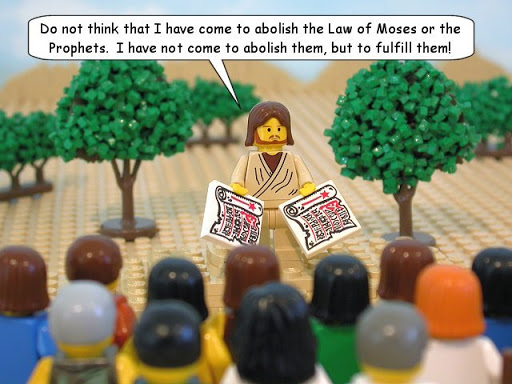
Jesus said to his disciples: “Do not think that I have come to abolish the law or the prophets. I have come not to abolish but to fulfill. Amen, I say to you, until heaven and earth pass away, not the smallest letter or the smallest part of a letter will pass from the law, until all things have taken place. Therefore, whoever breaks one of the least of these commandments and teaches others to do so will be called least in the Kingdom of heaven. But whoever obeys and teaches these commandments will be called greatest in the Kingdom of heaven.”
Commentary
There are few verses in the New Testament more widely debated than those from the Matthean Gospel read today. The claim for the lasting value of the Torah seems to be the antithesis of Paul’s teaching on freedom from the law. Moreover, there is no historical evidence that the church ever retained every precept of Torah. The fact is that most of its legislation did not continue.
It is helpful to begin with the facts. Paul insisted that the precepts of the Jewish law must not obtain among Gentile Christians. His position prevailed. If we are correct in the assumption that Matthew’s Gospel was written for a largely Jewish Christian community, then law observance may well have obtained for some period of time. This would have been seen as consonant with Jesus’ basic respect for the law during his lifetime.
The examples used in Matthew 5 of fulfilling the law and not destroying it do not in any way violate Paul’s thought. The Decalogue contained basic moral norms that Jesus did not ignore but raised to a new level. Where the law forbade killing, the teaching of Christ excludes even personal hostility. The law is fulfilled in going beyond it. Both Matthew and Paul champion a new ethic that in its premises respects and upholds the basic principles of Torah.
The reading from Deuteronomy today provides insight on why Torah was held in such esteem. It brought God close to his people. His will for them was expressed with clarity. It did not require mental gyrations to define God’s intentions.
As we make the journey of life, we are comforted by the fact that God’s will for us, especially as expressed in Jesus, is a guiding light, a beacon on what are at times stormy seas. At times we find it difficult to live as Christian. We make mistakes. But the will of God remains a great grace for which we can only be grateful as we make the journey.
Blessing
Let the great commandment given us by Jesus guide our life and make it beautiful and rich: Love God and love your neighbour as yourself, with the blessing of almighty God, the Father, and the Son, and the Holy Sprit. Amen!