

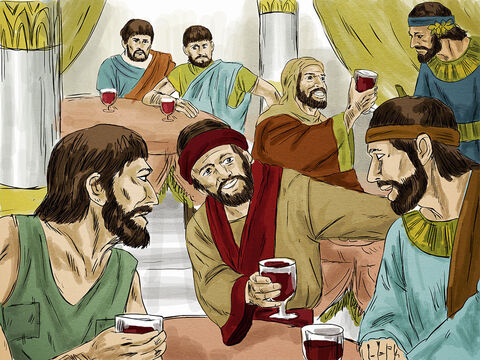
ALL ARE CALLED TO THE FEAST
Introduction
The first reading reflects the primitive conditions and the moral underdevelopment of the period of the Judges. Jephthah, a man of good will and a dedicated servant of Yahweh, lacks the moral discernment to distinguish between the binding force of an imprudent vow and respect for the human person.
All are invited to the kingdom of God, even repeatedly, the good and the bad alike. Salvation is open to all. But they should be willing, they must respond to the call. And once they respond, they should be consistent. They must share in the death struggle of Christ against evil, to live with the life of Christ. The force to live the Christ life is indeed given to us in the Eucharistic meal. There the Lord prepares us for the royal marriage feast.
Opening Prayer
Merciful Father of all people,
you open the doors of your kingdom
to invite us all, good and bad alike,
to share the life of Jesus, your Son.
Give us the wisdom and the strength
to respond to your generous call
with the whole of our being.
Help us to go the loyal way
to you and to one another
of Jesus Christ, your Son and our Lord,
who lives with you and the Holy Spirit,
one God, now and for ever. Amen!
1 Reading: Judges 11:29-39a
The Spirit of the LORD came upon Jephthah. He passed through Gilead and Manasseh, and through Mizpah-Gilead as well, and from there he went on to the Ammonites. Jephthah made a vow to the LORD. “If you deliver the Ammonites into my power,” he said, “whoever comes out of the doors of my house to meet me when I return in triumph from the Ammonites shall belong to the LORD. I shall offer him up as a burnt offering.” Jephthah then went on to the Ammonites to fight against them, and the LORD delivered them into his power, so that he inflicted a severe defeat on them, from Aroer to the approach of Minnith (twenty cities in all) and as far as Abel-keramim. Thus were the Ammonites brought into subjection by the children of Israel. When Jephthah returned to his house in Mizpah, it was his daughter who came forth, playing the tambourines and dancing. She was an only child: he had neither son nor daughter besides her. When he saw her, he rent his garments and said, “Alas, daughter, you have struck me down and brought calamity upon me. For I have made a vow to the LORD and I cannot retract.” She replied, “Father, you have made a vow to the LORD. Do with me as you have vowed, because the LORD has wrought vengeance for you on your enemies the Ammonites.” Then she said to her father, “Let me have this favour. Spare me for two months, that I may go off down the mountains to mourn my virginity with my companions.” “Go,” he replied, and sent her away for two months. So she departed with her companions and mourned her virginity on the mountains. At the end of the two months she returned to her father, who did to her as he had vowed.
Responsorial Psalm 40:5, 7-8a, 8b-9, 10
R. (8a and 9a) Here I am, Lord; I come to do your will.
Blessed the man who makes the LORD his trust;
who turns not to idolatry
or to those who stray after falsehood. R.
Sacrifice or oblation you wished not,
but ears open to obedience you gave me.
Burnt offerings or sin-offerings you sought not;
then said I, “Behold I come.” R.
“In the written scroll it is prescribed for me.
To do your will, O my God, is my delight,
and your law is within my heart!” R.
I announced your justice in the vast assembly;
I did not restrain my lips, as you, O LORD, know. R.
Alleluia: Psalm 95:8
Alleluia, alleluia.
If today you hear his voice,
harden not your hearts.
R. Alleluia, alleluia.
Gospel: Matthew 22:1-14
Jesus again in reply spoke to the chief priests and the elders of the people in parables saying, “The Kingdom of heaven may be likened to a king who gave a wedding feast for his son. He dispatched his servants to summon the invited guests to the feast, but they refused to come. A second time he sent other servants, saying, ‘Tell those invited: “Behold, I have prepared my banquet, my calves and fattened cattle are killed, and everything is ready; come to the feast.”‘ Some ignored the invitation and went away, one to his farm, another to his business. The rest laid hold of his servants, mistreated them, and killed them. The king was enraged and sent his troops, destroyed those murderers, and burned their city. Then the king said to his servants, ‘The feast is ready, but those who were invited were not worthy to come. Go out, therefore, into the main roads and invite to the feast whomever you find.’ The servants went out into the streets and gathered all they found, bad and good alike, and the hall was filled with guests. But when the king came in to meet the guests he saw a man there not dressed in a wedding garment. He said to him, ‘My friend, how is it that you came in here without a wedding garment?’ But he was reduced to silence. Then the king said to his attendants, ‘Bind his hands and feet, and cast him into the darkness outside, where there will be wailing and grinding of teeth.’ Many are invited, but few are chosen.”
Commentary
A banquet for busy people
The parable speaks to us of the Kingdom of God as a wedding feast. But the Gospel warns us: the invitation can be rejected. Many of the guests said no, because they were taken over by their personal interests. The guests, in fact, did not think that the wedding was sad or boring, but simply “did not care”: they were distracted by “their” interests. This is how we distances ourselves from love – both love of God and love of people – not out of malice, but because we prefer our own: security, comforts and pleasures.
We prefer to chase behind profits, pleasures, some hobbies that make us happy, but we fail to care about the invitation of God. we have time for everything else – for our work, for socialisations, for leisure trips, for meal gatherings, games, TV shows and movies … but no time for the Church, prayer, the Word of God… because we ignore His invitation.
And when everything depends on the self – what I want, what I need – we become rigid and evil, we react in a bad way for nothing, like the guests of the Gospel, who came to insult and even to kill (cf. v. 6) those who brought the invitation, just because they bothered them.
God is the opposite of selfishness, of self-reference. The Gospel tells us, in the face of the constant rejections he receives, in the face of the refusals of his invitations, the king goes on, he does not postpone the feast. He continues to invite, includes even more people. God, in the face of the injustices suffered, responds with a greater love. God, while suffering for our “no’s”, continues to take the initiative again and again. Because that’s how love is; because that’s the only way evil can be defeated.
There is one final aspect that the Gospel emphasizes: the dress of the guests, which is indispensable. It is not enough to answer once the invitation, to say “yes” and that’s it, but you have to put on the clothe, you need the habit of living love every day. Because one cannot say “Lord, Lord” without living according to God’s will (cf. Mt 7,21). We need to clothe ourselves every day with his love, to renew God’s choice every day.
We have received in Baptism the white robe, the bridal garment for God. Let us ask Him for the grace to choose and wear this dress every day and to keep it clean. How do I do it? Above all, by seeking without fear the Lord’s forgiveness: this is the decisive step to enter the wedding hall to celebrate the feast of love with Him.
Intercessions
– That the Lord may gather all peoples in one common praise of his name, we pray:
– That the lives of all Christians may radiate joy and hope and bring a feast of happiness to others, we pray:
– That the communities without priests, isolated and abandoned as they often feel, may receive the word of the Lord as their food and occasionally also the Lord’s body, we pray:
Prayer over the Gifts
Lord our God,
in these signs of bread and wine
you invite us now to the table
of your Son Jesus Christ,
as a token and pledge
of your unending feast meal in heaven.
Give us the strength to respond to your call,
that we may become new in Christ
and live his life day after day,
until you let us share in his glory
for ever and ever. Amen!
Prayer after Communion
Loving Father,
we thank you for giving us your Son
as our food and drink
on the long road to you.
Through this Eucharist
make us resemble him more and more,
that we may respect and love him
in one another,
that we may be his image to the world,
and that you may recognize his traits in us
when you welcome us
to the everlasting feast of joy.
Grant us this through Christ our Lord. Amen!
Blessing
All are invited to the Lord’s feast meal, but not all come. Are some absent because we do not make them feel welcome? Let us do all we can to make people feel at home with us. May God bless you all, the Father, and the Son, and the Holy Spirit. Amen!