

SERVANT OF THE POOR
Introduction
Holy Week is for us the time when we meditate on the saving death of our Lord. The days of his suffering are approaching. The first reading gives us the first of the famous songs about the Servant of Yahweh. The liturgy of the Holy Week characterizes Jesus as the Servant of Yahweh. This first song speaks perhaps directly about the attitude and role of God’s people, but we find these exemplified fully in Jesus, the perfect servant of God and of people. He is shown here to us as God’s servant who came to serve the poor and the suffering by bringing them justice and freedom, and light in darkness to all; he will be the covenant of us, the people, by uniting us with God and one another. All this he did for us by his saving death.
Reading: Is 42:1-7
Here is my servant whom I uphold,
my chosen one with whom I am pleased,
Upon whom I have put my Spirit;
he shall bring forth justice to the nations,
Not crying out, not shouting,
not making his voice heard in the street.
A bruised reed he shall not break,
and a smoldering wick he shall not quench,
Until he establishes justice on the earth;
the coastlands will wait for his teaching.
Thus says God, the LORD,
who created the heavens and stretched them out,
who spreads out the earth with its crops,
Who gives breath to its people
and spirit to those who walk on it:
I, the LORD, have called you for the victory of justice,
I have grasped you by the hand;
I formed you, and set you
as a covenant of the people,
a light for the nations,
To open the eyes of the blind,
to bring out prisoners from confinement,
and from the dungeon, those who live in darkness.
Responsorial Psalm 27:1, 2, 3, 13-14
R. (1a) The Lord is my light and my salvation.
The LORD is my light and my salvation;
whom should I fear?
The LORD is my life’s refuge;
of whom should I be afraid?
R. The Lord is my light and my salvation.
When evildoers come at me
to devour my flesh,
My foes and my enemies
themselves stumble and fall.
R. The Lord is my light and my salvation.
Though an army encamp against me,
my heart will not fear;
Though war be waged upon me,
even then will I trust.
R. The Lord is my light and my salvation.
I believe that I shall see the bounty of the LORD
in the land of the living.
Wait for the LORD with courage;
be stouthearted, and wait for the LORD.
R. The Lord is my light and my salvation.
Verse before the Gospel:
Hail to you, our King;
you alone are compassionate with our faults.
Gospel: John 12:1-11
Six days before Passover Jesus came to Bethany,
where Lazarus was, whom Jesus had raised from the dead.
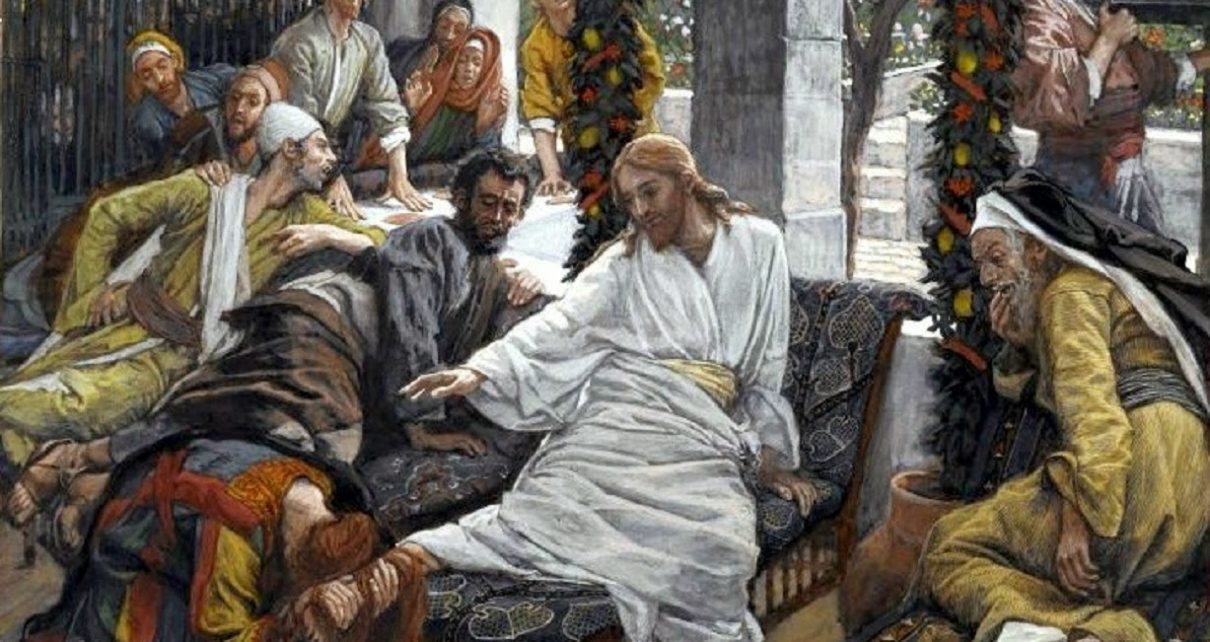
They gave a dinner for him there, and Martha served,
while Lazarus was one of those reclining at table with him.
Mary took a litre of costly perfumed oil
made from genuine aromatic nard
and anointed the feet of Jesus and dried them with her hair;
the house was filled with the fragrance of the oil.
Then Judas the Iscariot, one of his disciples,
and the one who would betray him, said,
“Why was this oil not sold for three hundred days’ wages
and given to the poor?”
He said this not because he cared about the poor
but because he was a thief and held the moneybag
and used to steal the contributions.
So Jesus said, “Leave her alone.
Let her keep this for the day of my burial.
You always have the poor with you, but you do not always have me.”
The large crowd of the Jews found out that he was there and came,
not only because of him, but also to see Lazarus,
whom he had raised from the dead.
And the chief priests plotted to kill Lazarus too,
because many of the Jews were turning away
and believing in Jesus because of him.
Commentary:
A few days before he would die, Jesus visits a family that had always been dearly beloved for him. How poignant a get-together! Jesus, who would soon be killed and then be raised, gets together with Lazarus who was once dead but was raised, with Martha waiting on him, and Mary anointing his feet with fabulous perfume. John does not mention them talking about anything. They didn’t have to. It is as if they read each other’s heart and words would only be superfluous. Of everyone present, Lazarus would have felt most clearly what was in the mind of Jesus, for to some extent he had been there where Jesus would soon be. And how deeply reassuring it would have been for Jesus to be with the one whom he raised from the dead! What he did to Lazarus, his Father would soon do to him. The visit would have given him the strength to face the next six days.
It is a pity that Judas could not make any sense of the intimations of the hearts assembled. He dared to speak and his words vitiated the fragrance of the silence.
Several iconic characters are presented through this story: the crowd that wants to satisfy its curiosity and represents the common evil of superficiality; then comes the hostility of the chief priests, who are ready to kill to defend their prerogatives; followed by Judas, the traitor, who can no longer hypocritically hide his lust for money. But amidst them all, we find Mary who welcomes Jesus into her house in Bethany: her luminous gesture of love and generosity points to the dramatic end which awaits Jesus but, in any case, breaks the cruel darkness of hate.
Blessing
We know that these days of the Holy Week the Lord Jesus will lead us from death to life if we learn from him to love and serve one another and to live for one another, even at the cost of sacrificing ourselves. May God give you this courage and bless you: the Father, and the Son, and the Holy Spirit. Amen!