

WHO DOES HE THINK HE IS?
Introduction
The author of Hebrews encourages those who had to flee from Jerusalem for the sake of following Jesus. Yes, their trials are hard to bear, but God loves them. He is a Father who corrects and tests his children out of love, that their faith may become more mature through the sufferings and difficulties that are part of life and of our being Christian. Do we too, accept this?
A man or woman like us from down the street, whose parents we know, how dare he or she speak God’s word to us – if it is God’s word! Jesus, the town carpenter whom everyone knew, how could he work miracles and where did he get this strange message? The Church with all its faults and the priest who is not any better than we are, how dare they speak to us in the name of God? God speaks through ordinary people. God’s word and message are stronger than the weak messengers he sends to speak his prophetic word. The people of Nazareth did not accept Jesus. Do we accept those who speak out for what is right and good?
Opening Prayer
God, our Father without equal,
your Son, your living Word, came among us
as one of our own, our own flesh and blood.
Dispose us to welcome him always
and to listen to what he tells us,
also when his word upsets and disturbs us.
And give us too, the courage
to pass on his word to one another,
that it may liberate us all
and lead us to you as your one people.
We ask this through Christ, our Lord. Amen!
1 Reading HEBREWS 12:4-7, 11-15
Brothers and sisters: In your struggle against sin you have not yet resisted to the point of shedding blood. You have also forgotten the exhortation addressed to you as children: My son, do not disdain the discipline of the Lord or lose heart when reproved by him; for whom the Lord loves, he disciplines; he scourges every son he acknowledges. Endure your trials as “discipline”; God treats you as his sons. For what “son” is there whom his father does not discipline? At the time, all discipline seems a cause not for joy but for pain, yet later it brings the peaceful fruit of righteousness to those who are trained by it. So strengthen your drooping hands and your weak knees. Make straight paths for your feet, that what is lame may not be dislocated but healed. Strive for peace with everyone, and for that holiness without which no one will see the Lord. See to it that no one be deprived of the grace of God, that no bitter root spring up and cause trouble, through which many may become defiled.
Responsorial PSALM 103:1-2, 13-14, 17-18a
R. (cf. 17) The Lord’s kindness is everlasting to those who fear him.
Bless the LORD, O my soul;
and all my being, bless his holy name.
Bless the LORD, O my soul,
and forget not all his benefits. R.
As a father has compassion on his children,
so the LORD has compassion on those who fear him,
For he knows how we are formed;
he remembers that we are dust. R.
But the kindness of the LORD is from eternity
to eternity toward those who fear him,
And his justice toward children’s children
among those who keep his covenant. R.
Alleluia JOHN 10:27
R. Alleluia, alleluia.
My sheep hear my voice, says the Lord;
I know them, and they follow me.
R. Alleluia, alleluia.
Gospel MARK 6:1-6
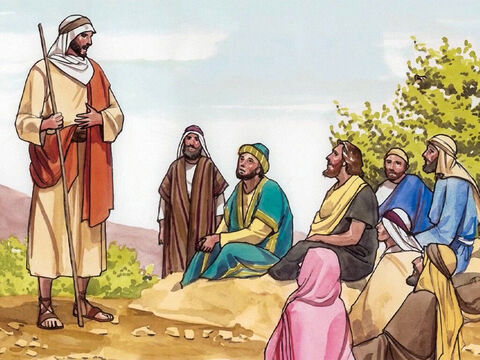
Jesus departed from there and came to his native place, accompanied by his disciples. When the Sabbath came he began to teach in the synagogue, and many who heard him were astonished. They said, “Where did this man get all this? What kind of wisdom has been given him? What mighty deeds are wrought by his hands! Is he not the carpenter, the son of Mary, and the brother of James and Joseph and Judas and Simon? And are not his sisters here with us?” And they took offense at him. Jesus said to them, “A prophet is not without honour except in his native place and among his own kin and in his own house.” So he was not able to perform any mighty deed there, apart from curing a few sick people by laying his hands on them. He was amazed at their lack of faith.
Commentary
Too familiar to appreciate
After spending a few months in Capernaum, visiting the villages of Galilee, preaching the gospel and healing the sick, Jesus returns to his native village. Jesus in Capernaum was involved in tragic conflicts with the political and religious authorities. But, now in his own native, it is the ordinary peasants of his country who do not understand and reject him. Jesus must have said or done something particularly provocative!
Sometime before, his relatives tried to convince him to return to his family and to resume his decent work as a carpenter, but he did not accede to their proposal. Looking on those around him to listen to him, he exclaimed: “Here are my mother and my brothers! Whoever does the will of God is brother and sister and mother to me” (Mk 3:31-35).
Now, on his own initiative, he returns to Nazareth, accompanied by his new family – the group of disciples, who responded to his call. They had left their boats, nets and father and all they had and followed him.
As long as Jesus remains quiet in the house where he grew up, that is, as long as he remains within the traditional mould, and appreciates the religious beliefs transmitted by the rabbis and shared by all, no one has anything to say about him. Problems arise as soon as he makes public the decision to set up a new home, a new family.
With his message and actions, Jesus is demolishing the old house in which they have placed all their hopes. What guarantees can “the carpenter, the son of Mary” offer? For more than thirty years, has done nothing but fix doors and windows, make hoes and ploughs, and they knew his brothers and sisters. Where does the message that he expounds come from? Who gives him the power to work wonders? They wonder: are they done in the name of God, or, as the scribes that came from Jerusalem accused him of (Mk 3:22), or do they come from the evil one?
The attitude taken by the people of Nazareth is repeated even today. Today there is no lack of prophets, but we refuse to accept them as such. Simply because we know them. We use the same argument that Jesus’ countrymen used. And we close ourselves off to the new possibilities, ways and hopes that God opens up to us through them. Certainly, they have their weaknesses as we all do, but through them the Spirit speaks. If we don’t listen to them, too bad for us!
Who are the prophets for you today? To what extent do we listen to them? Do you feel that, if listened to them, we could live differently?
Intentions
– That our Church may keep listening to the prophets among us, for the Spirit speaks through them, we pray:
– That God’s people may keep listening to the words Jesus speaks in our assemblies as a word spoken to each of us today, we pray:
– That in the silence of the voiceless, God’s people may hear the voice of the Lord crying out for justice and compassion, we pray:
Prayer over the Gifts
Lord our God,
you ask of us to accept with faith
your word spoken by your messengers
and above all by your living Word, Jesus Christ.
Make us truly recognize and welcome
the humble coming of your Son
in these simple signs of bread and wine.
Let his word and that of his prophets
take root in us and change us
into a community in which prevail
the love, the justice and the forgiveness
of Jesus Christ, our Lord. Amen!
Prayer after Communion
Lord God, loving Father,
you let us share in your strength
through Jesus, your Son in our midst.
Let his word that we have heard
come true in our lives
and give us the courage to proclaim it
without false shame or fear
to anyone willing to listen.
We ask this in the name of Jesus, the Lord. Amen!
Blessing
We have heard Jesus: let his word not fall on deaf ears. And may we not keep it for ourselves, but pass it on as a challenge to create together a community in which justice and love rule with the blessing of Almighty God, the Father, and the Son, and the Holy Spirit. Amen!