

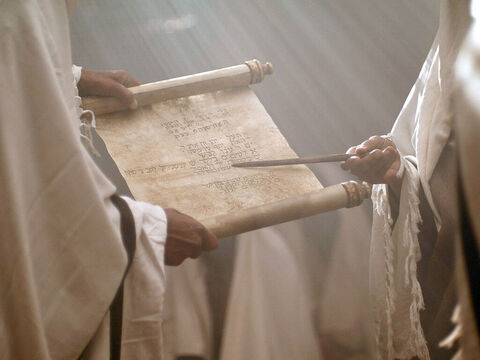
Commandments: Sign of Freedom and Love
Introduction
What is the meaning of the commandments to us? To some, they are the summary and summit of all morality; to others, narrow and outmoded rules; still to others, obstacles to the freedom of the gospel.
To Israel, they were the expression of fidelity to God and to the whole people as part of God’s covenant. They were the road to freedom from all forms of slavery: to other gods, to selfishness, to exploitation of one person by another. They were the sign of belonging to God and God’s nearness. And they were witnesses that love of God and love of neighbour cannot be separated.
In Christ, all this is fulfilled, and more. The commandments remain, but they become a basic step not to salvation by observances but to seeking communion with God in Christ and communion with our neighbour, and they are animated by love.
Opening Prayer
Lord our God,
you have given us your commandments
to set us on the road of freedom
from all forms of alienation.
May we learn to obey them
not to save ourselves by observances
nor to do you favours,
but to be free for you and for people
and to live in your love,
with Jesus Christ, your Son and our Lord. Amen!
1 Reading Deuteronomy 4:1, 5-9
Moses spoke to the people and said: “Now, Israel, hear the statutes and decrees which I am teaching you to observe, that you may live, and may enter in and take possession of the land which the LORD, the God of your fathers, is giving you. Therefore, I teach you the statutes and decrees as the LORD, my God, has commanded me, that you may observe them in the land you are entering to occupy. Observe them carefully, for thus will you give evidence of your wisdom and intelligence to the nations, who will hear of all these statutes and say, ‘This great nation is truly a wise and intelligent people.’ For what great nation is there that has gods so close to it as the LORD, our God, is to us whenever we call upon him? Or what great nation has statutes and decrees that are as just as this whole law which I am setting before you today? “However, take care and be earnestly on your guard not to forget the things which your own eyes have seen, nor let them slip from your memory as long as you live, but teach them to your children and to your children’s children.”
Responsorial Psalm 147:12-13, 15-16, 19-20
R. (12a) Praise the Lord, Jerusalem.
Glorify the LORD, O Jerusalem;
praise your God, O Zion.
For he has strengthened the bars of your gates;
he has blessed your children within you. R.
He sends forth his command to the earth;
swiftly runs his word!
He spreads snow like wool;
frost he strews like ashes. R.
He has proclaimed his word to Jacob,
his statutes and his ordinances to Israel.
He has not done thus for any other nation;
his ordinances he has not made known to them. R.
Gospel Acclamation John 6:63C, 68C
Glory and praise to you, Lord Jesus Christ.
Your words, Lord, are Spirit and life;
you have the words of everlasting life.
Glory and praise to you, Lord Jesus Christ.
Gospel Matthew 5:17-19
Jesus said to his disciples: “Do not think that I have come to abolish the law or the prophets. I have come not to abolish but to fulfill. Amen, I say to you, until heaven and earth pass away, not the smallest letter or the smallest part of a letter will pass from the law, until all things have taken place. Therefore, whoever breaks one of the least of these commandments and teaches others to do so will be called least in the Kingdom of heaven. But whoever obeys and teaches these commandments will be called greatest in the Kingdom of heaven.”
Commentary
Transcending the Law
The Law and the Prophets are two central pillars of faith in the Hebrew Bible. Jesus came not to displace either of them but to reconcile and absorb both into himself, and thereby completing them. This is evident from the scene of the Transfiguration where Jesus is seen with Moses (for the Law) and Elijah (for the Prophets). It is the temptation of the binary human thinking to see them as ‘either-or’ instead of ‘both-and.’ Let us look at it this way: No great musicians are born great; they begin by learning the laws of music, one by one. And once they have truly mastered them, they transcend them and compose new forms of music. This transcendence is no negation; but such a perfect absorption of the laws that they are able to transform them from inside out to create loftier music. And in their doing so, the law has served its purpose! Isn’t it the same dynamics we find in the life of Jesus or of our many mystics?
Thus, Commandments of God and what we know as the Church Laws are block-molds to freedom of the children of God to express their faith in Jesus. They are, nonetheless, a roadmap for believers.
Intercessions
– That we may learn to look at the commandments not as obstacles to our freedom, but like the people of God of old, as guidelines for fidelity and freedom, we pray:
– That we may not get entangled in the letter of the law but serve the Lord with the freedom of the sons and daughters of God as Jesus teaches us in the gospel, we pray:
– That we ask ourselves not so much what must we do but rather what can we do to for the love of God and people, we pray:
Prayer over the Gifts
Lord our God,
you are near to us
in your Son Jesus Christ.
May he make us aware
of the price he paid for our freedom.
As we sit at table with him,
may he give us the grace and strength
to give you a response of freedom,
that with him we may love you
as your sons and daughters,
now and for ever. Amen!
Prayer after Communion
Lord our God,
you have chosen us to be your people.
May your Son be alive in us,
that with him we may be faithful to you
and march forward together
to build a land of freedom
and to share with one another
until you share yourself with us for ever.
We ask this through Christ our Lord. Amen!
Blessing
Let the great commandment given us by Jesus guide our life and make it beautiful and rich: Love God and love your neighbour as yourself, with the blessing of almighty God, the Father, and the Son, and the Holy Sprit. Amen!