

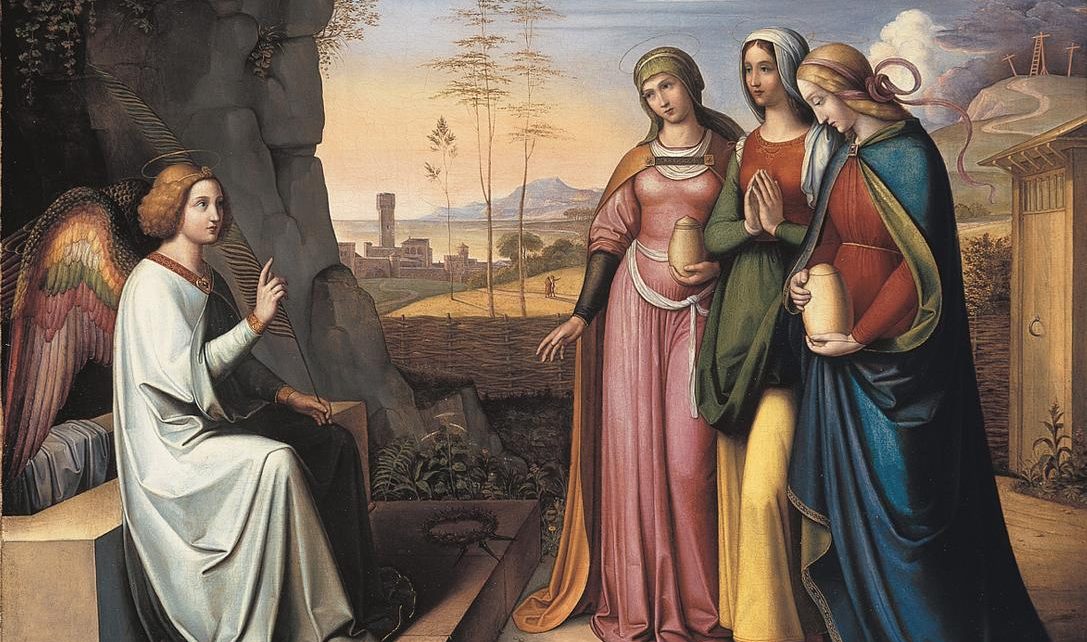
Recognizing The Risen Lord
Introduction
It is not always easy to recognize the risen Lord. This was the experience of Mary Magdalene. We too, are asked, “Whom are you seeking?” Are we really seeking the Lord Jesus? Do we recognize him not only in our prayers and during the reception of the Holy Eucharist, but also when he walks by our side in our sufferings and in our joys, in the people around us, and in the ordinary events and circumstances of life? Jesus is indeed our Lord and Messiah. Mary Magdalene recognized him when she heard his voice. Are we really in love with him and attuned to his Good News that we can say when hearing him: “It is you, Lord, speaking to me.”
1 Reading: ACTS 2:36-41
On the day of Pentecost, Peter said to the Jewish people,
“Let the whole house of Israel know for certain
that God has made him both Lord and Christ,
this Jesus whom you crucified.”
Now when they heard this, they were cut to the heart,
and they asked Peter and the other Apostles,
“What are we to do, my brothers?”
Peter said to them,
“Repent and be baptized, every one of you,
in the name of Jesus Christ, for the forgiveness of your sins;
and you will receive the gift of the Holy Spirit.
For the promise is made to you and to your children
and to all those far off,
whomever the Lord our God will call.”
He testified with many other arguments, and was exhorting them,
“Save yourselves from this corrupt generation.”
Those who accepted his message were baptized,
and about three thousand persons were added that day.
Responsorial Psalm 33:4-5, 18-19, 20 and 22
R. (5b) The earth is full of the goodness of the Lord. or: R. Alleluia.
Upright is the word of the LORD,
and all his works are trustworthy.
He loves justice and right;
of the kindness of the LORD the earth is full. R.
See, the eyes of the LORD are upon those who fear him,
upon those who hope for his kindness,
To deliver them from death
and preserve them in spite of famine. R.
Our soul waits for the LORD,
who is our help and our shield.
May your kindness, O LORD, be upon us
who have put our hope in you. R.
Alleluia: Psalm 118:24
Alleluia, alleluia.
This is the day the LORD has made;
let us be glad and rejoice in it.
R. Alleluia, alleluia.
Gospel: John 20:11-18
Mary Magdalene stayed outside the tomb weeping.
And as she wept, she bent over into the tomb
and saw two angels in white sitting there,
one at the head and one at the feet
where the Body of Jesus had been.
And they said to her, “Woman, why are you weeping?”
She said to them, “They have taken my Lord,
and I don’t know where they laid him.”
When she had said this, she turned around and saw Jesus there,
but did not know it was Jesus.
Jesus said to her, “Woman, why are you weeping?
Whom are you looking for?”
She thought it was the gardener and said to him,
“Sir, if you carried him away,
tell me where you laid him,
and I will take him.”
Jesus said to her, “Mary!”
She turned and said to him in Hebrew, “Rabbouni,”
which means Teacher.
Jesus said to her, “Stop holding on to me,
for I have not yet ascended to the Father.
But go to my brothers and tell them,
‘I am going to my Father and your Father,
to my God and your God.'”
Mary went and announced to the disciples,
“I have seen the Lord,”
and then reported what he had told her.
Commentary
The Johannine account of Mary Magdalene’s initial encounter with the risen Christ provides considerable food for thought. Her fidelity to the Lord through his passion and death is legendary. Now standing by the empty tomb, she is addressed by the two angels within. Asked why she is weeping, she replies that she does not know what has become of Jesus’ body.
It is at this point that Christ addresses her directly. Not recognizing him and believing that he is the gardener, she again expresses her grief at the loss of Christ’s body. Recognition comes with a single word: “Mary.” She immediately addresses him as “Rabboni” or Teacher.
In the Gospel of John, the resurrection, ascension, and Pentecost are united. Christ tells Mary not to detain him, since he is ascending to his Father and will return on that same Sunday evening to confer the Spirit on the apostles. His journey is not interrupted.
Mary then becomes the first witness to the resurrection. This woman from Jesus’ earthly company carries this central mystery to the apostles. In our times, when Mary is seen as an important woman of the Gospels, we see her today as the first ambassador of the risen Christ. And as we said yesterday, her role made her the ‘apostola apostolorum’.
There are two points that come quickly to mind. One is the expanding role of women in the church. This is an encouraging development. This is true not only of teaching, catechetics, and human outreach but in worship as well. We can only be grateful and supportive of the contribution women make and can make to the life of the church.
The second point is the force of the name. Our name is singularly our own. We are recognized by it, and we claim it unfailingly. To remember a person’s name does him or her honour. That name is to be reverenced and honoured. Its proper use is an unmatched sign of respect. Mary was able to recognize the Risen Lord at the call of her name.
Blessing
“Do not hold on to me,” says Jesus. Do not try to posses him for ourselves alone. Let us go to our brothers and sisters and share Jesus with them as the Lord of life who raises us above ourselves by making us with him people-for-others. May almighty God bless you, the Father, and the Son, and the Holy Spirit. Amen!