

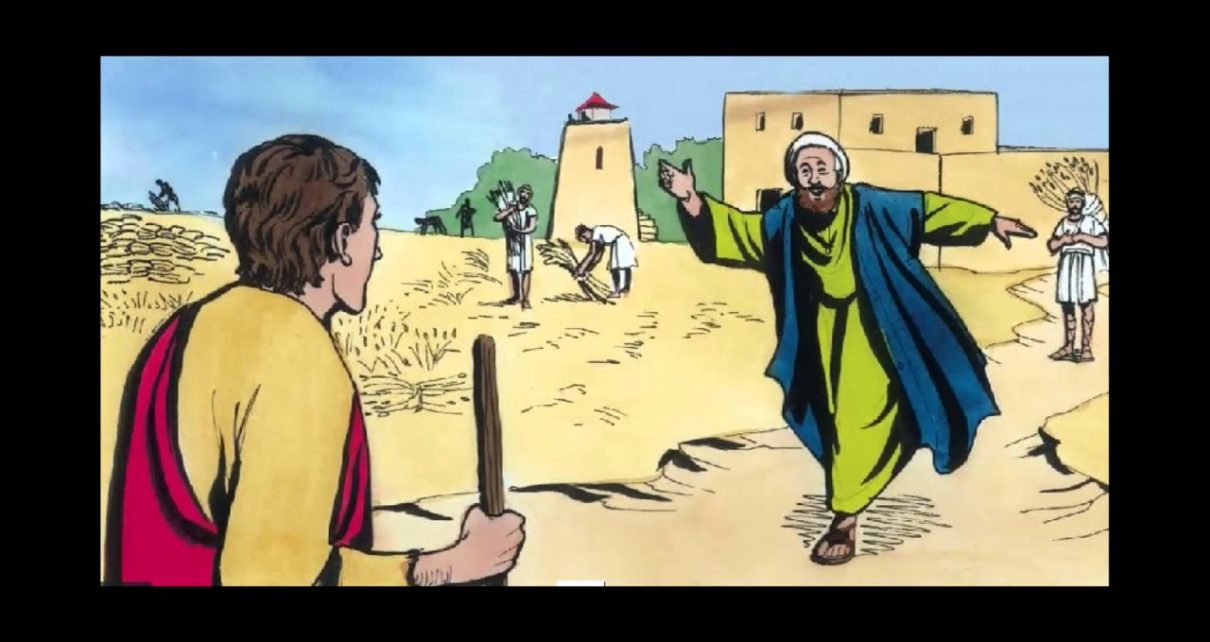
The Hope And Joy Of A Truly Repentant Sinner
1. A Father Prodigal with His Love
2. A Scandalizing Mercy
Introduction
1. A Father Prodigal with His Love
Can you imagine that, when half-heartedly sorry for the stupidities of your sins, you tell God that you come back to him, he embraces you and prepares a feast for you? It is almost like a hero’s welcome! A God prodigal with his love waits for us; the past belongs to the past. Let us join in the feast of forgiveness.
2. A Scandalizing Mercy
Sometimes it is said of good, tolerant people: that’s going too far to tolerate this, to forgive such a loss of face. Is there no spunk in him or her? No, we shouldn’t be anybody’s fool, but when it comes to forgiveness and patience we have still much to learn from God our Father. Has he not kept forgiving us? Has he ever stopped being patient with us? This is what we have to learn from him, however difficult it may be. Let us ask Jesus with us here to give us that strength.
First Reading: Joy of a Homeland
God had led his people from the land of slavery into their new homeland. They celebrated this homecoming by renewing the covenant with God. Then they had to live as his faithful people.
1 Reading: Joshua 5:9a, 10-12
The LORD said to Joshua,
“Today I have removed the reproach of Egypt from you.”
While the Israelites were encamped at Gilgal on the plains of Jericho,
they celebrated the Passover
on the evening of the fourteenth of the month.
On the day after the Passover,
they ate of the produce of the land
in the form of unleavened cakes and parched grain.
On that same day after the Passover,
on which they ate of the produce of the land, the manna ceased.
No longer was there manna for the Israelites,
who that year ate of the yield of the land of Canaan.
Responsorial Psalm: Ps 34:2-3, 4-5, 6-7.
R. (9a) Taste and see the goodness of the Lord.
I will bless the LORD at all times;
his praise shall be ever in my mouth.
Let my soul glory in the LORD;
the lowly will hear me and be glad.
R. Taste and see the goodness of the Lord.
Glorify the LORD with me,
let us together extol his name.
I sought the LORD, and he answered me
and delivered me from all my fears.
R. Taste and see the goodness of the Lord.
Look to him that you may be radiant with joy,
and your faces may not blush with shame.
When the poor one called out, the LORD heard,
and from all his distress he saved him.
R. Taste and see the goodness of the Lord.
Second Reading: Reconciled and Reconcilers
God offers us a new world of forgiveness and reconciliation. We have to bring that reconciliation to all.
2 Reading: 2 Corinthians 5:17-21
Brothers and sisters:
Whoever is in Christ is a new creation:
the old things have passed away;
behold, new things have come.
And all this is from God,
who has reconciled us to himself through Christ
and given us the ministry of reconciliation,
namely, God was reconciling the world to himself in Christ,
not counting their trespasses against them
and entrusting to us the message of reconciliation.
So we are ambassadors for Christ,
as if God were appealing through us.
We implore you on behalf of Christ,
be reconciled to God.
For our sake he made him to be sin who did not know sin,
so that we might become the righteousness of God in him.
Verse Before the Gospel: Lk 15:18
I will get up and go to my Father and shall say to him:
Father, I have sinned against heaven and against you.
Gospel: Welcome Back Home!
In the parable of the Father and his two sons, the father welcomes the repentant son back home with joy, but the self-righteous elder son, with the scribes and the Pharisees, refuses forgiveness.
Gospel: Luke 15:1-3, 11-32
Tax collectors and sinners were all drawing near to listen to Jesus,
but the Pharisees and scribes began to complain, saying,
“This man welcomes sinners and eats with them.”
So to them Jesus addressed this parable:
“A man had two sons, and the younger son said to his father,
‘Father give me the share of your estate that should come to me.’
So the father divided the property between them.
After a few days, the younger son collected all his belongings
and set off to a distant country
where he squandered his inheritance on a life of dissipation.
When he had freely spent everything,
a severe famine struck that country,
and he found himself in dire need.
So he hired himself out to one of the local citizens
who sent him to his farm to tend the swine.
And he longed to eat his fill of the pods on which the swine fed,
but nobody gave him any.
Coming to his senses he thought,
‘How many of my father’s hired workers
have more than enough food to eat,
but here am I, dying from hunger.
I shall get up and go to my father and I shall say to him,
“Father, I have sinned against heaven and against you.
I no longer deserve to be called your son;
treat me as you would treat one of your hired workers.”’
So he got up and went back to his father.
While he was still a long way off,
his father caught sight of him, and was filled with compassion.
He ran to his son, embraced him and kissed him.
His son said to him,
‘Father, I have sinned against heaven and against you;
I no longer deserve to be called your son.’
But his father ordered his servants,
‘Quickly bring the finest robe and put it on him;
put a ring on his finger and sandals on his feet.
Take the fattened calf and slaughter it.
Then let us celebrate with a feast,
because this son of mine was dead, and has come to life again;
he was lost, and has been found.’
Then the celebration began.
Now the older son had been out in the field
and, on his way back, as he neared the house,
he heard the sound of music and dancing.
He called one of the servants and asked what this might mean.
The servant said to him,
‘Your brother has returned
and your father has slaughtered the fattened calf
because he has him back safe and sound.’
He became angry,
and when he refused to enter the house,
his father came out and pleaded with him.
He said to his father in reply,
‘Look, all these years I served you
and not once did I disobey your orders;
yet you never gave me even a young goat to feast on with my friends.
But when your son returns
who swallowed up your property with prostitutes,
for him you slaughter the fattened calf.’
He said to him,
‘My son, you are here with me always;
everything I have is yours.
But now we must celebrate and rejoice,
because your brother was dead and has come to life again;
he was lost and has been found.’”
Commentary
One of the meanings of the word “prodigal” is: lavish in the bestowal or disposal of things. Thus, we hear people say – lavish party; lavish wedding etc. If so, then this parable could equally well be called the parable of the Prodigal Father. The father lavished mercy and love on his son. Jesus told this story to illustrate what God is like:
“The Lord is compassion and love,
Slow to anger and rich (lavish) in mercy.” (Ps 102)
The younger son had the wisdom to throw himself on his father’s mercy—much as he had thrown himself on the world some time before. They were a pair of Prodigals, with much in common! The older son couldn’t throw himself at all, neither for better nor worse. He was a careful self-possessed man, and how poorly he understood his father! I take interest in the action-phrases Luke purposely applied in describing the process of his reconciliation with his father, because conversion/repentance without attendant action (confession and true resolve to sin no more) is self-deceit. I break them this way:
– Coming to his senses > he thought > I shall get up > go to my father > I shall say to him… (And he did exactly that without procrastination). – So, > he got up > went back to his father… (And read his prepared script – personally composed Act of Contrition – the Cameroon Pidgin English Prayer Book calls it “Prayer for Sorry”. That’s it!)
The Church, this Lenten season, invites us to do the same for a fruitful penitential period: to come to our senses, to rise from our sinful state, to go to the Father, to say to the Father in the sacraments, “I am sorry”, “forgive”. We are prodigal children. No doubt. But we have a Father who is full of compassion. In this implication, a Prodigal Father.
Blessing
We know from experience
that it is hard to forgive
when we have been hurt deeply.
We have all come to wear scars
of betrayed trust and friendship,
of love turned down or left unanswered,
of hopes in one another never fulfilled.
This has been God’s experience with us too.
Yet he takes us back with joy,
holds no grudges, loves us no less.
May our love have grown more mature
through our encounter with a forgiving God
so that we too forgive those who have hurt us
without condition and with joy,
with the blessing of almighty God,
the Father, and the Son, and the Holy Spirit. R/ Amen.
Go in the peace of a loving and forgiving Father. R/ Thanks be to God.