

BREAD TO SHARE—THE EUCHARIST
Introduction
A sign worked by Jesus and told much in detail by all the evangelists is the multiplication of the bread. In all the Gospels, it is a sign of Jesus’ sharing himself, and even more so, a figure of Jesus’ continuing self-gift in the Eucharist. What about the disciple? Let us not forget that the Eucharist is also the sign and the prefiguration, the token of Jesus’ total self-giving on the cross.
1 Reading: ACTS 5:34-42
A Pharisee in the Sanhedrin named Gamaliel, a teacher of the law, respected by all the people, stood up, ordered the Apostles to be put outside for a short time, and said to the Sanhedrin, “Fellow children of Israel, be careful what you are about to do to these men. Some time ago, Theda’s appeared, claiming to be someone important, and about four hundred men joined him, but he was killed, and all those who were loyal to him were disbanded and came to nothing. After him came Judas the Galilean at the time of the census. He also drew people after him, but he too perished and all who were loyal to him were scattered. So now I tell you, have nothing to do with these men, and let them go. For if this endeavour or this activity is of human origin, it will destroy itself. But if it comes from God, you will not be able to destroy them; you may even find yourselves fighting against God.” They were persuaded by him. After recalling the Apostles, they had them flogged, ordered them to stop speaking in the name of Jesus, and dismissed them. So they left the presence of the Sanhedrin, rejoicing that they had been found worthy to suffer dishonour for the sake of the name. And all day long, both at the temple and in their homes, they did not stop teaching and proclaiming the Christ, Jesus.
Responsorial Psalm 27:1, 4, 13-14
R. (see 4abc) One thing I seek: to dwell in the house of the Lord. or:
R. Alleluia.
The LORD is my light and my salvation;
whom should I fear?
The LORD is my life’s refuge;
of whom should I be afraid? R.
One thing I ask of the LORD
this I seek:
To dwell in the house of the LORD
all the days of my life,
That I may gaze on the loveliness of the LORD
and contemplate his temple. R.
I believe that I shall see the bounty of the LORD
in the land of the living.
Wait for the LORD with courage;
be stouthearted, and wait for the LORD. R.
Alleluia Matthew 4:4B
R. Alleluia, alleluia.
One does not live on bread alone,
but on every word that comes forth from the mouth of God.
R. Alleluia, alleluia.
Gospel John 6:1-15
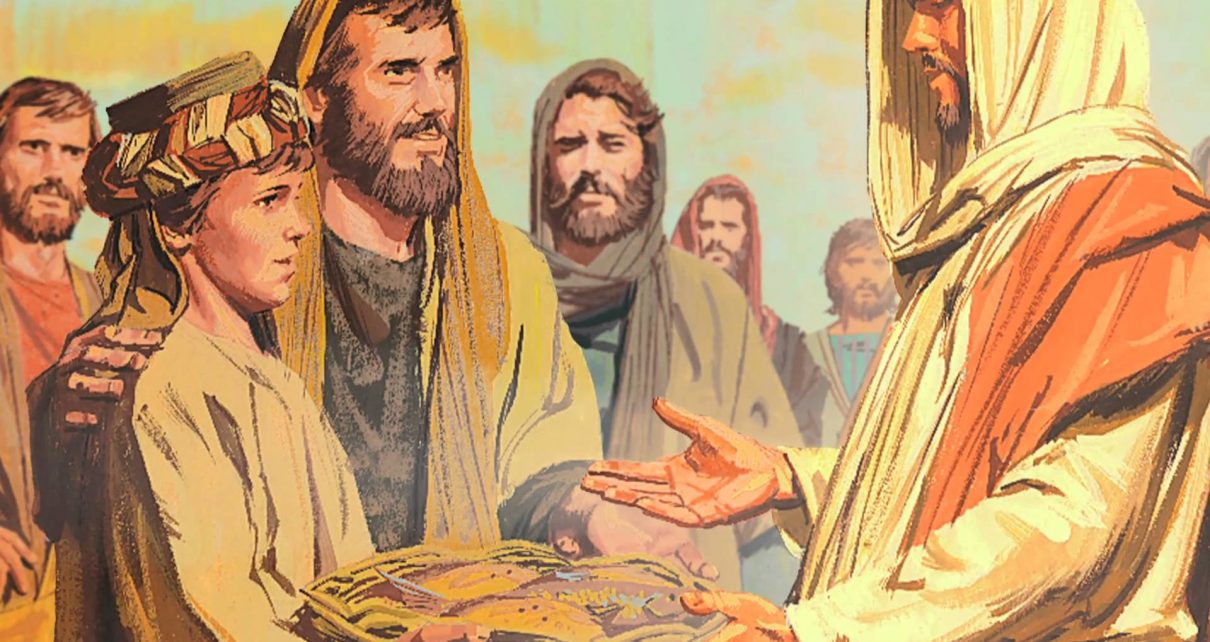
Jesus went across the Sea of Galilee. A large crowd followed him, because they saw the signs he was performing on the sick. Jesus went up on the mountain, and there he sat down with his disciples. The Jewish feast of Passover was near. When Jesus raised his eyes and saw that a large crowd was coming to him, he said to Philip, “Where can we buy enough food for them to eat?” He said this to test him, because he himself knew what he was going to do. Philip answered him, “Two hundred days’ wages worth of food would not be enough for each of them to have a little.” One of his disciples, Andrew, the brother of Simon Peter, said to him, “There is a boy here who has five barley loaves and two fish; but what good are these for so many?” Jesus said, “Have the people recline.” Now there was a great deal of grass in that place. So the men reclined, about five thousand in number. Then Jesus took the loaves, gave thanks, and distributed them to those who were reclining, and also as much of the fish as they wanted. When they had had their fill, he said to his disciples, “Gather the fragments left over, so that nothing will be wasted.” So they collected them, and filled twelve wicker baskets with fragments from the five barley loaves that had been more than they could eat. When the people saw the sign he had done, they said, “This is truly the Prophet, the one who is to come into the world.” Since Jesus knew that they were going to come and carry him off to make him king, he withdrew again to the mountain alone.
Commentary
There is a wisdom motif in today’s two readings. Before the court, Gamaliel argues from precedent in the matter of Jesus. Religious claimants had appeared in the past, but upon their death, their cause evaporated and their followers disbanded. The court would now show itself wise in abstaining from any action against the apostles. If their cause was from God, it would succeed; if not, it would disappear.
In John’s recounting of the story of the loaves, there is a distinct Eucharistic imprint. We are surprised by the fact that John’s Last Supper narrative makes no mention of the institution of the Eucharist, since the Gospel as a whole is strongly sacramental. In today’s narrative, Jesus took notice of the crowd with no food, he “took” the bread, gave “thanks,” and “distributed” the loaves to those reclining on the plain. The language clearly reflects the Last Supper account of the Synoptic Gospels. What we have here is a distinctly Eucharistic catechesis.
The Johannine wisdom in many parts of the Gospel stresses the continued presence of Christ in his church. If the people were blessed who followed Jesus personally during his life, so too are we. If we wish, we can receive daily that bread of life that sustains us on our journey. Christianity is an historical religion not only because it finds its origins in the person of the historical Jesus Christ but also because it relives the Christ event in every moment of history. Our belief tells us that Christ lives in the Spirit-filled Christian and in each one of the sacraments, especially the Eucharist. This sacrament is both sign and reality: the sign of Christ’s self-giving and the reality of his true body and blood.
The psalmist today prays to dwell always in the house of the Lord. With the assurance of faith, this is precisely what we do in the Eucharist.
Blessing
We believe in Jesus, our Risen Lord. He nourishes us with his Word of life; may it be Good News which we want to experience and practice. He nourishes us with his bread of life. May it prompt you to bring love and serving help to anyone in need, with the blessing of Almighty God, the Father, and the Son, and the Holy Spirit. Amen!