

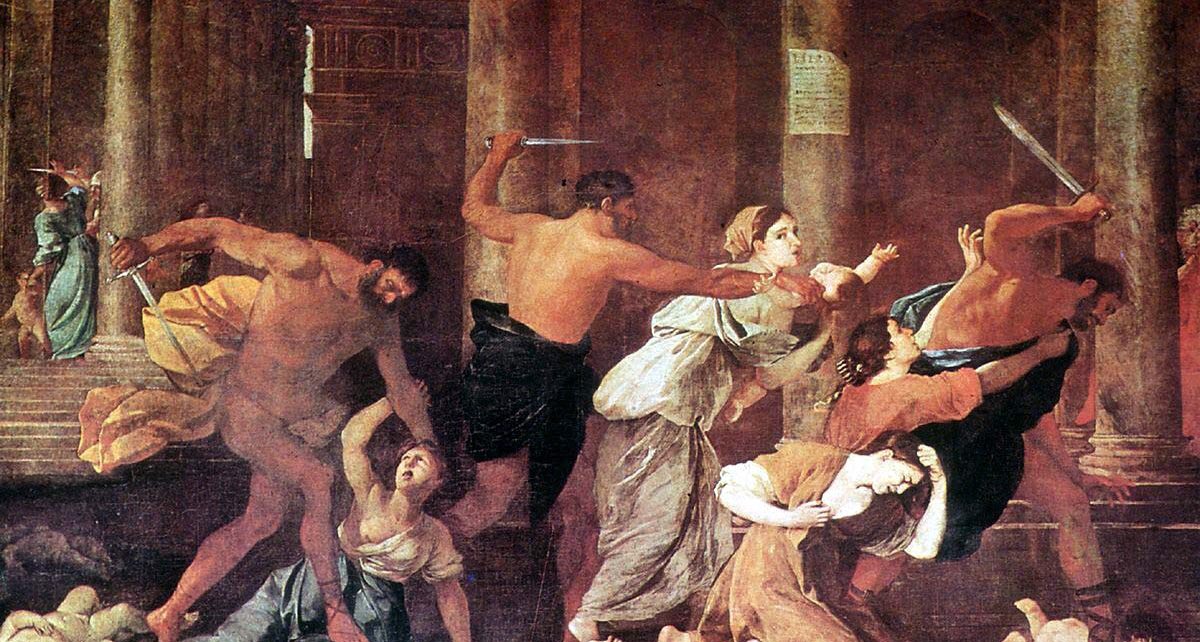
Herod Ordered The Massacre Of All The Boys
Introduction
Today’s celebration shocks us into the realization that the birth of Christ was not all peace and joy. The coming of Jesus was the beginning of a struggle-to-death between the powers of evil and the kingdom of light, a struggle that would have its climax in the passion and death of Jesus. Herod stands here for the forces of evil. Even innocent children are often the victims of this enmity.
The story of the Innocents may very well be a theological illustration of Matthew on this climactic clash between good and evil that began with the birth of Jesus. Often, the innocents have to suffer on account of so much evil in the world caused by other people.
1 Reading: 1 John 1:5—2:2
Beloved: This is the message that we have heard from Jesus Christ and proclaim to you: God is light, and in him there is no darkness at all. If we say, “We have fellowship with him,” while we continue to walk in darkness, we lie and do not act in truth. But if we walk in the light as he is in the light, then we have fellowship with one another, and the Blood of his Son Jesus cleanses us from all sin. If we say, “We are without sin,” we deceive ourselves, and the truth is not in us. If we acknowledge our sins, he is faithful and just and will forgive our sins and cleanse us from every wrongdoing. If we say, “We have not sinned,” we make him a liar, and his word is not in us. My children, I am writing this to you so that you may not commit sin. But if anyone does sin, we have an Advocate with the Father, Jesus Christ the righteous one. He is expiation for our sins, and not for our sins only but for those of the whole world.
Responsorial Psalm: 124:2-3, 4-5, 7CD-8
R. (7) Our soul has been rescued like a bird from the fowler’s snare.
Had not the LORD been with us—
When men rose up against us,
then would they have swallowed us alive,
When their fury was inflamed against us. R.
Then would the waters have overwhelmed us;
The torrent would have swept over us;
over us then would have swept the raging waters. R.
Broken was the snare,
and we were freed.
Our help is in the name of the LORD,
who made heaven and earth. R.
Alleluia (cf. Te Deum)
R. Alleluia, alleluia.
We praise you, O God,
we acclaim you as Lord;
the white robed army of martyrs praise you.
R. Alleluia, alleluia.
Gospel: Matthew 2:13-18
When the magi had departed, behold, the angel of the Lord appeared to Joseph in a dream and said, “Rise, take the child and his mother, flee to Egypt, and stay there until I tell you. Herod is going to search for the child to destroy him.” Joseph rose and took the child and his mother by night and departed for Egypt. He stayed there until the death of Herod, that what the Lord had said through the prophet might be fulfilled, Out of Egypt I called my son. When Herod realized that he had been deceived by the magi, he became furious. He ordered the massacre of all the boys in Bethlehem and its vicinity two years old and under, in accordance with the time he had ascertained from the magi. Then was fulfilled what had been said through Jeremiah the prophet: A voice was heard in Ramah, sobbing and loud lamentation; Rachel weeping for her children, and she would not be consoled, since they were no more.
Commentary
Interpreting the birth of Jesus and the visit of the Magi as a threat to his royal position, Herod orders the death of all male children in Bethlehem under two years old. Matthew is keenly interested in pointing up likenesses between Jesus and Moses and draws here a striking parallel to the pharaoh’s order to destroy the Hebrew male offspring at the time of Moses’ birth in Egypt.
The death of innocent children, whether in biblical times or our own, strikes us deeply as a real injustice. It is a grim fact that children continue to be subjected to barbarous deaths. In very recent times, from the former Yugoslavia in Europe to Rwanda in Africa, ethnic cleansing has made victims of helpless women and children. In the troubled Middle East, suicide bombers indiscriminately take the lives of innocent people, including children. And, despite all the talk of limited tactical strikes, war takes the lives of all too many noncombatants. The fact is that children are often the first to perish.
In addition, today’s feast reminds us of the innocent lives that are taken through abortion. Today more and more voices are being raised on behalf of the voiceless. Whatever the reason for an abortion, it is the innocent who suffer. It is not a sectarian issue; it is a human one.
We cannot pass over the reading from John’s epistle without touching on one of its issues. Life in the Spirit is granted through initial recognition of sin and guilt. But today’s reading makes clear that even after baptism, sin frequently occurs. In such a case our heavenly Intercessor stands with us in seeking forgiveness. So much emphasis in the New Testament falls on initial justification that we are often led to wonder if there is a “second plank after shipwreck.” The answer is an unequivocal “yes.” Even with the best of intentions, we all stumble along the way. While not rejecting Christ, we do not always live up to what he asks of us. It is good to know that the helping hand of Christ is there to lift us up. And 2020 is another moment to journey again with him.
Blessing
We ask the Lord today that he may bless our children, that they may grow up as God’s children, as good Christians and good citizens. May their tender lives not be terminated through war, domestic violence or abortion. May Almighty God bless them and you all, the Father, and the Son, and the Holy Spirit. Amen!