

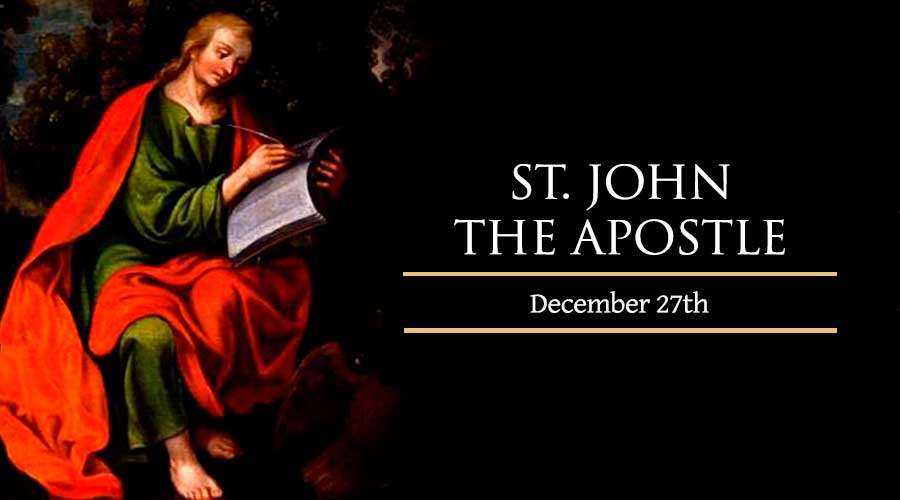
John—The Disciple Whom Jesus Loved
Introduction
Close to our Lord, obsessed by love. These may will be the marks of John, the Evangelist. He had experienced in his person what it means to be loved by Jesus and to love in return. And Jesus was the Lord, God’s Son! In later life, he was driven by this love, as his Gospel and his first letter reveal to us. He was the man who preached love; the words he used, the urgency and insistence with which he spoke cannot come but from a man who lived this love deeply and who felt that this should be the mark too, of the Christian communities.
1 Reading: 1 John 1:1-4
Beloved: What was from the beginning, what we have heard, what we have seen with our eyes, what we looked upon and touched with our hands concerns the Word of life —for the life was made visible; we have seen it and testify to it and proclaim to you the eternal life that was with the Father and was made visible to us—what we have seen and heard we proclaim now to you, so that you too may have fellowship with us; for our fellowship is with the Father and with his Son, Jesus Christ. We are writing this so that our joy may be complete.
Responsorial Psalm: 97:1-2, 5-6, 11-12
R. (12) Rejoice in the Lord, you just!
The LORD is king; let the earth rejoice;
let the many isles be glad.
Clouds and darkness are around him,
justice and judgment are the foundation of his throne. R.
The mountains melt like wax before the LORD,
before the LORD of all the earth.
The heavens proclaim his justice,
and all peoples see his glory. R.
Light dawns for the just;
and gladness, for the upright of heart.
Be glad in the LORD, you just,
and give thanks to his holy name. R.
Alleluia (cf. Te Deum)
R. Alleluia, alleluia.
We praise you, O God,
we acclaim you as Lord;
the glorious company of Apostles praise you.
R. Alleluia, alleluia.
Gospel: John 20:1a,2-8
On the first day of the week, Mary Magdalene ran and went to Simon Peter and to the other disciple whom Jesus loved, and told them, “They have taken the Lord from the tomb, and we do not know where they put him.” So Peter and the other disciple went out and came to the tomb. They both ran, but the other disciple ran faster than Peter and arrived at the tomb first; he bent down and saw the burial cloths there, but did not go in. When Simon Peter arrived after him, he went into the tomb and saw the burial cloths there, and the cloth that had covered his head, not with the burial cloths but rolled up in a separate place. Then the other disciple also went in, the one who had arrived at the tomb first, and he saw and believed.
Commentary
John the Apostle, one of the original Twelve, was the brother of James and the son of Zebedee. He was identified as the author of the fourth Gospel. Though, the author of the Gospel is simply said to be “the disciple whom Jesus loved” (John 21:20), and nowhere in the Gospel is that disciple identified.
The feast today, however, honors John, one of the apostles, one who certainly lived the life of discipleship. In today’s introduction to the first letter of the author John, the disciple is said to be one who accepts the reality of Christ, who believes that he is truly God’s Son who has appeared in the flesh. He was a man in the fullest sense of the word. At the same time, as today’s Gospel makes clear, the believer is convinced that the tomb was empty because Jesus had risen and had gone to the Father.
Moreover, as the Gospel of John describes him, the “disciple whom Jesus loved” is the one who rests his head on the chest of Jesus, stands at the foot of the cross, is entrusted to Mary, runs to the tomb on Easter morning, and recognizes the risen Christ on the lake shore. In short, he is the true believer who never falters and never abandons the Lord. Early Christianity saw the emergence of heterodox groups who were qualifying their belief in the God-Man. Some claimed that he was not truly man but only appeared to be such. Others recognized his manhood but not his divinity; he was the best of all possible men but that and no more. Orthodoxy has consistently taught what the writings of John the Evangelist express: Christ was God in the flesh.
At times we find it difficult to be the faithful disciple. We are prone to avoid the difficult choice that often leads to the cross. We practice our faith but hardly run to the tomb. We view the shoreline of life from various angles but do not always see the Lord in what transpires. There is a real lesson in today’s readings. To remain true to Christ throughout fife is not an easy path but becomes possible with the conviction that Christ alone is truly the way, the truth, and the life. In the words of Isaiah, it means “to run and not grow weary.”
Blessing
John is the apostle who insists that we should love one another as Jesus loves us. Jesus asks us to live in him as he lives in us. May we remain and grow in this love, with the blessing of Almighty God, the Father, and the Son, and the Holy Spirit. Amen!