

Living so as to be imitated
(St Monica, mother of St Augustine, Memorial)
Introduction
The introductory thanksgiving of 2 Thes is very similar to the one of 1 Thes. It expresses the joy and the gratitude of Paul for the fast growth as a Christian community of the young Church of Thessalonica. Paul makes also an allusion to their suffering, which came either from the antagonism of the synagogue, which had been strong, or from their questions and discussions about the end of the world, or from both.
When we hold on to the letter of the law without concern for its spirit, we easily become hypocrites, perhaps without realizing it fully; also when in the name of tradition we sap it of all life, or worse, when we speak beautiful words but act differently. For example, when we speak of poverty, community, or dialogue, but live in grand style or fail to communicate from person to person. Such contradictions are not only the lot of Pharisees and scribes: they are often with us today.
1 Reading 2 Thessalonians 1:1-5, 11-12
Paul, Silvanus, and Timothy to the Church of the Thessalonians
in God our Father and the Lord Jesus Christ:
grace to you and peace from God our Father
and the Lord Jesus Christ.
We ought to thank God always for you, brothers and sisters,
as is fitting, because your faith flourishes ever more,
and the love of every one of you for one another grows ever greater.
Accordingly, we ourselves boast of you in the churches of God
regarding your endurance and faith in all your persecutions
and the afflictions you endure.
This is evidence of the just judgment of God,
so that you may be considered worthy of the Kingdom of God
for which you are suffering.
We always pray for you,
that our God may make you worthy of his calling
and powerfully bring to fulfilment every good purpose
and every effort of faith,
that the name of our Lord Jesus may be glorified in you,
and you in him,
in accord with the grace of our God and Lord Jesus Christ.
Responsorial Psalm 96:1-2a, 2b-3, 4-5
R. (3) Proclaim God’s marvellous deeds to all the nations.
Sing to the LORD a new song;
sing to the LORD, all you lands.
Sing to the LORD; bless his name.
R. Proclaim God’s marvellous deeds to all the nations.
Announce his salvation, day after day.
Tell his glory among the nations;
among all peoples, his wondrous deeds.
R. Proclaim God’s marvellous deeds to all the nations.
For great is the LORD and highly to be praised;
awesome is he, beyond all gods.
For all the gods of the nations are things of nought,
but the LORD made the heavens.
R. Proclaim God’s marvellous deeds to all the nations.
Alleluia John 10:27
R. Alleluia, alleluia.
My sheep hear my voice, says the Lord;
I know them, and they follow me.
R. Alleluia, alleluia.
Gospel Matthew 23:13-22
Jesus said to the crowds and to his disciples:
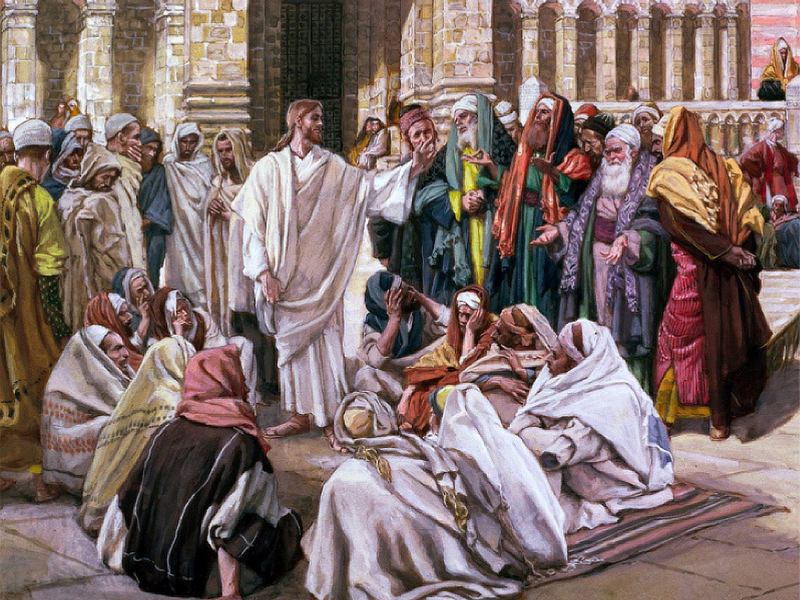
“Woe to you, scribes and Pharisees, you hypocrites.
You lock the Kingdom of heaven before men.
You do not enter yourselves,
nor do you allow entrance to those trying to enter.
“Woe to you, scribes and Pharisees, you hypocrites.
You traverse sea and land to make one convert,
and when that happens you make him a child of Gehenna
twice as much as yourselves.
“Woe to you, blind guides, who say,
‘If one swears by the temple, it means nothing,
but if one swears by the gold of the temple, one is obligated.’
Blind fools, which is greater, the gold,
or the temple that made the gold sacred?
And you say, ‘If one swears by the altar, it means nothing,
but if one swears by the gift on the altar, one is obligated.’
You blind ones, which is greater, the gift,
or the altar that makes the gift sacred?
One who swears by the altar swears by it and all that is upon it;
one who swears by the temple swears by it
and by him who dwells in it;
one who swears by heaven swears by the throne of God
and by him who is seated on it.”
Commentary
For the next three days, we hear the famous “Woes” that Jesus pronounced. Matthew presents eight of them, as if paralleling the eight “Beatitudes” or blessings that Jesus had proclaimed earlier (Matt 5: 3-12). They are indeed burdensome woes, made heavier by the fact that they are pronounced by Jesus who rarely quarrels or cries out (Matt 12:19; Is 42:2) and is gentle and humble of heart (Matt 11:29). Jesus came to bless and, if he is forced to condemn, there can be no greater woe for a person.
In today’s reading, Jesus’s sadness and anger blaze against people who not only refuse to enter the Kingdom, but prevent others from entering it either. It is bad enough to reject the good news; and it cannot get any worse when one deliberately prevents others from accepting the gospel even when they want to. Let us examine our hearts and see if our words and deeds prevent God’s people from receiving the good news and entering the Kingdom.
Blessing
We are to be pitied as Christians if we think we can save ourselves by outward practices. What saves us, what makes us God’s sons and daughters, is our love of God and neighbour, how we live our daily life in closeness to the Lord. May almighty God bless you, the Father, and the Son, and the Holy Spirit. Amen!