

COME AND SEE
Introduction
“Come and see,” says Jesus to the two disciples of John who were curious about him. They came and saw their Saviour and followed him. “Come and see.” Would that we could say the same to people today and show them Christ present in our midst. Would they find him among us? And do we ourselves recognize Christ passing among us?
1 Reading: 1 John 3:7-10
Children, let no one deceive you. The person who acts in righteousness is righteous, just as he is righteous. Whoever sins belongs to the Devil, because the Devil has sinned from the beginning. Indeed, the Son of God was revealed to destroy the works of the Devil. No one who is begotten by God commits sin, because God’s seed remains in him; he cannot sin because he is begotten by God. In this way, the children of God and the children of the Devil are made plain; no one who fails to act in righteousness belongs to God, nor anyone who does not love his brother.
Responsorial Psalm: PS 98:1, 7-8, 9
R. (3cd) All the ends of the earth have seen the saving power of God.
Sing to the LORD a new song,
for he has done wondrous deeds;
His right hand has won victory for him,
his holy arm. R.
Let the sea and what fills it resound,
the world and those who dwell in it;
Let the rivers clap their hands,
the mountains shout with them for joy before the LORD. R.
The LORD comes;
he comes to rule the earth;
He will rule the world with justice
and the peoples with equity. R.
Alleluia Hebrews 1:1-2
R. Alleluia, alleluia.
In the past God spoke to our ancestors through the prophets:
in these last days, he has spoken to us through the Son.
R. Alleluia, alleluia.
Gospel: John 1:35-42
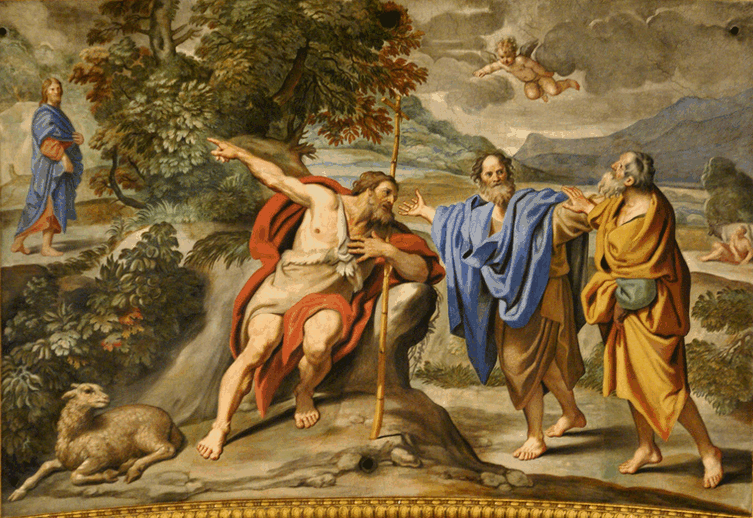
John was standing with two of his disciples, and as he watched Jesus walk by, he said, “Behold, the Lamb of God.” The two disciples heard what he said and followed Jesus. Jesus turned and saw them following him and said to them, “What are you looking for?” They said to him, “Rabbi” (which translated means Teacher), “where are you staying?” He said to them, “Come, and you will see.” So they went and saw where he was staying, and they stayed with him that day. It was about four in the afternoon. Andrew, the brother of Simon Peter, was one of the two who heard John and followed Jesus. He first found his own brother Simon and told him, “We have found the Messiah,” which is translated Christ. Then he brought him to Jesus. Jesus looked at him and said, “You are Simon the son of John; you will be called Cephas,” which is translated Peter.
Commentary
Today the gospel of John claims that the person who belongs to Christ cannot sin. This is in seeming contradiction to his earlier statement that we all sin and cannot claim that we are innocent (1:8). Here John speaks of a sinful way of life, not the occasional mishaps that befall all of us (5:16f). In other words, we set ourselves on the right course and strive to adhere to it. That is a sinless way of life. For John there are only two possibilities: to choose death and abandon Christ or to choose life and remain with the Lord on our earthly journey, occasional mishaps notwithstanding.
This all corresponds well with the call of the first disciples in today’s Gospel. Two of them, one of whom is Andrew, ask Jesus, “Where are you staying?” The question can be read on two levels, one regarding Jesus’ place of residence; the other, the divine indwelling. The truth is that Jesus “stays” in the Father and the Father in him. In “coming” and “seeing,” the disciples are invited to a deeper life in God. Later, Andrew goes to his brother Simon and claims to have met the Messiah. The journey of faith has begun.
It is interesting to note that the first disciples are not said to be fishermen. In John there are no boats or nets; they are simply disciples of the Baptist, who pass from him to the Lord. In the synoptic tradition, Simon’s change of name comes later. In John, Jesus calls him Cephas (“Peter”) right away.
The passage from sin to grace, from Satan to Christ, is a matter of choice. But once undertaken, it represents a complete transition. It is as different from a sinful way of life as darkness is from light. The Christmas season reminds us of what that choice has meant in our own lives.
We are often saddened when people dear to us no longer walk the path of faith, when the Eucharist and the other sacraments no longer have meaning for them. Yet prayer can work wonders, as St. Monica discovered after years of praying for her son St. Augustine. In our love for those whose faith has grown dim, let us never fail to bring them before the Lord. At the same time, we are grateful to know where the Lord “is staying.” We too dwell with Father, Son, and Spirit in the household of God.
Blessing
“We have found the Saviour,” exclaims the apostle. We too have found him. May this be our joy and prompt us to tell others about it. May all of us find him, with the blessing of almighty God, the Father, and the Son, and the Holy Spirit. Amen!