

Last Day Of The Year… It’s Last Hours.. We’re Crossing-Over!!!
Introduction
Today, the liturgy fits in very well with the celebration of New Year’s Eve: it both looks forward to the end of time (1st Reading) and back to the beginning: to the Word that created all and came among people as the living Word, Jesus, to make a new beginning with us. And that’s life: the end of what is past, a new beginning to be made ever anew. It was mixture of joys shared together and miseries that were lighter when they too were borne together. And a time for which we are grateful to one another and to God. A turning point is also a time of hope. The past is gone; we look forward. We say goodbye and we welcome what is coming with hope, for the Lord is with us; we resume our journey together as God’s pilgrim people.
1 Reading: 1 John 2:18-21
Children, it is the last hour; and just as you heard that the antichrist was coming, so now many antichrists have appeared. Thus we know this is the last hour. They went out from us, but they were not really of our number; if they had been, they would have remained with us. Their desertion shows that none of them was of our number. But you have the anointing that comes from the Holy One, and you all have knowledge. I write to you not because you do not know the truth but because you do, and because every lie is alien to the truth.
Responsorial Psalm: Ps 96:1-2, 11-12, 13
R. (11a) Let the heavens be glad and the earth rejoice!
Sing to the LORD a new song;
sing to the LORD, all you lands.
Sing to the LORD; bless his name;
announce his salvation, day after day. R.
Let the heavens be glad and the earth rejoice;
let the sea and what fills it resound;
let the plains be joyful and all that is in them!
Then shall all the trees of the forest exult before the LORD. R.
The LORD comes,
he comes to rule the earth.
He shall rule the world with justice
and the peoples with his constancy. R.
Alleluia: John 1:14a, 12a
R. Alleluia, alleluia.
The Word of God became flesh and dwelt among us.
To those who accepted him
he gave power to become the children of God.
R. Alleluia, alleluia.
Gospel: John 1:1-18
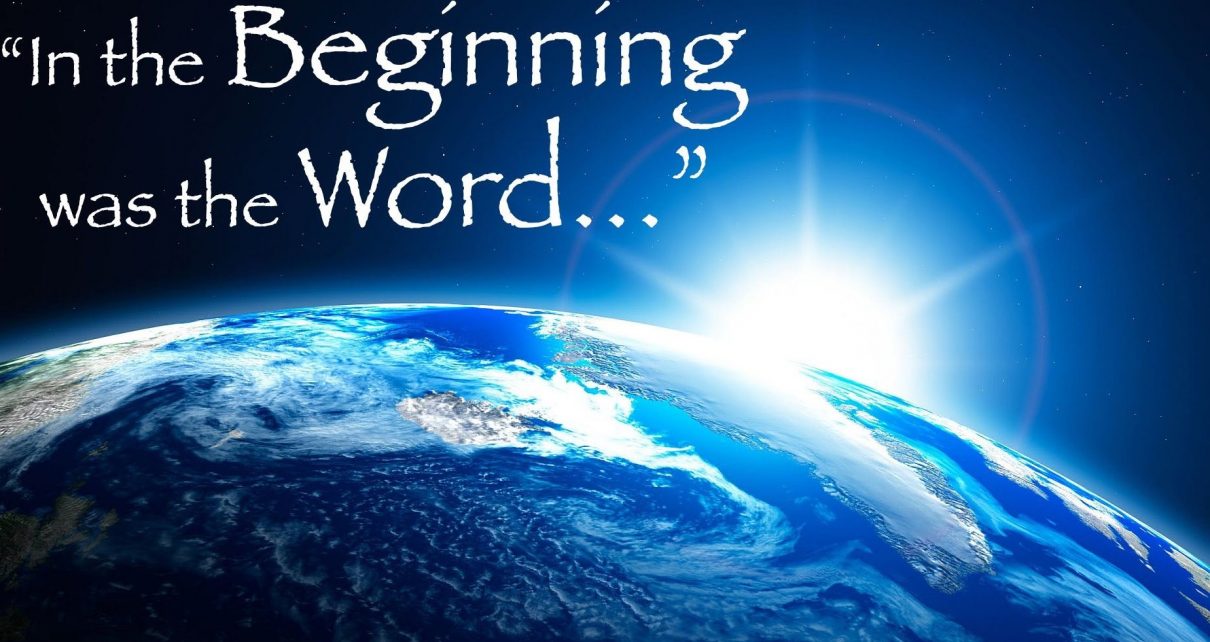
In the beginning was the Word, and the Word was with God, and the Word was God. He was in the beginning with God. All things came to be through him, and without him nothing came to be. What came to be through him was life, and this life was the light of the human race; the light shines in the darkness, and the darkness has not overcome it. A man named John was sent from God. He came for testimony, to testify to the light, so that all might believe through him. He was not the light, but came to testify to the light. The true light, which enlightens everyone, was coming into the world. He was in the world, and the world came to be through him, but the world did not know him. He came to what was his own, but his own people did not accept him. But to those who did accept him he gave power to become children of God, to those who believe in his name, who were born not by natural generation nor by human choice nor by a man’s decision but of God. And the Word became flesh and made his dwelling among us, and we saw his glory, the glory as of the Father’s only-begotten Son, full of grace and truth. John testified to him and cried out, saying, “This was he of whom I said, ‘The one who is coming after me ranks ahead of me because he existed before me.'” From his fullness we have all received, grace in place of grace, because while the law was given through Moses, grace and truth came through Jesus Christ. No one has ever seen God. The only-begotten Son, God, who is at the Father’s side, has revealed him.
Commentary
The prologue to John’s Gospel, read on Christmas day and repeated at today’s Mass, offers four points for our reflection. First, it highlights the eternity of Jesus Christ. In fact he is actually called God, an unusual designation in the New Testament since “God” was initially seen as applying only to Yahweh. In his eternal Godhead, Jesus is present with the Father in the whole process of creation. In fact, as God’s wisdom, he is the blueprint that guides the whole creative process.
Second, Jesus enters the world as the life giver; he confers the Spirit, described variously in John’s Gospel as light, life, or water. It is the Spirit that lifts humans to a whole new plateau of existence; it is life in God. If the law given to Moses was a gift, the life of the Spirit is called simply “grace and truth.”
Third, Jesus came in the flesh. Contrary to some of the thinking within the early Johannine community, he was not simply an apparition or vision. To those who looked with disdain on anything human or material (perhaps those identified with the antichrists of today’s epistle), there was only one response. “The Word became flesh and lived among us” (John 1:14). He was man in the full sense of the term.
Finally, John the Baptist was not the light, as some may have suggested. He had a clearly subordinate role as the forerunner, the one who prepared the way of the Lord. There is some New Testament evidence for a strong advocacy of John’s baptism, perhaps because Christ himself had received it. The Gospel of John, however, is clearly interested in setting the record straight.
While John is rich in its very positive approach, it has a very distinctive apologetic. It wants to uphold the eternity of Christ while never losing sight of his humanity. He is the saviour and life giver in a way that far outdistances anyone from Moses to John the Baptist. When we consider all that the term “Jesus Christ” connotes, it is not surprising that there were some failures in articulating the Lord and his mission adequately in the early years of the church’s life. But error often leads to gain—in this case, a clearer expression of belief. The prologue to John’s Gospel, even with its soaring beauty, serves a very practical purpose.
Blessing
Let us go in the peace of the Lord. May the Lord be with you wherever you go. May he bless your coming and your going, your work and your care, your joys and your suffering. As he blessed you the past year 2019, may he bless you even more in the new year 2020: the Father, and the Son, and the Holy Spirit. Amen!