

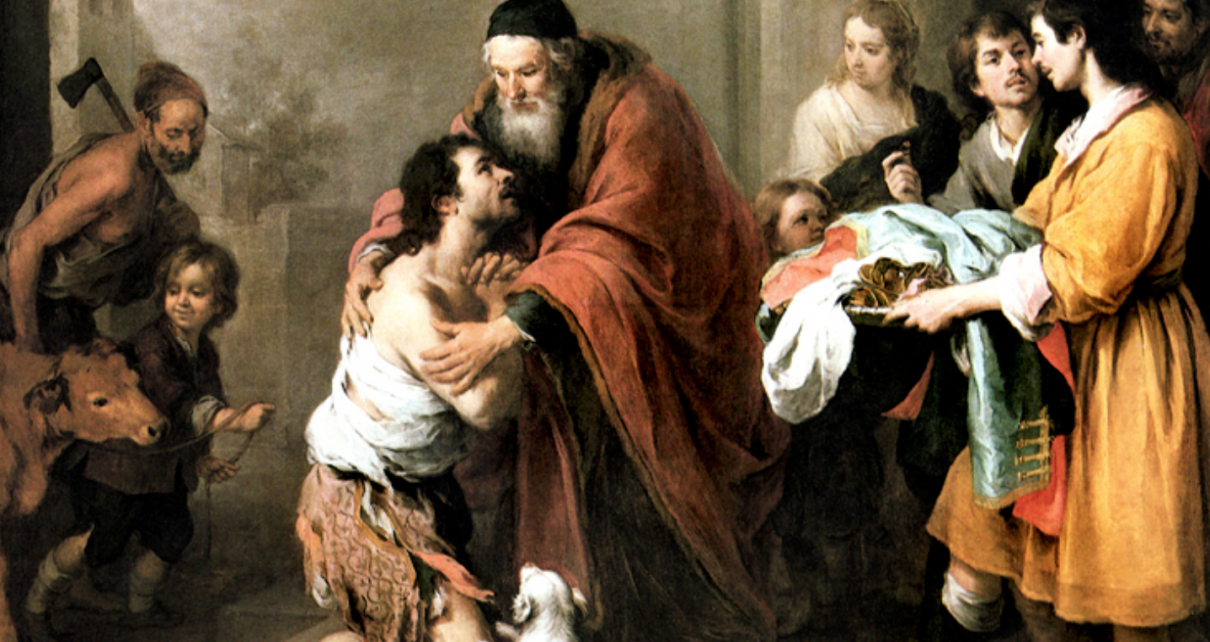
A God Prodigal In His Mercy
Introduction
When we forgive those who have hurt us, often some scars remain and take a long time to heal. Even if we have not personally suffered from a crime, we cry for blood and vengeance in the name of society, and we don’t treat a released prisoner or sinner who has made up for his failure as if he had done no wrong. But God does. He remains faithful to the love once given. He comes forward both to welcome the returning sinner and to invite the brother or sister who has a hard time to welcome his lost brother or sister to share in the joy of forgiveness and his return.
1 Reading: Micah 7:14-15, 18-20
Shepherd your people with your staff,
the flock of your inheritance,
That dwells apart in a woodland,
in the midst of Carmel.
Let them feed in Bashan and Gilead,
as in the days of old;
As in the days when you came from the land of Egypt,
show us wonderful signs.
Who is there like you, the God who removes guilt
and pardons sin for the remnant of his inheritance;
Who does not persist in anger forever,
but delights rather in clemency,
And will again have compassion on us,
treading underfoot our guilt?
You will cast into the depths of the sea all our sins;
You will show faithfulness to Jacob,
and grace to Abraham,
As you have sworn to our fathers
from days of old.
Responsorial Psalm 103:1-2, 3-4, 9-10, 11-12
R. (8a) The Lord is kind and merciful.
Bless the LORD, O my soul;
and all my being, bless his holy name.
Bless the LORD, O my soul,
and forget not all his benefits.
R. The Lord is kind and merciful.
He pardons all your iniquities,
he heals all your ills.
He redeems your life from destruction,
he crowns you with kindness and compassion.
R. The Lord is kind and merciful.
He will not always chide,
nor does he keep his wrath forever.
Not according to our sins does he deal with us,
nor does he requite us according to our crimes.
R. The Lord is kind and merciful.
For as the heavens are high above the earth,
so surpassing is his kindness toward those who fear him.
As far as the east is from the west,
so far has he put our transgressions from us.
R. The Lord is kind and merciful.
Verse before the Gospel: Luke 15:18
I will get up and go to my father and shall say to him,
Father, I have sinned against heaven and against you.
Gospel: Luke 15:1-3, 11-32
Tax collectors and sinners were all drawing near to listen to Jesus,
but the Pharisees and scribes began to complain, saying,
“This man welcomes sinners and eats with them.”
So to them Jesus addressed this parable.
“A man had two sons, and the younger son said to his father,
‘Father, give me the share of your estate that should come to me.’
So the father divided the property between them.
After a few days, the younger son collected all his belongings
and set off to a distant country
where he squandered his inheritance on a life of dissipation.
When he had freely spent everything,
a severe famine struck that country,
and he found himself in dire need.
So he hired himself out to one of the local citizens
who sent him to his farm to tend the swine.
And he longed to eat his fill of the pods on which the swine fed,
but nobody gave him any.
Coming to his senses he thought,
‘How many of my father’s hired workers
have more than enough food to eat,
but here am I, dying from hunger.
I shall get up and go to my father and I shall say to him,
“Father, I have sinned against heaven and against you.
I no longer deserve to be called your son;
treat me as you would treat one of your hired workers.”‘
So he got up and went back to his father.
While he was still a long way off,
his father caught sight of him, and was filled with compassion.
He ran to his son, embraced him and kissed him.
His son said to him,
‘Father, I have sinned against heaven and against you;
I no longer deserve to be called your son.’
But his father ordered his servants,
‘Quickly, bring the finest robe and put it on him;
put a ring on his finger and sandals on his feet.
Take the fattened calf and slaughter it.
Then let us celebrate with a feast,
because this son of mine was dead, and has come to life again;
he was lost, and has been found.’
Then the celebration began.
Now the older son had been out in the field
and, on his way back, as he neared the house,
he heard the sound of music and dancing.
He called one of the servants and asked what this might mean.
The servant said to him,
‘Your brother has returned
and your father has slaughtered the fattened calf
because he has him back safe and sound.’
He became angry,
and when he refused to enter the house,
his father came out and pleaded with him.
He said to his father in reply,
‘Look, all these years I served you
and not once did I disobey your orders;
yet you never gave me even a young goat to feast on with my friends.
But when your son returns
who swallowed up your property with prostitutes,
for him you slaughter the fattened calf.’
He said to him,
‘My son, you are here with me always;
everything I have is yours.
But now we must celebrate and rejoice,
because your brother was dead and has come to life again;
he was lost and has been found.'”
Commentary
This well-known Gospel story is named after the wayward son, not because of his sterling qualities, but because of the forgiveness showered upon him by a gracious and loving father. The story illustrates the teaching of Micah in today’s first reading. Ours is a God who does not persist in anger but delights in clemency, the one who is compassionate and treads guilt underfoot.
The younger son not only makes a mistake but persists in wrongdoing. He squanders his inheritance, is left without income, and finally engages in an unsavory occupation for a Jewish man: feeding pigs. Without any real sense of sorrow, he realizes that even the employees on his father’s estate are better off than he. Deciding to return home, he prepares, a short speech admitting his guilt and sets forth. Upon his approach, the father, throwing convention to the wind and with a complete loss of composure, runs to greet his son, does not allow the short speech to be given in its entirety, and restores his son to his former status. Finally, he prepares a major homecoming feast. He asks no question but gives unqualified acceptance.
The reaction of the other son is, in a sense, quite understandable. He has always rendered valuable service to his father, has never wavered from his sense of duty, and has never been feted like his “never do well” brother. In speaking with his father, he does not refer to the returning son as “my brother,” only “this son of yours.” But his father subtly corrects him: “This brother of yours was dead.” By the same token, his compassion and love for his younger son is profound.
People often return to sins of the past and wonder about forgiveness. The fact is that God has long since put guilt away; there is no doubt about forgiveness; now there is only cause for rejoicing. God’s forgiveness is well described by the psalmist today: “As the heavens are high above the earth…, as far as the east is from the west.” Our theme captures this fact: the story – A God Prodigal In His Mercy.
Blessing
We have to celebrate and rejoice when brothers and sisters of ours had been dead and have come back to life through forgiveness; they were lost and have been found. Rejoice, with the blessing of almighty God, the Father, and the Son, and the Holy Spirit. Amen!