

The Truth That Haunts Us
Introduction
When the Jews celebrated the jubilee year every fiftieth year, slaves were supposed to be set free, land alienated through debts to be returned to its original owner. The idea was to allow for a radically new beginning, with respect for human rights and dignity. It was an attempt to bring about a more equitable distribution of goods within the people of God. The Christian Holy Year takes its inspiration from the Jewish Jubilee Year. For us, then, should the jubilee year not mean to create more justice within the Church, with a new start to be made, new chances offered to start from scratch? Is this not the image of the Christian life? A clean slate to start with, new reconciliation?
Would we welcome prophets better than the people in their time, even if they are right? A very old and elementary definition of truth is that “truth is bitter.” It is also so difficult to face the truth about ourselves. We feel it haunts us. Because it is difficult to change, to be open to true conversion. Let us pray in this Eucharist for the courage to face this disturbing truth.
1 Reading: Leviticus 25:1, 8-17
The LORD said to Moses on Mount Sinai, “Seven weeks of years shall you count–seven times seven years–so that the seven cycles amount to forty-nine years. Then, on the tenth day of the seventh month, let the trumpet resound; on this, the Day of Atonement, the trumpet blast shall re-echo throughout your land. This fiftieth year you shall make sacred by proclaiming liberty in the land for all its inhabitants. It shall be a jubilee for you, when every one of you shall return to his own property, every one to his own family estate. In this fiftieth year, your year of jubilee, you shall not sow, nor shall you reap the aftergrowth or pick the grapes from the untrimmed vines. Since this is the jubilee, which shall be sacred for you, you may not eat of its produce, except as taken directly from the field. “In this year of jubilee, then, every one of you shall return to his own property. Therefore, when you sell any land to your neighbour or buy any from him, do not deal unfairly. On the basis of the number of years since the last jubilee shall you purchase the land from your neighbour; and so also, on the basis of the number of years for crops, shall he sell it to you. When the years are many, the price shall be so much the more; when the years are few, the price shall be so much the less. For it is really the number of crops that he sells you. Do not deal unfairly, then; but stand in fear of your God. I, the LORD, am your God.”
Responsorial Psalm: Ps 67:2-3, 5, 7-8
R. (4) O God, let all the nations praise you!
May God have pity on us and bless us;
may he let his face shine upon us.
So may your way be known upon earth;
among all nations, your salvation. R.
May the nations be glad and exult
because you rule the peoples in equity;
the nations on the earth you guide. R.
The earth has yielded its fruits;
God, our God, has blessed us.
May God bless us,
and may all the ends of the earth fear him! R.
Alleluia: Matthew 5:10
R. Alleluia, alleluia.
Blessed are they who are persecuted for the sake of righteousness
for theirs is the Kingdom of heaven.
R. Alleluia, alleluia.
Gospel: Matthew 14:1-12
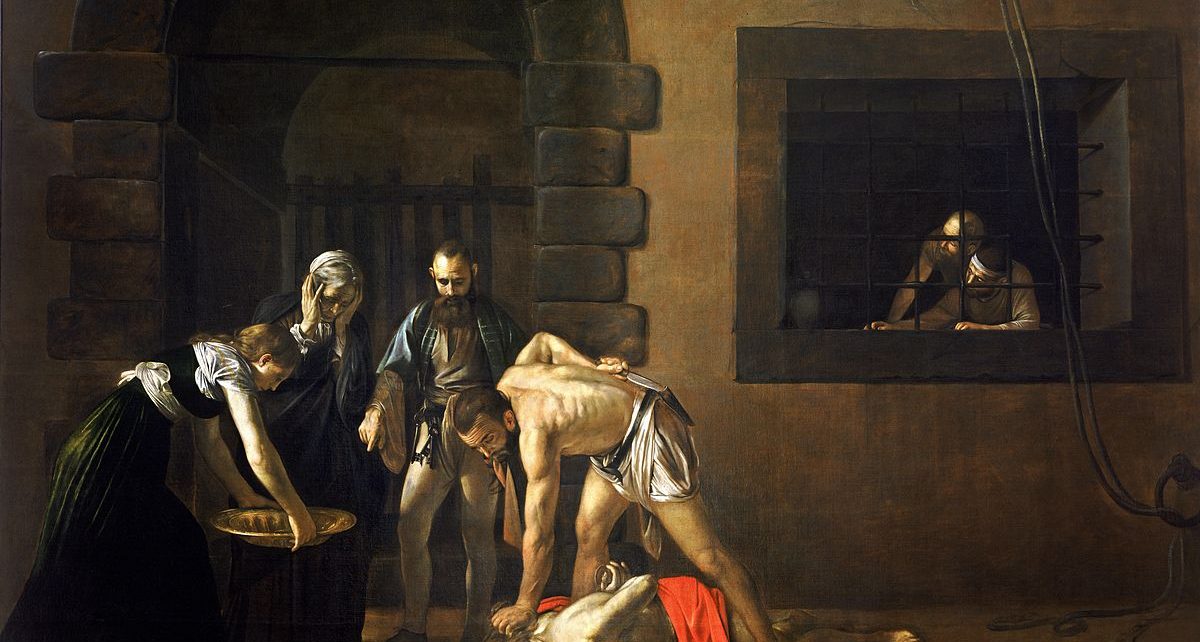
Herod the tetrarch heard of the reputation of Jesus and said to his servants, “This man is John the Baptist. He has been raised from the dead; that is why mighty powers are at work in him.” Now Herod had arrested John, bound him, and put him in prison on account of Herodias, the wife of his brother Philip, for John had said to him, “It is not lawful for you to have her.” Although he wanted to kill him, he feared the people, for they regarded him as a prophet. But at a birthday celebration for Herod, the daughter of Herodias performed a dance before the guests and delighted Herod so much that he swore to give her whatever she might ask for. Prompted by her mother, she said, “Give me here on a platter the head of John the Baptist.” The king was distressed, but because of his oaths and the guests who were present, he ordered that it be given, and he had John beheaded in the prison. His head was brought in on a platter and given to the girl, who took it to her mother. His disciples came and took away the corpse and buried him; and they went and told Jesus.
Commentary
Land and life—two basic goods that are addressed in today’s readings. The fiftieth or Jubilee year was one in which private property on lease or loan reverted to its original owner. It was seen as a matter of basic justice, and personal property was not permanently alienated. The right to ownership of personal property has long been championed in the Judeo-Christian tradition.
Any political or economic system that denies people the right to property has not long endured. But this is not a right without limits. We have a right to what we need, not the right to accumulate property as desired.
Wars have been fought against the tyranny of denying the right of ownership, as well as against landowners who overran the poor to have more for personal gain. The right to private property is not limitless. That John the Baptist should lose his life under such tawdry conditions only adds to the pain and insult. Herod was moved to take his life because of the insistence of a dancing stepdaughter and her scheming mother. It all takes place in the context of Herod’s birthday party.
Excesses in food and drink can produce great tragedy. The one whom Jesus thought of as the greatest ever born of women died because of a woman’s whim, with no serious charge brought against him. A lack of discretion often accompanies excessive consumption of alcohol. It is one of those cases where forewarned is forearmed. The best time to take crucial decisions is not when angry, neither in merry mood, when tipsy, or worse tupsy.
Blessing
We should appreciate jubilees. We are accustomed to consider them as conclusions of a long era, a crowning event. In fact, a jubilee is meant to be a new starting point. Embracing the truth. May almighty God bless you, the Father, and the Son, and the Holy Spirit. Amen!