

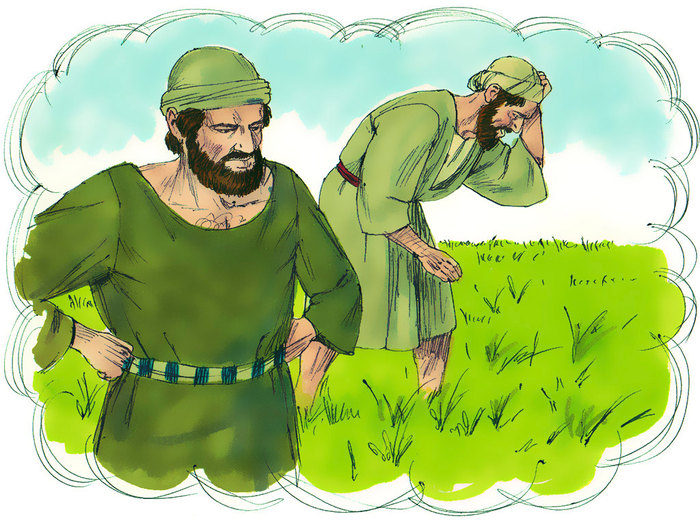
WHICH WEED DO YOU FEED IN YOUR HEART?
Introduction
Jeremiah decries the people’s attachment to false securities: the temple, their religious practices. For their attitude in life does not correspond to the words that they give to God. Mere lip service. They do not seek God, for they are unjust to their brothers and sisters, oppress and exploit them. Their formalism will not save them. Neither will the false securities of formalistic religion save us.
All around us, but in our hearts as well, weeds are growing together with the wheat – the bad with the good. This is life, and it is not easy to take. We see first of all the weeds growing in the garden of our neighbour, and we want him to pull them out. But we should look into our own hearts as well. What to do? To pluck out the bad as best as we can. And not to be upset that, after all, we are not entirely good. We have to live with it in faith and in hope and leave it all in the hands of God.
1 Reading Jeremiah 7:1-11
The following message came to Jeremiah from the LORD:
Stand at the gate of the house of the LORD,
and there proclaim this message:
Hear the word of the LORD, all you of Judah
who enter these gates to worship the LORD!
Thus says the LORD of hosts, the God of Israel:
Reform your ways and your deeds,
so that I may remain with you in this place.
Put not your trust in the deceitful words:
“This is the temple of the LORD!
The temple of the LORD! The temple of the LORD!”
Only if you thoroughly reform your ways and your deeds;
if each of you deals justly with his neighbour;
if you no longer oppress the resident alien,
the orphan, and the widow;
if you no longer shed innocent blood in this place,
or follow strange gods to your own harm,
will I remain with you in this place,
in the land I gave your fathers long ago and forever.
But here you are, putting your trust in deceitful words to your own loss!
Are you to steal and murder, commit adultery and perjury,
burn incense to Baal,
go after strange gods that you know not,
and yet come to stand before me
in this house which bears my name, and say:
“We are safe; we can commit all these abominations again”?
Has this house which bears my name
become in your eyes a den of thieves?
I too see what is being done, says the LORD.
Responsorial Psalm 84:3, 4, 5-6a and 8a, 11
R. (2) How lovely is your dwelling place, Lord, mighty God!
My soul yearns and pines
for the courts of the LORD.
My heart and my flesh
cry out for the living God.
R. How lovely is your dwelling place, Lord, mighty God!
Even the sparrow finds a home,
and the swallow a nest
in which she puts her young—
Your altars, O LORD of hosts,
my king and my God!
R. How lovely is your dwelling place, Lord, mighty God!
Blessed they who dwell in your house!
continually they praise you.
Blessed the men whose strength you are!
They go from strength to strength.
R. How lovely is your dwelling place, Lord, mighty God!
I had rather one day in your courts
than a thousand elsewhere;
I had rather lie at the threshold of the house of my God
than dwell in the tents of the wicked.
R. How lovely is your dwelling place, Lord, mighty God!
Alleluia James 1:21bc
R. Alleluia, alleluia.
Humbly welcome the word that has been planted in you
and is able to save your souls.
R. Alleluia, alleluia.
Gospel Matthew 13:24-30
Jesus proposed a parable to the crowds.
“The Kingdom of heaven may be likened to a man
who sowed good seed in his field.
While everyone was asleep his enemy came
and sowed weeds all through the wheat, and then went off.
When the crop grew and bore fruit, the weeds appeared as well.
The slaves of the householder came to him and said,
‘Master, did you not sow good seed in your field?
Where have the weeds come from?’
He answered, ‘An enemy has done this.’
His slaves said to him, ‘Do you want us to go and pull them up?’
He replied, ‘No, if you pull up the weeds
you might uproot the wheat along with them.
Let them grow together until harvest;
then at harvest time I will say to the harvesters,
“First collect the weeds and tie them in bundles for burning;
but gather the wheat into my barn.”‘”
Commentary
If the field where the seed is sown is our heart, and the wheat and the weed are found there, how do we deal with them, without causing any damage to the wheat? How can we ensure that at harvest there would be mostly wheat and very little weed, without causing any internal violence? Recalling a popular Native American story can help:
An elderly Native American was teaching his grandchildren about life, saying, “There is a fight going on inside me. It is a terrible fight and it is between two wolves. One wolf is bad and evil—he creates anger, fear, envy, despair, greed, arrogance, guilt, lies, false pride, resentment, and competition in me. The other is good and noble—he generates love, faith, peace, joy, hope, humility, kindness, friendship, generosity, truthfulness, and compassion in me. You too have this same fight going on inside you. In fact, the fight goes on inside every person on earth.” The kids thought about it for a moment and then one of them asked, “Which wolf will win, grandpa?” The grandfather replied, “The one you feed.” The question is for us then: which of the wolves do you feed?
Blessing
God is patient with us. He gives us the time to heal and to grow. Let us show the same care and patience with one another, and may almighty God bless you, the Father, and the Son, and the Holy Spirit. Amen!