

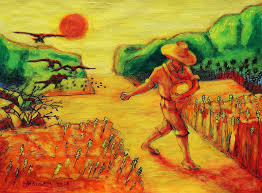
The Word of God as seed that grows and bears fruit in us
Introduction
How will the dead rise? A person dies but dies like a seed and from that seed a new plant is born and rises in glory.
We hear today Luke’s version of the parable of the seed. In Jesus’ original intent it pictured the difficult growth of the kingdom towards its final accomplishment, of which also Paul speaks in the first reading. Luke applies it in the explanation of the parable to the reception of the word of God and the life of faith in people’s hearts. God sows the seed, but people receive it differently and react to it in various ways, for it is hard to let it grow and remain loyal to it in the humble and sometimes difficult realities of daily life. How does God’s word grow and bear fruit in us?
1 Reading 1 Corinthians 15:35-37, 42-49
Brothers and sisters:
Someone may say, “How are the dead raised?
With what kind of body will they come back?”
You fool!
What you sow is not brought to life unless it dies.
And what you sow is not the body that is to be
but a bare kernel of wheat, perhaps, or of some other kind.
So also is the resurrection of the dead.
It is sown corruptible; it is raised incorruptible.
It is sown dishonourable; it is raised glorious.
It is sown weak; it is raised powerful.
It is sown a natural body; it is raised a spiritual body.
If there is a natural body, there is also a spiritual one.
So, too, it is written,
“The first man, Adam, became a living being,”
the last Adam a life-giving spirit.
But the spiritual was not first;
rather the natural and then the spiritual.
The first man was from the earth, earthly;
the second man, from heaven.
As was the earthly one, so also are the earthly,
and as is the heavenly one, so also are the heavenly.
Just as we have borne the image of the earthly one,
we shall also bear the image of the heavenly one.
Responsorial Psalm 56:10c-12, 13-14
R. (14) I will walk in the presence of God, in the light of the living.
Now I know that God is with me.
In God, in whose promise I glory,
in God I trust without fear;
what can flesh do against me?
R. I will walk in the presence of God, in the light of the living.
I am bound, O God, by vows to you;
your thank offerings I will fulfil.
For you have rescued me from death,
my feet, too, from stumbling;
that I may walk before God in the light of the living.
R. I will walk in the presence of God, in the light of the living.
Alleluia Luke 8:15
R. Alleluia, alleluia.
Blessed are they who have kept the word with a generous heart
and yield a harvest through perseverance.
R. Alleluia, alleluia.
Gospel Luke 8:4-15
When a large crowd gathered, with people from one town after another
journeying to Jesus, he spoke in a parable.
“A sower went out to sow his seed.
And as he sowed, some seed fell on the path and was trampled,
and the birds of the sky ate it up.
Some seed fell on rocky ground, and when it grew,
it withered for lack of moisture.
Some seed fell among thorns,
and the thorns grew with it and choked it.
And some seed fell on good soil, and when it grew,
it produced fruit a hundredfold.”
After saying this, he called out,
“Whoever has ears to hear ought to hear.”
Then his disciples asked him
what the meaning of this parable might be.
He answered,
“Knowledge of the mysteries of the Kingdom of God
has been granted to you;
but to the rest, they are made known through parables
so that they may look but not see, and hear but not understand.
“This is the meaning of the parable.
The seed is the word of God.
Those on the path are the ones who have heard,
but the Devil comes and takes away the word from their hearts
that they may not believe and be saved.
Those on rocky ground are the ones who, when they hear,
receive the word with joy, but they have no root;
they believe only for a time and fall away in time of temptation.
As for the seed that fell among thorns,
they are the ones who have heard, but as they go along,
they are choked by the anxieties and riches and pleasures of life,
and they fail to produce mature fruit.
But as for the seed that fell on rich soil,
they are the ones who, when they have heard the word,
embrace it with a generous and good heart,
and bear fruit through perseverance.”
Commentary
“So that ‘they may see but not perceive…’” This is a very puzzling phrase; it suggests that Jesus tells parable in order to hide the meaning of what he is saying. Matthew (13:13) says the opposite: Jesus speaks in parable because people are unable to understand. The question of images and parables in spirituality is a real one. Through visible things, as the Liturgy says, “we are caught up in the love of what we cannot see.” Therefore, images (and stories, parables, etc.) have an important role. At the same time, we read in St John of the Cross (and the author of the Cloud of Unknowing, and others) that we should pay no attention to images – even sacred images; and Eckhart tells us to enter into the depths of our soul, “where no image ever shone in.” As in everything, it has to do with stages and timing. There is a time for absorbing images and a time for going beyond them, embracing Christ in an interior encounter. From, there, the seed bears fruit abundantly.
Blessing
Let the seed of God’s word fall in the good soil of our eager and receptive hearts, and may almighty God bless you, the Father, and the Son, and the Holy Spirit. Amen!