

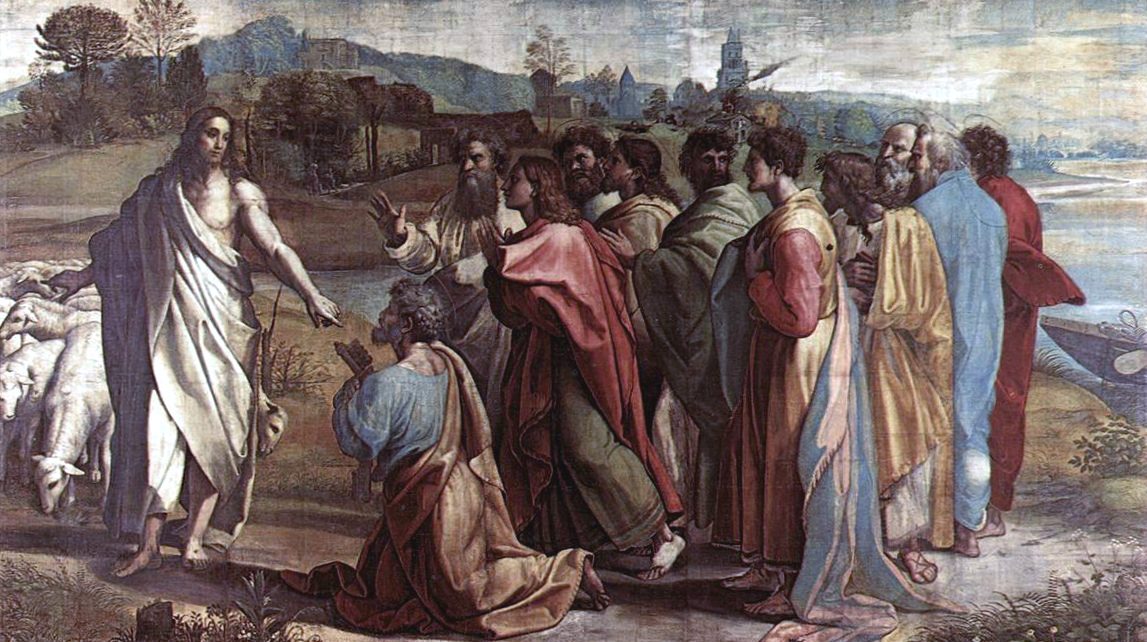
Feed And Tend My Sheep
1. Encountering the Risen Lord
2. Do You Love Me?
Introduction
1. Encountering the Risen Lord
Perhaps we envy the apostles for having seen and experienced Jesus after he had risen from the dead. There is no reason to be envious of them: If we have faith, we too experience him as risen, alive, present, and sharing our life. If we have faith we know he is there when we suffer mishaps and failures or when we rejoice. If we have faith, we know Jesus is there when we strengthen and encourage one another. If we have faith, we know Jesus is with us when we share a meal of friendship, and, especially and deeply, when we eat together from the table of the Eucharist. Lift up your heads and be happy: the risen Lord is with us in life.
2. Do You Love Me?
If Jesus would ask you today: “How close am I to you? Do you really love me?” what answer could you give him? There have certainly been times when we offended and betrayed him by our sins. I hope that you still dare to answer: “Jesus, notwithstanding my weakness and my occasional cowardice (which you know very well), I still want to say that I believe in you and that I love you. I know you keep loving me and I want to keep loving you.”
First Reading: We Bear Witness That Jesus Is Our Guide and Saviour
No threats from the powerful can silence a Church that bears witness to the risen Lord. Like the apostles, we can count on the strength of the Holy Spirit.
1 Reading: Acts 5:27-32, 40b-41
When the captain and the court officers had brought the apostles in
and made them stand before the Sanhedrin,
the high priest questioned them,
“We gave you strict orders, did we not,
to stop teaching in that name?
Yet you have filled Jerusalem with your teaching
and want to bring this man’s blood upon us.”
But Peter and the apostles said in reply,
“We must obey God rather than men.
The God of our ancestors raised Jesus,
though you had him killed by hanging him on a tree.
God exalted him at his right hand as leader and saviour
to grant Israel repentance and forgiveness of sins.
We are witnesses of these things,
as is the Holy Spirit whom God has given to those who obey him.”
The Sanhedrin ordered the apostles
to stop speaking in the name of Jesus, and dismissed them.
So they left the presence of the Sanhedrin,
rejoicing that they had been found worthy
to suffer dishonor for the sake of the name.
Responsorial Psalm: Ps 30:2, 4, 5-6, 11-12, 13
R. (2a) I will praise you, Lord, for you have rescued me. or: R. Alleluia.
I will extol you, O LORD, for you drew me clear
and did not let my enemies rejoice over me.
O LORD, you brought me up from the netherworld;
you preserved me from among those going down into the pit. R.
Sing praise to the LORD, you his faithful ones,
and give thanks to his holy name.
For his anger lasts but a moment;
a lifetime, his good will.
At nightfall, weeping enters in,
but with the dawn, rejoicing. R.
Hear, O LORD, and have pity on me;
O LORD, be my helper.
You changed my mourning into dancing;
O LORD, my God, forever will I give you thanks. R.
Second Reading: All Glory to the Lamb That Was Sacrificed
The apostle John encourages his persecuted Christians with a vision from heaven. There he sees Jesus in his glory. Though Jesus was slain, he is alive and glorious. Those brought to life by him share in his risen life and victory.
2 Reading: Revelation 5:11-14
I, John, looked and heard the voices of many angels
who surrounded the throne
and the living creatures and the elders.
They were countless in number, and they cried out in a loud voice:
“Worthy is the Lamb that was slain
to receive power and riches, wisdom and strength,
honor and glory and blessing.”
Then I heard every creature in heaven and on earth
and under the earth and in the sea,
everything in the universe, cry out:
“To the one who sits on the throne and to the Lamb
be blessing and honor, glory and might,
forever and ever.”
The four living creatures answered, “Amen,”
and the elders fell down and worshiped.
Alleluia
R. Alleluia, alleluia.
Christ is risen, creator of all;
he has shown pity on all people.
R. Alleluia, alleluia.
Gospel: It Is the Lord!
The apostles were toiling, apparently without success. They did not recognize the Lord’s presence. But he was really with them, as he is with us, to give us strength and hope.
Gospel: John 21:1-19
At that time, Jesus revealed himself again to his disciples at the Sea of Tiberias.
He revealed himself in this way.
Together were Simon Peter, Thomas called Didymus,
Nathanael from Cana in Galilee,
Zebedee’s sons, and two others of his disciples.
Simon Peter said to them, “I am going fishing.”
They said to him, “We also will come with you.”
So they went out and got into the boat,
but that night they caught nothing.
When it was already dawn, Jesus was standing on the shore;
but the disciples did not realize that it was Jesus.
Jesus said to them, “Children, have you caught anything to eat?”
They answered him, “No.”
So he said to them, “Cast the net over the right side of the boat
and you will find something.”
So they cast it, and were not able to pull it in
because of the number of fish.
So the disciple whom Jesus loved said to Peter, “It is the Lord.”
When Simon Peter heard that it was the Lord,
he tucked in his garment, for he was lightly clad,
and jumped into the sea.
The other disciples came in the boat,
for they were not far from shore, only about a hundred yards,
dragging the net with the fish.
When they climbed out on shore,
they saw a charcoal fire with fish on it and bread.
Jesus said to them, “Bring some of the fish you just caught.”
So Simon Peter went over and dragged the net ashore
full of one hundred fifty-three large fish.
Even though there were so many, the net was not torn.
Jesus said to them, “Come, have breakfast.”
And none of the disciples dared to ask him, “Who are you?”
because they realized it was the Lord.
Jesus came over and took the bread and gave it to them,
and in like manner the fish.
This was now the third time Jesus was revealed to his disciples
after being raised from the dead.
When they had finished breakfast, Jesus said to Simon Peter,
“Simon, son of John, do you love me more than these?”
Simon Peter answered him, “Yes, Lord, you know that I love you.”
Jesus said to him, “Feed my lambs.”
He then said to Simon Peter a second time,
“Simon, son of John, do you love me?”
Simon Peter answered him, “Yes, Lord, you know that I love you.”
Jesus said to him, “Tend my sheep.”
Jesus said to him the third time,
“Simon, son of John, do you love me?”
Peter was distressed that Jesus had said to him a third time,
“Do you love me?” and he said to him,
“Lord, you know everything; you know that I love you.”
Jesus said to him, “Feed my sheep.
Amen, amen, I say to you, when you were younger,
you used to dress yourself and go where you wanted;
but when you grow old, you will stretch out your hands,
and someone else will dress you
and lead you where you do not want to go.”
He said this signifying by what kind of death he would glorify God.
And when he had said this, he said to him, “Follow me.”
Commentary
Three times Jesus asked Peter, “Do you love me?” People like to connect this with Peter’s triple denial of Jesus: he was being given a chance to undo the damage. In addition, something else is happening in the original language, something that doesn’t appear in English. There are several words for “love” in Greek. “Philein” means to love someone as a friend; “agapan” means to love someone in the distinctive New Testament sense: to love them unselfishly, creatively, in the way that Jesus loved. This kind of love is mysteriously deeper and wider than friendship, because it doesn’t depend on like-mindedness as friendship does; it can even reach out to include an enemy. Now, Jesus first asked Peter, “Agapas me?” (Do you love me with this kind of love?) Peter replies, “Philo se”. (I love you as a friend.) The second time around, the words are the same. But the third time, Jesus asks him, “Phileis me?” And Peter answers as before, “Philo se”. How will you feel if you ask someone if he ‘loves you’, and he replies, ‘yes, I like your person?’
There is something touching about this. Peter wasn’t yet able to love Jesus in that heroic way; he could love him only as the friend he had known for three years. But the third time around, Jesus steps down, as it were, to accept what Peter was able to offer at that time.
Can we put it this way: all forms of love and friendship are capable of advancing gradually towards to “agapè’’. How do we go along that road? By doing the best we can.
Blessing
It is good that we have become more aware
how the risen Lord is with us
not only in this Eucharist
but also in the life of every day.
Let us learn to see the signs of his presence
in the people we meet,
in the good they do to us
and all we do for one another.
May this bring you great joy
and may almighty God bless you all:
the Father, and the Son, and the Holy Spirit. R/ Amen.
Go in the joy of the Lord. Alleluia! Alleluia!
R/ Thanks be to God. Alleluia! Alleluia!