

1. God Is Pro-Life
2. Life Is Victorious
……..Talitha koum!
Introduction
1. God Is Pro-Life
Two great enemies in life are death and illness. Almost every one of us is scared of them. Are we convinced that God too is pro-life, that he is an enemy of death? Even the Old Testament assures us: “Death is not of God’s making.” Jesus’ resurrection is the sign that death has been overcome in its roots. It is the gate to life. In this Eucharist we express our faith that we believe in Jesus as the Lord of life.
2. Life Is Victorious
Almost everyone fears death and has a hard time to deal with it in faith. Life is a beautiful gift from God but it is brittle; sickness is a normal share of it and death comes as an inescapable reality. How can we reconcile this with faith in a God who has made us for life? We do not always see clearly, but we know at least this: since Christ rose from the dead, death has been overcome; it is not the end. We ask Jesus here in the Eucharist to touch us with his power of life.
First Reading: The God of Life Made Us Imperishable
God made us for life; it was sin that brought death into the world. But Christ will make life triumph over death.
1 Reading Wisdom 1:13-15; 2:23-24
God did not make death,
nor does he rejoice in the destruction of the living.
For he fashioned all things that they might have being;
and the creatures of the world are wholesome,
and there is not a destructive drug among them
nor any domain of the netherworld on earth,
for justice is undying.
For God formed man to be imperishable;
the image of his own nature he made him.
But by the envy of the devil, death entered the world,
and they who belong to his company experience it.
Responsorial Psalm 30:2, 4, 5-6, 11, 12, 13
R. (2a) I will praise you, Lord, for you have rescued me.
I will extol you, O LORD, for you drew me clear
and did not let my enemies rejoice over me.
O LORD, you brought me up from the netherworld;
you preserved me from among those going down into the pit.
R. I will praise you, Lord, for you have rescued me.
Sing praise to the LORD, you his faithful ones,
and give thanks to his holy name.
For his anger lasts but a moment;
a lifetime, his good will.
At nightfall, weeping enters in,
but with the dawn, rejoicing.
R. I will praise you, Lord, for you have rescued me.
Hear, O LORD, and have pity on me;
O LORD, be my helper.
You changed my mourning into dancing;
O LORD, my God, forever will I give you thanks.
R. I will praise you, Lord, for you have rescued me.
Second Reading: Sharing and Solidarity in the Church
Local churches that are better off should help the poorer ones, just as Christ made himself poor to make us rich.
2 Reading 2 Corinthians 8:7, 9, 13-15
Brothers and sisters:
As you excel in every respect, in faith, discourse,
knowledge, all earnestness, and in the love we have for you,
may you excel in this gracious act also.
For you know the gracious act of our Lord Jesus Christ,
that though he was rich, for your sake he became poor,
so that by his poverty you might become rich.
Not that others should have relief while you are burdened,
but that as a matter of equality
your abundance at the present time should supply their needs,
so that their abundance may also supply your needs,
that there may be equality.
As it is written:
Whoever had much did not have more,
and whoever had little did not have less.
Alleluia cf. 2 Timothy 1:10
R. Alleluia, alleluia.
Our Saviour Jesus Christ destroyed death
and brought life to light through the Gospel.
R. Alleluia, alleluia.
Gospel: Jesus Has the Power to Give Life
The power of resurrection is at work in Jesus: he restores the sick to fuller life, he brings the dead back to life.
Gospel Mark 5:21-43 or 5:21-24, 35b-43
When Jesus had crossed again in the boat
to the other side,
a large crowd gathered around him, and he stayed close to the sea.
One of the synagogue officials, named Jairus, came forward.
Seeing him he fell at his feet and pleaded earnestly with him, saying,
“My daughter is at the point of death.
Please, come lay your hands on her
that she may get well and live.”
He went off with him,
and a large crowd followed him and pressed upon him.
There was a woman afflicted with hemorrhages for twelve years.
She had suffered greatly at the hands of many doctors
and had spent all that she had.
Yet she was not helped but only grew worse.
She had heard about Jesus and came up behind him in the crowd
and touched his cloak.
She said, “If I but touch his clothes, I shall be cured.”
Immediately her flow of blood dried up.
She felt in her body that she was healed of her affliction.
Jesus, aware at once that power had gone out from him,
turned around in the crowd and asked, “Who has touched my clothes?”
But his disciples said to Jesus,
“You see how the crowd is pressing upon you,
and yet you ask, ‘Who touched me?'”
And he looked around to see who had done it.
The woman, realizing what had happened to her,
approached in fear and trembling.
She fell down before Jesus and told him the whole truth.
He said to her, “Daughter, your faith has saved you.
Go in peace and be cured of your affliction.”
While he was still speaking,
people from the synagogue official’s house arrived and said,
“Your daughter has died; why trouble the teacher any longer?”
Disregarding the message that was reported,
Jesus said to the synagogue official,
“Do not be afraid; just have faith.”
He did not allow anyone to accompany him inside
except Peter, James, and John, the brother of James.
When they arrived at the house of the synagogue official,
he caught sight of a commotion,
people weeping and wailing loudly.
So he went in and said to them,
“Why this commotion and weeping?
The child is not dead but asleep.”
And they ridiculed him.
Then he put them all out.
He took along the child’s father and mother
and those who were with him
and entered the room where the child was.
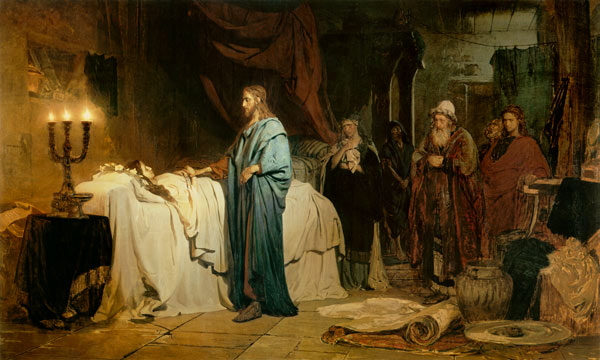
He took the child by the hand and said to her, “Talitha koum,”
which means, “Little girl, I say to you, arise!”
The girl, a child of twelve, arose immediately and walked around.
At that they were utterly astounded.
He gave strict orders that no one should know this
and said that she should be given something to eat.
Commentary:
Today’s gospel reading is a sandwiching of two healing stories: on his way to heal the little girl, Jesus heals the lady. There is something warm and very touching about these two stories and about the way they are placed here. The sandwiching of the stories gives a feeling of speed and urgency to Mark’s account: Jesus is almost stumbling over himself to heal the afflicted and bring solution to rather unsolvable issues afflicting humanity, his own creation. Yet the pressure of expectations didn’t make him impersonal or mechanical, as it does many very busy people. His affectionate expression to the little girl, “Talitha kumi!”, is retained in his own language, Aramaic. Terms of affection translate poorly, because they are more than their dictionary meaning: they are warm words.
Likewise, when the lady wanted a cure and touched his cloak rather than face him, he said, “Who touched me?” He didn’t want her cure to be anonymous; he wanted to speak to her and restore her self-worth and assurance, not just relieve her symptoms.
Blessing
We have broken bread with the Lord
and we remember his words:
Those who eat my flesh and drink my blood
have everlasting life
and I will raise them up on the last day.
God wants us to live
and Jesus nourishes this life
with the food of his own body.
Ah, we are the living!
Let us live this life to the full
and may almighty God bless you,
the Father, and the Son, and the Holy Spirit. R/ Amen.
Go in the peace of the Lord and bring his peace
and healing to one another.
R/ Thanks be to God.