

I Am Who Am. I Will Liberate You
Introduction
We pay special attention today to the first reading, in which God reveals his name to Moses. God is he who is, he who is beyond any name, but who will also be known by what he does for his people, the God who told Moses: “I will lead my people out of their misery to a land flowing with milk and honey.” He is the liberating God, whose yoke is a burden of love. God is still this God for us today: totally other, and yet nearer to the human heart than anyone else can be, because he gave us our human liberty, respects it and loves us.
The gospel assures us that Jesus is with us and that we can go to him with our burdens and questions. The weak and the poor are open to the love of Jesus, for they are aware that they are fragile and vulnerable. He will give them rest and make them aware that what Jesus asks of them is a light burden, for it is carried in love. They will find rest in him.
1 Reading: Exodus 3:13-20
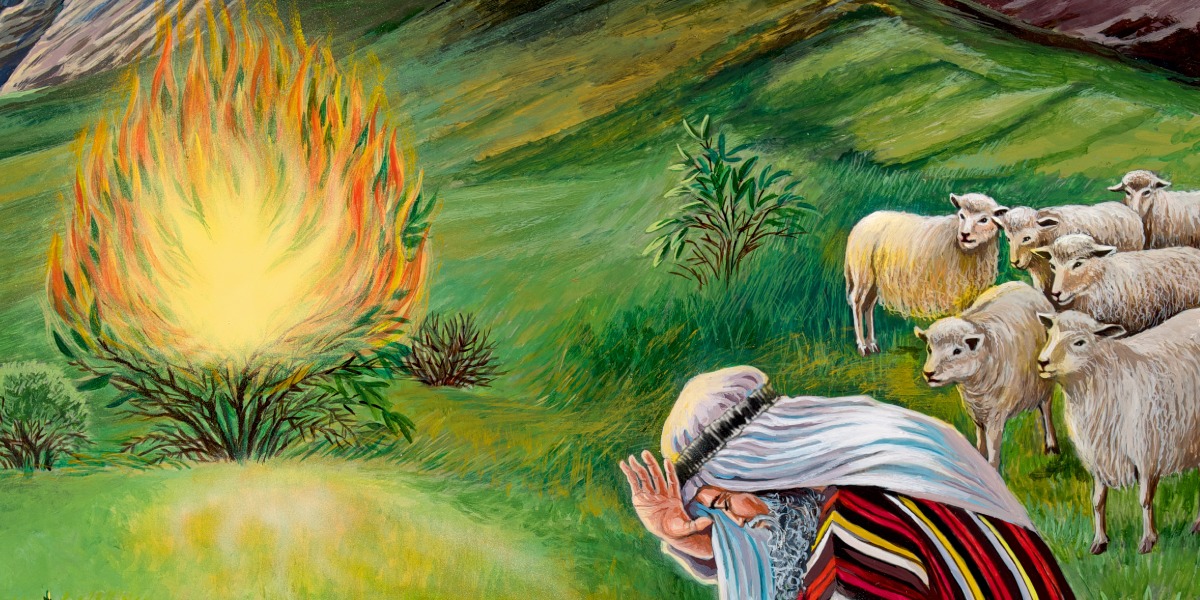
Moses, hearing the voice of the LORD from the burning bush, said to him, “When I go to the children of Israel and say to them, ‘The God of your fathers has sent me to you,’ if they ask me, ‘What is his name?’ what am I to tell them?” God replied, “I am who am.” Then he added, “This is what you shall tell the children of Israel: I AM sent me to you.” God spoke further to Moses, “Thus shall you say to the children of Israel: The LORD, the God of your fathers, the God of Abraham, the God of Isaac, the God of Jacob, has sent me to you. “This is my name forever; this my title for all generations. “Go and assemble the elders of Israel, and tell them: The LORD, the God of your fathers, the God of Abraham, Isaac, and Jacob, has appeared to me and said: I am concerned about you and about the way you are being treated in Egypt; so I have decided to lead you up out of the misery of Egypt into the land of the Canaanites, Hittites, Amorites, Perizzites, Hivites, and Jebusites, a land flowing with milk and honey. “Thus they will heed your message. Then you and the elders of Israel shall go to the king of Egypt and say to him: “The LORD, the God of the Hebrews, has sent us word. Permit us, then, to go a three-days’ journey in the desert, that we may offer sacrifice to the LORD, our God. “Yet I know that the king of Egypt will not allow you to go unless he is forced. I will stretch out my hand, therefore, and smite Egypt by doing all kinds of wondrous deeds there. After that he will send you away.”
Responsorial Psalm: Ps 105:1 and 5, 8-9, 24-25, 26-27
R. (8a) The Lord remembers his covenant for ever. or: R. Alleluia.
Give thanks to the LORD, invoke his name;
make known among the nations his deeds.
Recall the wondrous deeds that he has wrought,
his portents, and the judgments he has uttered. R.
He remembers forever his covenant
which he made binding for a thousand generations
Which he entered into with Abraham
and by his oath to Isaac. R.
He greatly increased his people
and made them stronger than their foes,
Whose hearts he changed, so that they hated his people,
and dealt deceitfully with his servants. R.
He sent Moses his servant;
Aaron, whom he had chosen.
They wrought his signs among them,
and wonders in the land of Ham. R.
Alleluia: Matthew 11:28
R. Alleluia, alleluia.
Come to me, all you who labor and are burdened,
and I will give you rest, says the Lord.
R. Alleluia, alleluia.
Gospel: Matthew 11:28-30
Jesus said: “Come to me, all you who labour and are burdened, and I will give you rest. Take my yoke upon you and learn from me, for I am meek and humble of heart; and you will find rest for yourselves. For my yoke is easy, and my burden light.”
Commentary
God’s name and accessibility. Pressing God for his name, Moses is given what he asks, but the answer is not so simple. “I AM WHO I AM.” Certainly the name Yahweh is related to the verb “to be” and, in the simplest terms, he is identified with the God who truly “is” as opposed to the gods of the heathens who “are not.” He goes on to identify himself with the God of the patriarchs: Abraham, Isaac, and Jacob. Whatever the etymology of the name, it became sacred in Israel, was at first pronounced only under sacred circumstances, and then, in the course of time, was not pronounced at all.
Many of us grew up with a marked respect for God’s name, but much of that respect has vanished with the passing of years. Gratuitous and even vulgar invocations of God’s name have become commonplace in our culture, so much so that we hardly notice them. We cannot change the way other people speak, but as Christians, we ourselves should not invoke sacred names in a negative fashion. Worse to swear at all by it and worst to swear falsely by it. The name of Jesus Christ is particularly sacred in view of all that God has accomplished for us through his son.
While there is a certain awesome quality to the revelation of God’s name, it is a note of intimacy that appears in Jesus’ words today. Where there is grief or discouragement, it is to him that we should turn for solace. While our responsibilities may at times lead to discouragement, the path of the Christian life is ultimately one of vision and great joy.
The truth is that the one God whom we adore has drawn close to us in Jesus Christ, who invites us to find hope and consolation in his life and message.
Blessing
“I will be with you,” said God to Moses. “I will be with you,” says God to us too. May our living and loving God bless you, the Father, and the Son, and the Holy Spirit. Amen!