

Seeing Jesus On The Faces Of The Poor
Introduction
Those who place their faith in themselves and in the means they possess are not open to God or God’s kingdom. They make themselves their own gods and adore what they have made. They adore the golden calf. They fail to see the needs of others, especially of the poor. Those who have more are not condemned because they have more, but because they don’t see the needs of those who have less. We must learn to see also the unspoken needs of the poor, especially of the humble, of those who dare not voice their poverty and distress.
Reading: Jeremiah 17:5-10
Thus says the LORD:
Cursed is the man who trusts in human beings,
who seeks his strength in flesh,
whose heart turns away from the LORD.
He is like a barren bush in the desert
that enjoys no change of season,
But stands in a lava waste,
a salt and empty earth.
Blessed is the man who trusts in the LORD,
whose hope is the LORD.
He is like a tree planted beside the waters
that stretches out its roots to the stream:
It fears not the heat when it comes,
its leaves stay green;
In the year of drought it shows no distress,
but still bears fruit.
More tortuous than all else is the human heart,
beyond remedy; who can understand it?
I, the LORD, alone probe the mind
and test the heart,
To reward everyone according to his ways,
according to the merit of his deeds.
Responsorial Psalm 1:1-2, 3, 4 and 6
R. (40:5a) Blessed are they who hope in the Lord.
Blessed the man who follows not
the counsel of the wicked
Nor walks in the way of sinners,
nor sits in the company of the insolent,
But delights in the law of the LORD
and meditates on his law day and night.
R. Blessed are they who hope in the Lord.
He is like a tree
planted near running water,
That yields its fruit in due season,
and whose leaves never fade.
Whatever he does, prospers.
R. Blessed are they who hope in the Lord.
Not so, the wicked, not so;
they are like chaff which the wind drives away.
For the LORD watches over the way of the just,
but the way of the wicked vanishes.
R. Blessed are they who hope in the Lord.
Verse before the Gospel: Luke 8:15
Blessed are they who have kept the word with a generous heart
and yield a harvest through perseverance.
Gospel: Luke 16:19-31
Jesus said to the Pharisees:
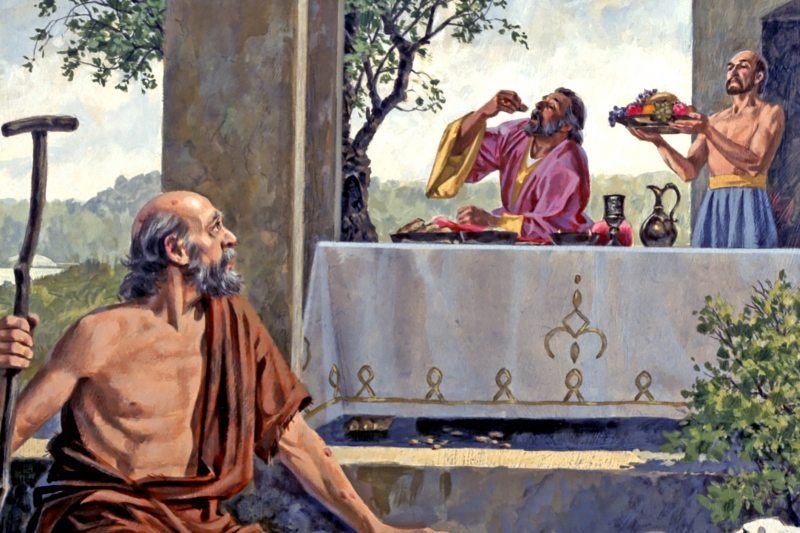
“There was a rich man who dressed in purple garments and fine linen
and dined sumptuously each day.
And lying at his door was a poor man named Lazarus, covered with sores,
who would gladly have eaten his fill of the scraps
that fell from the rich man’s table.
Dogs even used to come and lick his sores.
When the poor man died,
he was carried away by angels to the bosom of Abraham.
The rich man also died and was buried,
and from the netherworld, where he was in torment,
he raised his eyes and saw Abraham far off
and Lazarus at his side.
And he cried out, ‘Father Abraham, have pity on me.
Send Lazarus to dip the tip of his finger in water and cool my tongue,
for I am suffering torment in these flames.’
Abraham replied, ‘My child,
remember that you received what was good during your lifetime
while Lazarus likewise received what was bad;
but now he is comforted here, whereas you are tormented.
Moreover, between us and you a great chasm is established
to prevent anyone from crossing
who might wish to go from our side to yours
or from your side to ours.’
He said, ‘Then I beg you, father, send him
to my father’s house,
for I have five brothers, so that he may warn them,
lest they too come to this place of torment.’
But Abraham replied, ‘They have Moses and the prophets.
Let them listen to them.’
He said, ‘Oh no, father Abraham,
but if someone from the dead goes to them, they will repent.’
Then Abraham said,
‘If they will not listen to Moses and the prophets,
neither will they be persuaded
if someone should rise from the dead.'”
Commentary
If we take today’s two readings as a unit, then Lazarus, the beggar, is represented by the flourishing tree planted near the water. The wealthy man is the barren bush, withered and dry, on the desert floor.
The point of the parable is clear enough. A person’s material and physical circumstances in life do not tell the whole story. A person may be poor but rich in spiritual values. Or a person may be very wealthy but at the same time self-absorbed, with little or no interest in the well-being of others. Or, even strictly, well-being of his soul. Afterlife belief changes the complexion of human destiny. Upon his death, Lazarus is taken to the place of bliss, spoken of as “with Abraham.” The lot of the rich man, on the other hand, is one of separation and unhappiness.
From his place of grief, the rich man asks Abraham for relief for himself and a warning for his living brothers. But the warning is already present. The norms of human conduct have already been set forth by Moses and the prophets. To follow the counsel of the scriptures is to be assured of salvation.
We believe deeply that God is not only just but kind and merciful. His will is clearly set forth in his word. But like the rich man, especially in our day and age, we can become immersed in values that carry us far from God. There is always the “something better” drawing our attention: the larger and better home, the newer model car, the extended vacation. But there are people, never far from us, who lack the necessities of life: clothes that are old and tattered, a daily diet that seldom varies, the lack of means to give the children common, if not quality education. The fact is that no joy matches bringing happiness to others. Yes, God is eternal, so his attributes: mercy, love, compassion etc. But we are finite beings. Our life ticks with time. Now is the acceptable time, or as the ancients said, ‘Carpe diem’! “Seize the day!”
Blessing
Eyes to see the needs of people, ears to hear their cries for justice, mercy, a fair share in the goods of the earth, material and spiritual, that is what we all need very much. May almighty God be good to you and give you these. May he bless you, the Father, and the Son, and the Holy Spirit. Amen!