

The Saving Power Of God In Jesus
Introduction
Though Jesus emptied himself of all privileges as God or, as the Letter to the Hebrews says, was made lower than the angels to join us in our wounded humanity – he who was without sin passed through death; his suffering was the way to glory for him and for us. But his power could not be hidden, when he spoke with authority and was leading a great number of brothers and sister to glory.
In the Gospel, Mark shows the power of God at work in Jesus, the Messiah. It is a power that is contested by the powers of evil, that must struggle and come to grip with contradiction and suffering, but which will ultimately win – through struggle and contradiction. Such is also the power of God today in the world, the power of God in answer to our faith and prayer.
1 Reading: Hebrews 2:5-12
It was not to angels that God subjected the world to come,
of which we are speaking.
Instead, someone has testified somewhere:
What is man that you are mindful of him,
or the son of man that you care for him?
You made him for a little while lower than the angels;
you crowned him with glory and honor,
subjecting all things under his feet.
In “subjecting” all things to him,
he left nothing not “subject to him.”
Yet at present we do not see “all things subject to him,”
but we do see Jesus “crowned with glory and honor”
because he suffered death,
he who “for a little while” was made “lower than the angels,”
that by the grace of God he might taste death for everyone.
For it was fitting that he,
for whom and through whom all things exist,
in bringing many children to glory,
should make the leader to their salvation perfect through suffering.
He who consecrates
and those who are being consecrated all have one origin.
Therefore, he is not ashamed to call them “brothers” saying:
I will proclaim your name to my brethren,
in the midst of the assembly I will praise you.
Responsorial Psalm: Ps 8:2ab and 5, 6-7, 8-9
R. (see 7) You have given your Son rule over the works of your hands.
O LORD, our Lord,
how glorious is your name over all the earth!
What is man that you should be mindful of him,
or the son of man that you should care for him?
R. You have given your Son rule over the works of your hands.
You have made him little less than the angels,
and crowned him with glory and honor.
You have given him rule over the works of your hands,
putting all things under his feet.
R. You have given your Son rule over the works of your hands.
All sheep and oxen,
yes, and the beasts of the field,
The birds of the air, the fishes of the sea,
and whatever swims the paths of the seas.
R. You have given your Son rule over the works of your hands.
Alleluia: (See 1 Thessalonians 2:13)
R. Alleluia, alleluia.
Receive the word of God, not as the word of men,
but as it truly is, the word of God.
R. Alleluia, alleluia.
Gospel: Mark 1:21-28
Jesus came to Capernaum with his followers,
and on the Sabbath he entered the synagogue and taught.
The people were astonished at his teaching,
for he taught them as one having authority and not as the scribes.
In their synagogue was a man with an unclean spirit;
he cried out, “What have you to do with us, Jesus of Nazareth?
Have you come to destroy us?
I know who you are–the Holy One of God!”
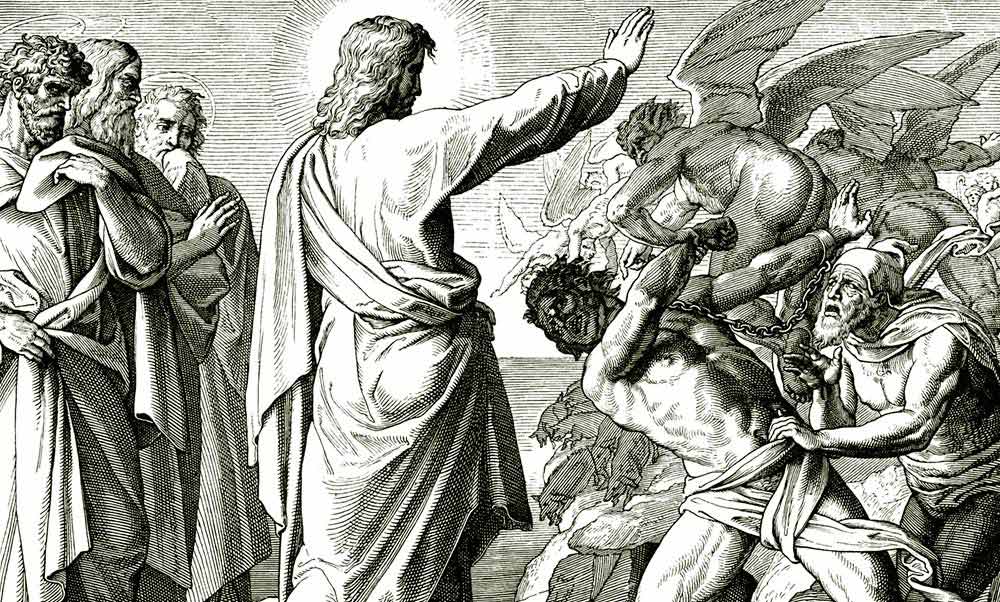
Jesus rebuked him and said, “Quiet! Come out of him!”
The unclean spirit convulsed him and with a loud cry came out of him.
All were amazed and asked one another,
“What is this?
A new teaching with authority.
He commands even the unclean spirits and they obey him.”
His fame spread everywhere throughout the whole region of Galilee.
Commentary
The reading from Hebrews today accords Christ total primacy in the created order. In his humanity, subsequent to his death and resurrection, there is nothing in creation that stands above him. He is the alpha and omega, the beginning and the end of all that has ever been or will ever be.
Yet, the author of Hebrews makes clear that Christ was made perfect through what he suffered. Without suffering, Christ would not have been completely human. With his suffering, he is like us in everything except sin. Suffering is always a bitter pill to swallow. But just as it was part of Christ’s coming to glory, so too it is for us. The burden of sickness and distress plays a significant part in our offering to the Father. Paul even says that suffering endured for the sake of Christ’s body, the church becomes part of Christ’s redemptive suffering offered to the Father. Pain, then, is never worthless; it has a part to play in the plan of salvation.
In today’s Gospel, Jesus’ authority appears in the expulsion of the demon tormenting the man in the Capernaum synagogue. Onlookers are astounded. The demon’s question to Jesus: “What have you to do with us?” may be better translated, “What do you have in common with us?” The answer, of course, is “Nothing.” In fact, Jesus came to vanquish evil. Like the rest of creation, it too is subject to him.
Our baptism means that we have cast our lot with Christ, not with lesser powers. Victory will ultimately be ours, in spite of the pain and suffering that will be part of our earthly journey. When tempted, let us have nothing in common with evil, but put evil behind us and move forward. We are of Christ (Christians); and we belong to Christ!
Blessing
Jesus was teaching with authority. Why? Because he fully believed in what he said and backed up his teaching with signs. Perhaps the greatest sign was that he lived what he taught. May we too, live as we believe, with the blessing of Almighty God, the Father, and the Son, and the Holy Spirit. Amen!