

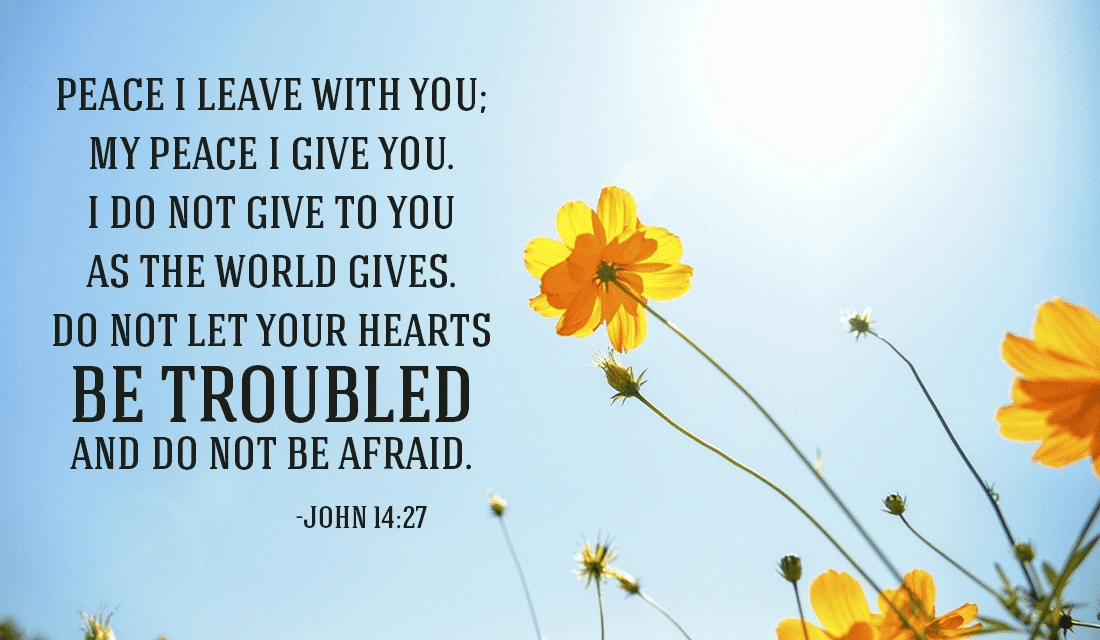
The Peace of Christ, the Peace the World Cannot Give Us
Introduction
In carrying out his mission of proclaiming the Gospel, Paul and Barnabas with him, is persecuted, stoned, driven from one place to another. He doesn’t give up; he continues founding local communities and giving them basic structure of leadership, so that they can function on their own. He has even the courage to “put fresh hearts into the disciples” and to acknowledge that God has accomplished great things in them.
Likewise, before his passion and death, Christ speaks of peace and encourages the apostles not to be troubled or afraid. Nothing will keep him from carrying out his mission of love. No one can rob us of our interior peace, serenity and freedom if we are united with God in love.
1 Reading: Acts 14:19-28
In those days, some Jews from Antioch and Iconium arrived and won over the crowds. They stoned Paul and dragged him out of the city, supposing that he was dead. But when the disciples gathered around him, he got up and entered the city. On the following day he left with Barnabas for Derbe. After they had proclaimed the good news to that city and made a considerable number of disciples, they returned to Lystra and to Iconium and to Antioch. They strengthened the spirits of the disciples and exhorted them to persevere in the faith, saying, “It is necessary for us to undergo many hardships to enter the Kingdom of God.” They appointed presbyters for them in each Church and, with prayer and fasting, commended them to the Lord in whom they had put their faith. Then they traveled through Pisidia and reached Pamphylia. After proclaiming the word at Perga they went down to Attalia. From there they sailed to Antioch, where they had been commended to the grace of God for the work they had now accomplished. And when they arrived, they called the Church together and reported what God had done with them and how he had opened the door of faith to the Gentiles. Then they spent no little time with the disciples.
Responsorial Psalm Ps 145:10-11, 12-13ab, 21
R.(see 12) Your friends make known, O Lord, the glorious splendor of your kingdom.
or: R. Alleluia.
Let all your works give you thanks, O LORD,
and let your faithful ones bless you.
Let them discourse of the glory of your kingdom
and speak of your might. R.
Making known to men your might
and the glorious splendor of your kingdom.
Your kingdom is a kingdom for all ages,
and your dominion endures through all generations. R.
May my mouth speak the praise of the LORD,
and may all flesh bless his holy name forever and ever. R.
Alleluia: See Luke 24:46, 26
R. Alleluia, alleluia.
Christ had to suffer and to rise from the dead,
and so enter into his glory.
R. Alleluia, alleluia.
Gospel: John 14:27-31a
Jesus said to his disciples: “Peace I leave with you; my peace I give to you. Not as the world gives do I give it to you. Do not let your hearts be troubled or afraid. You heard me tell you, ‘I am going away and I will come back to you.’ If you loved me, you would rejoice that I am going to the Father; for the Father is greater than I. And now I have told you this before it happens, so that when it happens you may believe. I will no longer speak much with you, for the ruler of the world is coming. He has no power over me, but the world must know that I love the Father and that I do just as the Father has commanded me.”
Commentary
Hope and peace emerge as significant themes in today’s readings. Paul and Barnabas come to the end of their initial journey. There had been moments of joy, but adversity also had dogged them along the way. Today Paul is stoned by the Jews and left for dead. But restored to health, he is able to complete his journey.
It is in the midst of suffering that hope proves its mettle. It does not stand simply as a conviction that the ultimate goal will be reached. It means that in the midst of trial and severe human misgiving, there is the conviction that the future remains intact. We cannot separate hardship from the meaning of hope.
Hope has major importance in the church today. The storm clouds of dissension, polarization, and misconduct weigh heavily. In addition, we look at those parts of the world, traditionally strong in the faith, where in our time belief is severely threatened and the future uncertain. In the face of anticlericalism, Neopaganism, Islamic extremist attacks and abuses, it is hope that convinces us that the final word will be God’s. Someone once said that the Church is a ‘Hope Industry.’ How right he was.
Peace has been cynically described as a “period of preparation between two wars.” In the biblical sense, however, peace is the restoration of primitive accord. Peace was lost when humanity rebelled against God. Pain and suffering became our common lot, as well as moral disorientation. There was a rupture in the relationship of God and the world. As Christ comes to his disciples in the upper room, he announces the reestablishment of peace between heaven and earth. In our new covenant in the Holy Spirit, our restoration is attained, not only with God but with our fellow human beings and the created world, which is also redeemed. He has made us one through the blood of the cross.
“War, war—never again” is not simply an ardent wish. It is a Christian mandate. Peace is held in contempt in a world of strife and conflict. The Gospel states today that the evil prince of this world may make temporary gains, but only the Father who lives in Jesus, our hope and our peace, will triumph.
Blessing
“Do not let your hearts be troubled and do not be afraid, for peace I leave with you, my peace I give you.” This is the assurance Jesus gives us. We are in God’s hands. May Almighty God bless you, the Father, and the Son, and the Holy Spirit. Amen!