

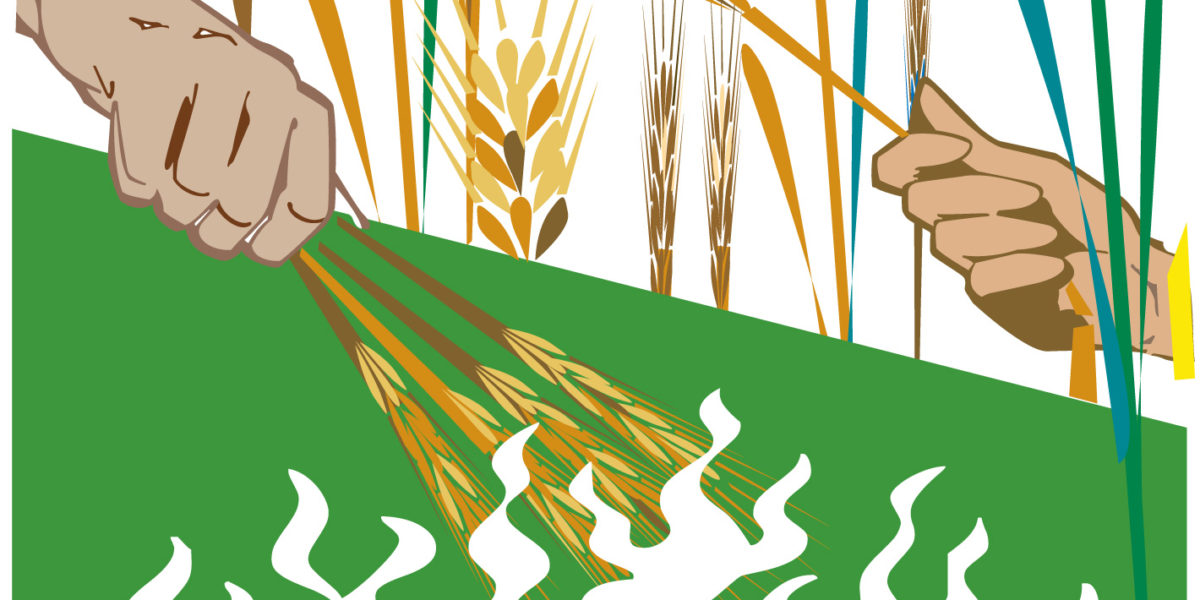
He That Has Ears Let Him Hear
Introduction
Exodus gives us here a beautiful example of God’s tender covenant love for his sometimes-wayward people. He keeps protecting them and being present to them (hence, the cloud). His presence is very intimate especially for Moses. Hence, the radiance of Moses’ face.
Jesus explains the parable of the wheat and the weeds. Good and evil will always coexist in the Church and in the world, until God’s good time comes. The word of the Lord should perhaps help us to be patient and understanding with the all too human aspects of the Church of the past and of our day. The good will ultimately triumph; we have this assurance, while we already work in the present to purify the Church and ourselves.
1 Reading: Exodus 33:7-11; 34:5b-9, 28
The tent, which was called the meeting tent, Moses used to pitch at some distance away, outside the camp. Anyone who wished to consult the LORD would go to this meeting tent outside the camp. Whenever Moses went out to the tent, the people would all rise and stand at the entrance of their own tents, watching Moses until he entered the tent. As Moses entered the tent, the column of cloud would come down and stand at its entrance while the LORD spoke with Moses. On seeing the column of cloud stand at the entrance of the tent, all the people would rise and worship at the entrance of their own tents. The LORD used to speak to Moses face to face, as one man speaks to another. Moses would then return to the camp, but his young assistant, Joshua, son of Nun, would not move out of the tent. Moses stood there with the LORD and proclaimed his name, “LORD.” Thus the LORD passed before him and cried out, “The LORD, the LORD, a merciful and gracious God, slow to anger and rich in kindness and fidelity, continuing his kindness for a thousand generations, and forgiving wickedness and crime and sin; yet not declaring the guilty guiltless, but punishing children and grandchildren to the third and fourth generation for their fathers’ wickedness!” Moses at once bowed down to the ground in worship. Then he said, “If I find favour with you, O LORD, do come along in our company. This is indeed a stiff-necked people; yet pardon our wickedness and sins, and receive us as your own.” So Moses stayed there with the LORD for forty days and forty nights, without eating any food or drinking any water, and he wrote on the tablets the words of the covenant, the Ten Commandments.
Responsorial Psalm: Ps 103:6-7, 8-9, 10-11, 12-13
R. (8a) The Lord is kind and merciful.
The LORD secures justice
and the rights of all the oppressed.
He has made known his ways to Moses,
and his deeds to the children of Israel. R.
Merciful and gracious is the LORD,
slow to anger and abounding in kindness.
He will not always chide,
nor does he keep his wrath forever. R.
Not according to our sins does he deal with us,
nor does he requite us according to our crimes.
For as the heavens are high above the earth,
so surpassing is his kindness toward those who fear him. R.
As far as the east is from the west,
so far has he put our transgressions from us.
As a father has compassion on his children,
so the LORD has compassion on those who fear him. R.
Alleluia
R. Alleluia, alleluia.
The seed is the word of God, Christ is the sower;
all who come to him will live for ever.
R. Alleluia, alleluia.
Gospel: Matthew 13:36-43
Jesus dismissed the crowds and went into the house. His disciples approached him and said, “Explain to us the parable of the weeds in the field.” He said in reply, “He who sows good seed is the Son of Man, the field is the world, the good seed the children of the Kingdom. The weeds are the children of the Evil One, and the enemy who sows them is the Devil. The harvest is the end of the age, and the harvesters are angels. Just as weeds are collected and burned up with fire, so will it be at the end of the age. The Son of Man will send his angels, and they will collect out of his Kingdom all who cause others to sin and all evildoers. They will throw them into the fiery furnace, where there will be wailing and grinding of teeth. Then the righteous will shine like the sun in the Kingdom of their Father. Whoever has ears ought to hear.”
Commentary
It was in the meeting tent outside the camp that Moses conversed with Yahweh. As the Book of Exodus presents the case, it was on these occasions that Moses gained further insights into the nature of God.
The meetings were revelatory. In today’s reading the Lord declares himself as patient and forgiving, “for the thousandth generation.” This is a fundamental notion of God in the Judeo-Christian tradition. Yet punishment for wrongdoing, where there is not a contrite spirit, is clearly not overlooked. Punishment for sin is never absent from the Lord’s sight. That’s why he’s a just judge, reading from this context.
People often conjecture about the presence of the weeds at the end of time. And it should be noted that the weeds are not only sinners but those who cause others to sin. Will the rejected be many or few? It is very hard and of little value for us to play the “numbers game.”
What the scriptures speak about very clearly is accountability. God is loving and infinitely forgiving but is also not mocked. Our time here is very limited. We all make mistakes, and that is understandable. But we should never succumb to a spirit of indifference in the most important undertaking of our lives. The Christian must realize that the weed, growing side-by-side, mounts the obstacles of distraction, bad influence and sin. He must remain focused on Jesus, gazing heavenward, and not sideways where the weed is even holding sway. He who has ears, let him hear.
Blessing
God lets his sun shine on the good and the bad alike. We are not the judges of the Church or of the world: let God do the judging. Pray that he keep us faithful. May almighty God bless you, the Father, and the Son, and the Holy Spirit. Amen!