

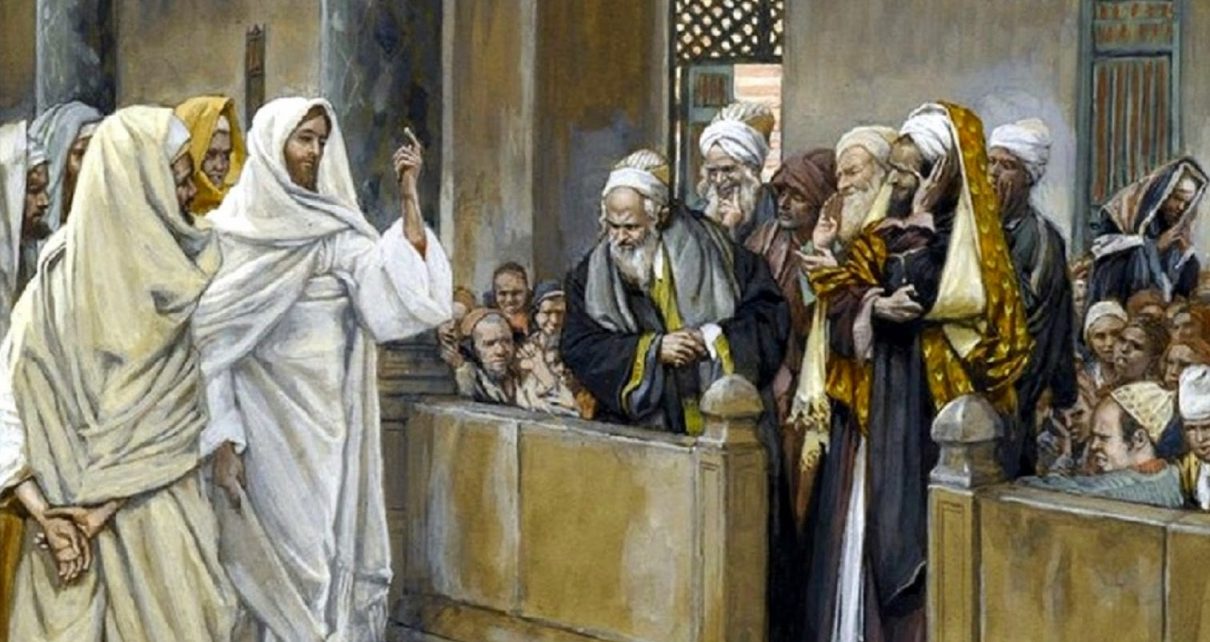
Religion is about internal transformation: promoting justice, mercy and faithfulness
Introduction
Paul is aware that his Thessalonians are in danger of becoming an end-of-the-world sect, something we understand easily in the light of the many similar sects appearing among us today. Paul invites them to look serenely at the traditions of the early Church about the end of the world which Paul had brought to them. Jesus comes not to end the world but to bring us another world of justice and mercy.
There is always the danger that religions turn into a kind of ritualism that imposes practices of little meaning as if they were the saving factors. Ritualism and rubricism is still raising its ugly head even after Vatican II. How ridiculous, almost superstitious! Equally ridiculous because it is empty, is a religion that professes to have faith but minimizes or shuns religious practices. Be sure that with this attitude quite rampant in our time, true faith disappears.
1 Reading 2 Thessalonians 2:1-3a, 14-17
We ask you, brothers and sisters,
with regard to the coming of our Lord Jesus Christ
and our assembling with him,
not to be shaken out of your minds suddenly,
or to be alarmed either by a “spirit,” or by an oral statement,
or by a letter allegedly from us
to the effect that the day of the Lord is at hand.
Let no one deceive you in any way.
To this end he has also called you through our Gospel
to possess the glory of our Lord Jesus Christ.
Therefore, brothers and sisters, stand firm
and hold fast to the traditions that you were taught,
either by an oral statement or by a letter of ours.
May our Lord Jesus Christ himself and God our Father,
who has loved us and given us everlasting encouragement
and good hope through his grace,
encourage your hearts and strengthen them
in every good deed and word.
Responsorial Psalm 96:10, 11-12, 13
R. (13b) The Lord comes to judge the earth.
Say among the nations: The LORD is king.
He has made the world firm, not to be moved;
he governs the peoples with equity.
R. The Lord comes to judge the earth.
Let the heavens be glad and the earth rejoice;
let the sea and what fills it resound;
let the plains be joyful and all that is in them!
Then shall all the trees of the forest exult.
R. The Lord comes to judge the earth.
Before the LORD, for he comes;
for he comes to rule the earth.
He shall rule the world with justice
and the peoples with his constancy.
R. The Lord comes to judge the earth.
Alleluia Hebrews 4:12
R. Alleluia, alleluia.
The word of God is living and effective,
able to discern reflections and thoughts of the heart.
R. Alleluia, alleluia.
Gospel Matthew 23:23-26
Jesus said:
“Woe to you, scribes and Pharisees, you hypocrites.
You pay tithes of mint and dill and cummin,
and have neglected the weightier things of the law:
judgment and mercy and fidelity.
But these you should have done, without neglecting the others.
Blind guides, who strain out the gnat and swallow the camel!
“Woe to you, scribes and Pharisees, you hypocrites.
You cleanse the outside of cup and dish,
but inside they are full of plunder and self-indulgence.
Blind Pharisee, cleanse first the inside of the cup,
so that the outside also may be clean.”
Commentary
Jesus did not come to abolish the Law, but to perfect it (Matt 5:17) by showing us what is most fundamental to the Law—justice, mercy, and faith. At the level of these fundamentals, law is grounded in love, or in other words, love is the law. The word “religion” is said to have originated from the Latin roots ‘re’ + ‘ligare’ meaning “to bind again.” There are two ways to bind people: we can bind them in knots so as to snuff the life out of them. Or we can reconnect them with God and others in loving communion. “Bind us together with Love”, the music sings.
The Pharisees and the teachers of the Law whom Jesus chastises today practiced religion in a life-negating manner by insisting on peripheral obligations and forgetting the life-affirming essentials of justice, mercy, and faith. They are far more concerned about the external observance of religion than the internal transformation in freedom that practice of religion should lead one to. Religion is to link one to God and to others, not lay burdens on others
Blessing
Let us, as Jesus recommends, pay attention first of all to the important matters of the law: to justice and mercy, faith and love. The rest will follow easily. May almighty God bless you all, the Father, and the Son, and the Holy Spirit. Amen!