

An Outsider’s Faith And Gratitude
1. Giving Thanks at the Top of Our Voices
2. A Grateful Stranger
Introduction
1. Giving Thanks at the Top of Our Voices
We appreciate grateful people very much. Do we ourselves not forget to thank? For many, it is the Lord who is forgotten. Look at everything we owe God: our life, our bodies with our eyes to see the marvels of creation and our ears to hear creation’s songs. There is all the beauty around us and all the good people to appreciate and love. Above all, God himself has come near to us in Jesus. He brought us repeated forgiveness and the capacity to forgive and to love. Let us thank God and praise him at the top of our voices.
2. A Grateful Stranger
Isn’t it a pity that we believers, are at times, even often, put to shame by people who are not Christians, or separated or not practicing? Not that we are in competition with them or have to think that we are better than they, but we owe it to Christ, to the Church, to the kingdom for which we work, to live our faith in practice, to do deeds of faith. We see “outsiders” do these deeds even as we fail to do them. Let us recognize the good deeds done by others and learn from them, as Jesus points out to us today.
First Reading: A Grateful Foreigner
Naaman, a foreigner, had come to beg the prophet Elisha to cure him of his leprosy in the name of the God of Israel. When he was healed, he gratefully promised to honor the God of Israel.
1 Reading: 2 Kings 5:14-17
Naaman went down and plunged into the Jordan seven times at the word of Elisha, the man of God. His flesh became again like the flesh of a little child, and he was clean of his leprosy. Naaman returned with his whole retinue to the man of God. On his arrival he stood before Elisha and said, “Now I know that there is no God in all the earth, except in Israel. Please accept a gift from your servant.” Elisha replied, “As the LORD lives whom I serve, I will not take it;” and despite Naaman’s urging, he still refused. Naaman said: “If you will not accept, please let me, your servant, have two mule-loads of earth, for I will no longer offer holocaust or sacrifice to any other god except to the LORD.”
Responsorial Psalm: Ps 98:1, 2-3, 3-4
R. (cf. 2b) The Lord has revealed to the nations his saving power.
Sing to the LORD a new song,
for he has done wondrous deeds;
his right hand has won victory for him,
his holy arm. R.
The LORD has made his salvation known:
in the sight of the nations he has revealed his justice.
He has remembered his kindness and his faithfulness
toward the house of Israel. R.
All the ends of the earth have seen
the salvation by our God.
Sing joyfully to the LORD, all you lands:
break into song; sing praise. R.
Second Reading: Remember Jesus Christ!
God’s greatest gift to us is Jesus Christ, who sums up all gifts. Gratitude prompts us to be loyal to him and to live the life of Jesus.
2 Reading: 2 Timothy 2:8-13
Beloved: Remember Jesus Christ, raised from the dead, a descendant of David: such is my gospel, for which I am suffering, even to the point of chains, like a criminal. But the word of God is not chained. Therefore, I bear with everything for the sake of those who are chosen, so that they too may obtain the salvation that is in Christ Jesus, together with eternal glory. This saying is trustworthy: If we have died with him we shall also live with him; if we persevere we shall also reign with him. But if we deny him he will deny us. If we are unfaithful he remains faithful, for he cannot deny himself.
Alleluia: 1 Thessalonians 5:18
R. Alleluia, alleluia.
In all circumstances, give thanks,
for this is the will of God for you in Christ Jesus.
R. Alleluia, alleluia.
Gospel: Another Grateful Stranger
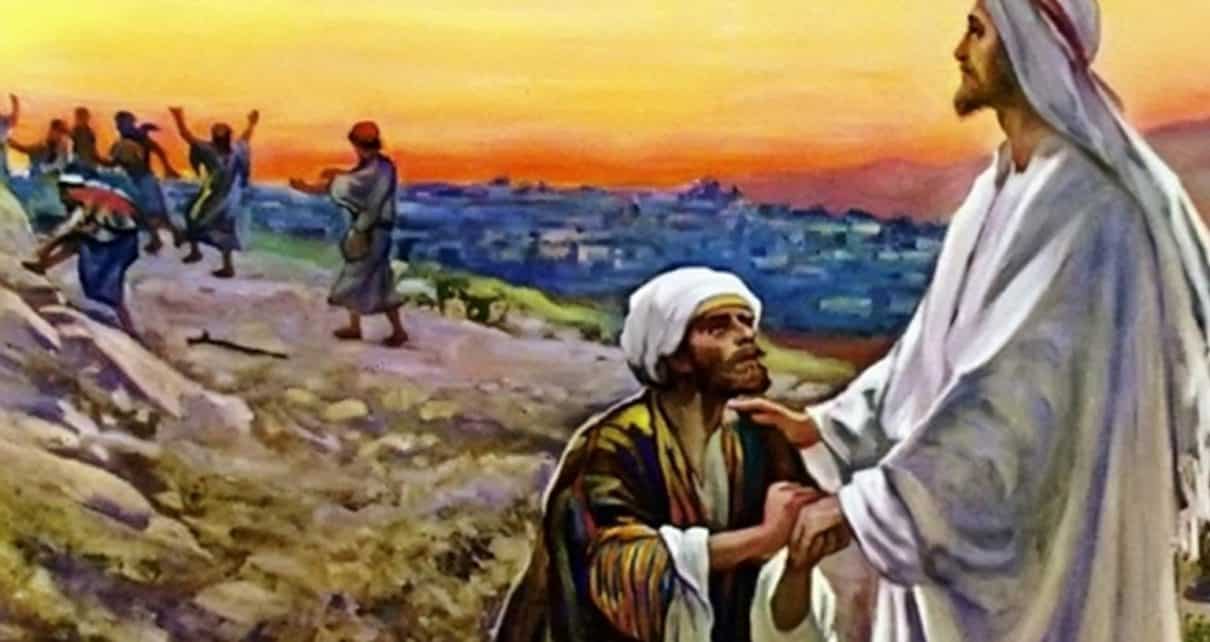
Jesus cured ten men, simply because they believed in him. But only one returned to thank him. He was a foreigner, and a Samaritan at that.
Gospel: Luke 17:11-19
As Jesus continued his journey to Jerusalem, he traveled through Samaria and Galilee. As he was entering a village, ten lepers met him. They stood at a distance from him and raised their voices, saying, “Jesus, Master! Have pity on us!” And when he saw them, he said, “Go show yourselves to the priests.” As they were going they were cleansed. And one of them, realizing he had been healed, returned, glorifying God in a loud voice; and he fell at the feet of Jesus and thanked him. He was a Samaritan. Jesus said in reply, “Ten were cleansed, were they not? Where are the other nine? Has none but this foreigner returned to give thanks to God?” Then he said to him, “Stand up and go; your faith has saved you.”
Commentary
There is currently a lot of talk about the healing of memories. In reality, in any reconciliation or authentic healing there has to be a healing of memory or else the bitterness of the wound or injury will always be there, preventing the wound from closing. The issue sprout again during this time of the so-called xenophobic attacks by South Africans against African nationals. Have the memories of apartheid been wiped-out from the minds of South Africans? This can also happen in nearly all the circumstances of our life. Holding on to painful memories, to the memories of injury and pain, rejections whether real or perceived, prevents a genuine healing from occurring. Memories cannot be healed, however, by simply denying or ignoring the pain, but by acknowledging them in order to forgive. Rwanda did so, and today is the destination as the fastest improving country in the world after the genocide. Gratitude can help greatly in this. There is a saying that gratefulness is the memory of the heart.
A grateful heart, contrary to the heart that holds on to pain, keeps the memory of blessings received, the free gifts of God and of people close to us. A grateful heart can open up to salvation, just as the officer in the first reading and the leper in the gospel. The other nine perhaps went away still with the pain of having suffered leprosy, having endured the rejection of others, and suffering illness. Perhaps they went away with the feeling that the justice they deserved had finally arrived. In either case, these nine people left without true healing or salvation, because it is only gratitude that opens the door to grace, to true salvation. It is not that we deserve or have been born in one place or another, but opening up in faith to God. That is true salvation and true healing. The nine, though healed physically, are still leprous at heart. In this category many us Christians belong.
It is possible that sometimes we are likely to feel that we have been hurt: someone has discriminated against us, the laws are hostile to us, and there is prejudice and a prevalent anti-politicial sentiment. Regardless of the veracity of these feelings that can make us feel rejected, it is only our gratitude to God for the many blessings that we have freely received, gratitude toward those near us, to those in the parish or community, that have opened doors or opportunities for progress that heals us and opens the door to salvation.
Blessing
This Eucharist has been
a feast of thanksgiving to the Lord.
Let us always be grateful for the gifts of life,
and the gift of one another.
Let us turn everything we do
into an act of thanksgiving to God.
And may almighty God bless you all:
the Father, and the Son, and the Holy Spirit. R/ Amen.
Go in the peace of the Lord
and thank him with your living faith. R/ Thanks be to God.