

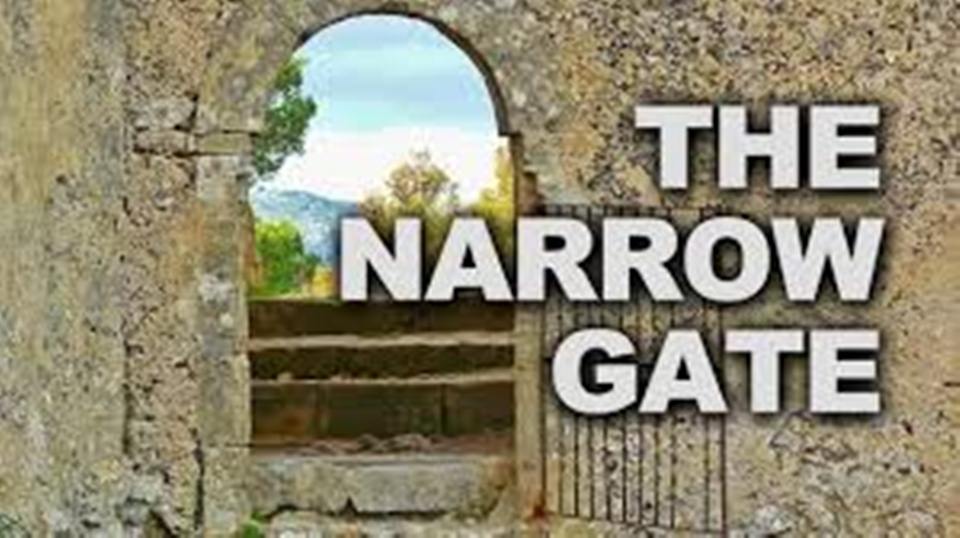
The Kingdom Invites All – Though the Gate is Narrow
1. Who Will Be Saved?
2. Many Will Come from East and West
Introduction
1. Who Will Be Saved?
We are accustomed to go to Mass on Sundays and we hear the Lord speak his Word to us in the readings of the scriptures. Is that an insurance good enough to make us faithful Christians, to prove that we belong to the Kingdom of God? Outward practices and statements are not enough. We belong there if we try to be good Christians who do their best to live their faith. Jesus’ message and life must become visible in us by the way we love God in our everyday life, and serve him in our neighbour. This is the way, whoever we are, from wherever we come, that Jesus will recognize us as his disciples.
2. Many Will Come from East and West
Everyone likes to go to a house where the doors are always open in welcome. That is how Jesus wants the Church to be: a house of welcome open to anyone. Pope Francis calls the Church a hospital in an open field. Jesus says of himself that he is the gate or the door. He welcomes all who seek him and even goes out of his way to look for people. But at the same time the door is narrow. We have to make an effort to become like Jesus and to serve and love God and people with him and to live in the spirit of the gospel. With Jesus we now thank the Father, and ask that we too may be open to all.
First Reading: I Will Gather All Nations
The last part of the book of Isaiah ends with a grandiose vision: God will gather all the nations into one holy people. All will be brothers and sisters.
1 Reading: Isaiah 66:18-21
Thus says the LORD: I know their works and their thoughts, and I come to gather nations of every language; they shall come and see my glory. I will set a sign among them; from them I will send fugitives to the nations: to Tarshish, Put and Lud, Mosoch, Tubal and Javan, to the distant coastlands that have never heard of my fame, or seen my glory; and they shall proclaim my glory among the nations. They shall bring all your brothers and sisters from all the nations as an offering to the LORD, on horses and in chariots, in carts, upon mules and dromedaries, to Jerusalem, my holy mountain, says the LORD, just as the Israelites bring their offering to the house of the LORD in clean vessels. Some of these I will take as priests and Levites, says the LORD.
Responsorial Psalm: Ps 117:1, 2
R. (Mk 16:15) Go out to all the world and tell the Good News. or:
R. Alleluia.
Praise the LORD all you nations;
glorify him, all you peoples! R.
For steadfast is his kindness toward us,
and the fidelity of the LORD endures forever. R.
Second Reading: God Is a Real Father
God would not be a good Father if he did not correct his children. Our trials serve to train and strengthen us in the faith.
2 Reading: Hebrews 12:5-7, 11-13
Brothers and sisters, You have forgotten the exhortation addressed to you as children: “My son, do not disdain the discipline of the Lord or lose heart when reproved by him; for whom the Lord loves, he disciplines; he scourges every son he acknowledges.” Endure your trials as “discipline”; God treats you as sons. For what “son” is there whom his father does not discipline? At the time, all discipline seems a cause not for joy but for pain, yet later it brings the peaceful fruit of righteousness to those who are trained by it. So strengthen your drooping hands and your weak knees. Make straight paths for your feet, that what is lame may not be disjointed but healed.
Alleluia: John 14:6
R. Alleluia, alleluia.
I am the way, the truth and the life, says the Lord;
no one comes to the Father, except through me.
R. Alleluia, alleluia.
Gospel: People from East and West Will Enter
To be saved, it is not enough to belong to the people of God. All those who live the life of Christ, from wherever they come, are admitted into the kingdom.
Gospel: Luke 13:22-30
Jesus passed through towns and villages, teaching as he went and making his way to Jerusalem. Someone asked him, “Lord, will only a few people be saved?” He answered them, “Strive to enter through the narrow gate, for many, I tell you, will attempt to enter but will not be strong enough. After the master of the house has arisen and locked the door, then will you stand outside knocking and saying, ‘Lord, open the door for us.’ He will say to you in reply, ‘I do not know where you are from. And you will say, ‘We ate and drank in your company and you taught in our streets.’ Then he will say to you, ‘I do not know where you are from. Depart from me, all you evildoers!’ And there will be wailing and grinding of teeth when you see Abraham, Isaac, and Jacob and all the prophets in the kingdom of God and you yourselves cast out. And people will come from the east and the west and from the north and the south and will recline at table in the kingdom of God. For behold, some are last who will be first, and some are first who will be last.”
Commentary
For the third time in 7 days, we are stunned to hear at the end of the Gospel: “some are last who will be first, and some are first who will be last.” However, Hans Urs von Balthasar, one of the greatest of 20th-century theologians, wrote a book entitled “Dare we hope that all will be saved?” His answer, in brief, was that we not only dare to hope, but we are obliged to hope, that all will be saved. St. Augustine, he said, was the first Christian writer to claim that he knew there were people in hell. Before his time (5th century) no Christian writer ever claimed to know that there were people in hell. This may be news to some, since we inherited the medieval view that only a minority would be saved. Von Balthasar concluded: if you say you know there are people in hell, you are saying more than you know; if you say you know there is no one in hell, you are likewise saying more than you know. That is how it rests. We don’t know, but we hope.
Notice that in today’s reading, Jesus did not answer the question, “Is it true that few people will be saved?” It may have been this text that set the early custom of not trying to answer it. Among the medievals, Julian of Norwich was exceptional in her insistence on leaving such questions unanswered. There are two aspects to revealed truth, she said. The first is what we know of “our Saviour and our salvation.” This is “open and clear, lovely and light, and plentiful.” The other is “our Lord’s secret counsel (privy council),” and we should not “pry into those secrets (not to wel wetyn his conselye).” We must “always avoid dwelling on what the last deed of God will be,” she wrote. God gives us everything needed for our salvation, it seems, and statistics are no part of that.
Blessing
As he sent his apostles,
so our Lord sends us too,
to go out into the whole wide world
to proclaim his Good News,
with the blessing of almighty God,
the Father, and the Son, and the Holy Spirit. R/ Amen.
Let us go and take Christ with us to people. R/ Thanks be to God.