

A God Who Loves To Forgive
1. It Is a Joy for God to Forgive
2. Which Son Am I?
Introduction
1. It Is a Joy for God to Forgive
When you forgive someone who has hurt you much, how much does it cost you to forgive? Is it done reluctantly or with joy? Do you have the courage to take the first step, or do you wait until the other humbly begs you? Today’s message is one of great joy and peace: God is happy to forgive sinners. He welcomes them and he embraces them. That’s what he has done for us. How many times? Can we do it for one another? Let us celebrate with Jesus the feast of our reconciliation with God and with one another.
2. Which Son Am I?
Forgiveness is so difficult and at the same time so sublime that it surpasses our own powers. But not the power of God’s love. When God forgives us we are loved in the deepest of our being, even where we are not lovable. We are accepted not because of what we have or what we are; for we are accepted also when we stand empty-handed and feel we are not worth much. We cannot earn forgiveness; it comes as a surprise from God. He begs us to spring that surprise on others too: he alone can make us capable of doing so.
First Reading: God’s Love Is Greater Than His Justice
God had saved his people, yet they abandoned him to adore the golden calf. Moses pleaded with God to spare his people.
1 Reading: Ex 32:7-11, 13-14
The LORD said to Moses, “Go down at once to your people, whom you brought out of the land of Egypt, for they have become depraved. They have soon turned aside from the way I pointed out to them, making for themselves a molten calf and worshiping it, sacrificing to it and crying out, ‘This is your God, O Israel, who brought you out of the land of Egypt!’ “I see how stiff-necked this people is,” continued the LORD to Moses. “Let me alone, then, that my wrath may blaze up against them to consume them. Then I will make of you a great nation.” But Moses implored the LORD, his God, saying, “Why, O LORD, should your wrath blaze up against your own people, whom you brought out of the land of Egypt with such great power and with so strong a hand? Remember your servants Abraham, Isaac, and Israel, and how you swore to them by your own self, saying, ‘I will make your descendants as numerous as the stars in the sky; and all this land that I promised, I will give your descendants as their perpetual heritage.'” So the LORD relented in the punishment he had threatened to inflict on his people.
Responsorial Psalm: Ps 51:3-4, 12-13, 17, 19
R. (Lk 15:18) I will rise and go to my father.
Have mercy on me, O God, in your goodness;
in the greatness of your compassion wipe out my offense.
Thoroughly wash me from my guilt
and of my sin cleanse me. R.
A clean heart create for me, O God,
and a steadfast spirit renew within me.
Cast me not out from your presence,
and your Holy Spirit take not from me. R.
O Lord, open my lips,
and my mouth shall proclaim your praise.
My sacrifice, O God, is a contrite spirit;
a heart contrite and humbled, O God, you will not spurn. R.
Second Reading: Christ Has Forgiven Me
Paul is aware that he is a sinner. But he has encountered the forgiving Christ. Full of gratitude, he praises God’s greatness and love.
2 Reading: 1 Timothy 1:12-17
Beloved: I am grateful to him who has strengthened me, Christ Jesus our Lord, because he considered me trustworthy in appointing me to the ministry. I was once a blasphemer and a persecutor and arrogant, but I have been mercifully treated because I acted out of ignorance in my unbelief. Indeed, the grace of our Lord has been abundant, along with the faith and love that are in Christ Jesus. This saying is trustworthy and deserves full acceptance: Christ Jesus came into the world to save sinners. Of these I am the foremost. But for that reason I was mercifully treated, so that in me, as the foremost, Christ Jesus might display all his patience as an example for those who would come to believe in him for everlasting life. To the king of ages, incorruptible, invisible, the only God, honour and glory forever and ever. Amen.
Alleluia: 2 Corinthians 5:19
R. Alleluia, alleluia.
God was reconciling the world to himself in Christ
and entrusting to us the message of reconciliation.
R. Alleluia, alleluia.
Gospel: It Is a Joy for God to Forgive
The parables of this chapter of Luke have one focal point: God does not give up on sinners; he keeps looking for them and welcomes them back with joy.
Gospel: Luke 15:1-32
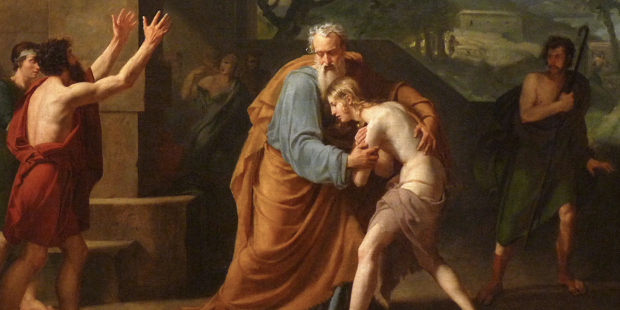
Tax collectors and sinners were all drawing near to listen to Jesus, but the Pharisees and scribes began to complain, saying, “This man welcomes sinners and eats with them.” So to them he addressed this parable. “What man among you having a hundred sheep and losing one of them would not leave the ninety-nine in the desert and go after the lost one until he finds it? And when he does find it, he sets it on his shoulders with great joy and, upon his arrival home, he calls together his friends and neighbours and says to them, ‘Rejoice with me because I have found my lost sheep.’ I tell you, in just the same way there will be more joy in heaven over one sinner who repents than over ninety-nine righteous people who have no need of repentance. “Or what woman having ten coins and losing one would not light a lamp and sweep the house, searching carefully until she finds it? And when she does find it, she calls together her friends and neighbours and says to them, ‘Rejoice with me because I have found the coin that I lost.’ In just the same way, I tell you, there will be rejoicing among the angels of God over one sinner who repents.” Then he said, “A man had two sons, and the younger son said to his father, ‘Father give me the share of your estate that should come to me.’ So the father divided the property between them. After a few days, the younger son collected all his belongings and set off to a distant country where he squandered his inheritance on a life of dissipation. When he had freely spent everything, a severe famine struck that country, and he found himself in dire need. So he hired himself out to one of the local citizens who sent him to his farm to tend the swine. And he longed to eat his fill of the pods on which the swine fed, but nobody gave him any. Coming to his senses he thought, ‘How many of my father’s hired workers have more than enough food to eat, but here am I, dying from hunger. I shall get up and go to my father and I shall say to him, “Father, I have sinned against heaven and against you. I no longer deserve to be called your son; treat me as you would treat one of your hired workers.”’ So he got up and went back to his father. While he was still a long way off, his father caught sight of him, and was filled with compassion. He ran to his son, embraced him and kissed him. His son said to him, ‘Father, I have sinned against heaven and against you; I no longer deserve to be called your son.’ But his father ordered his servants, ‘Quickly bring the finest robe and put it on him; put a ring on his finger and sandals on his feet. Take the fattened calf and slaughter it. Then let us celebrate with a feast, because this son of mine was dead, and has come to life again; he was lost, and has been found.’ Then the celebration began. Now the older son had been out in the field and, on his way back, as he neared the house, he heard the sound of music and dancing. He called one of the servants and asked what this might mean. The servant said to him, ‘Your brother has returned and your father has slaughtered the fattened calf because he has him back safe and sound.’ He became angry, and when he refused to enter the house, his father came out and pleaded with him. He said to his father in reply, ‘Look, all these years I served you and not once did I disobey your orders; yet you never gave me even a young goat to feast on with my friends. But when your son returns, who swallowed up your property with prostitutes, for him you slaughter the fattened calf.’ He said to him, ‘My son, you are here with me always; everything I have is yours. But now we must celebrate and rejoice, because your brother was dead and has come to life again; he was lost and has been found.’”
Commentary
After many problems, anxiety, and sleepless nights, the mother of a gang member told him that she could not bear it anymore and, if he got into more trouble, he should not count on her to help. Soon after, the young man was imprisoned and the bail was set high so the young man did not dare to call his mother. When she found out, she ran to the penitentiary and asked him why he had not said anything. “How could you think I would leave you here?” she asked. “I am your mother?”
Many had told her that she could not do anything else and that she had to make the young man learn a lesson. They gave her one thousand reasons for leaving the young man to his own devices; and to each one of the arguments, she would open her eyes wide and say again and again: “I know all that and I have told myself the same thing many times; but I cannot stop being his mother.”
It seems that in today’s readings we are also told about that stubborn faithfulness of love. In spite of the lack of gratitude and unfaithfulness of the people of Israel, in spite of the persecution of Saul, God cannot stop being God. Moses reminds him by telling him he has made promises and cannot back down. Saul receives God’s extravagant love without being able to explain why. The shepherd who leaves the 99 sheep behind cannot stop being a shepherd of the one gone astray. The nature of God is such that, as Paul says somewhere else, “If we are unfaithful, he remains faithful, since he cannot deny himself” (2Tim2:13). He cannot stop being who he is; just like the mother of the gang member couldn’t stop being a mother, no matter how many things the kid did. The boy does not deserve any more kindness and caring, his mother’s friends would say, which by the way could also be said about the Israelites worshipping a golden calf and about any of us in many occasions; but a mother is a mother and God is God. A person who does not love could perhaps be more objective and rational.
This is not to say that love makes those who love more foolish or less reasonable, but that love sees with different eyes. Those who love know that only love can bring back those who left. Moses reminds God of this and God answers by forgiving again, and again, and again; and the people respond to that. The faithfulness of God lasts forever. Just as the Israelites in the desert, Saul, or the sheep that leaves the herd to wander, we often create our own idols, substituting the one who really loves us with these idols. After all this, it may even seem impossible that when we try to return, we can still attain God’s forgiveness.
Unconditional faithfulness and forgiveness might seem strange and even extravagant; but they are part of the nature of God. God is love.
Blessing
We know from experience
that one of the hardest things in life
is to forgive completely and without regret.
How much happier our communities would be
if we could put aside our injured pride
and forgive one another wholeheartedly,
if also we could give a place and new chances
to those who have failed.
May we be such a community
of acceptance, friendship and reconciliation,
with the blessing of almighty God,
the Father, and the Son and the Holy Spirit. R/ Amen.
Let us share with one another the peace of the Lord. R/ Thanks be to God.