

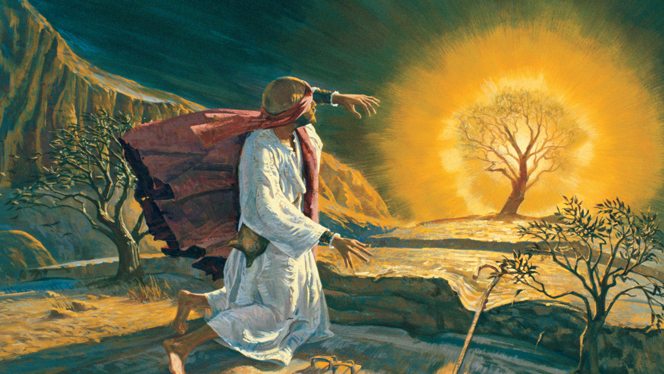
The Burning Bush: Am Here For You
Introduction
God reveals himself as “the one who is there for you,” for his people. God created people free. When people rob themselves or others from their freedom, God’s love is wounded. For God is totally committed to people, to their struggles and sufferings, to their precious freedom. When his people is not free, God is not free. He committed himself so much to our freedom that he sent Jesus among us to free us from sin through his death on the cross.
Those open-hearted will understand Jesus and respond to him. To see God, to know that he is with us, to hear the message of the gospel, one must have the openness and receptivity of a child and be aware of one’s poverty. Salvation is given. Those who are filled with their own wisdom cannot hear or welcome him, for they try to conform God and the gospel to their own ideas, not theirs to God’s.
1 Reading: Exodus 3:1-6, 9-12
Moses was tending the flock of his father-in-law Jethro, the priest of Midian. Leading the flock across the desert, he came to Horeb, the mountain of God. There an angel of the LORD appeared to him in fire flaming out of a bush. As he looked on, he was surprised to see that the bush, though on fire, was not consumed. So Moses decided, “I must go over to look at this remarkable sight, and see why the bush is not burned.” When the LORD saw him coming over to look at it more closely, God called out to him from the bush, “Moses! Moses!” He answered, “Here I am.” God said, “Come no nearer! Remove the sandals from your feet, for the place where you stand is holy ground. I am the God of your father,” he continued, “the God of Abraham, the God of Isaac, the God of Jacob. The cry of the children of Israel has reached me, and I have truly noted that the Egyptians are oppressing them. Come, now! I will send you to Pharaoh to lead my people, the children of Israel, out of Egypt.” But Moses said to God, “Who am I that I should go to Pharaoh and lead the children of Israel out of Egypt?” He answered, “I will be with you; and this shall be your proof that it is I who have sent you: when you bring my people out of Egypt, you will worship God on this very mountain.”
Responsorial Psalm: Ps 103:1b-2, 3-4, 6-7
R. (8a) The Lord is kind and merciful.
Bless the LORD, O my soul;
and all my being, bless his holy name.
Bless the LORD, O my soul,
and forget not all his benefits. R.
He pardons all your iniquities,
he heals all your ills.
He redeems your life from destruction,
he crowns you with kindness and compassion. R.
The LORD secures justice
and the rights of all the oppressed.
He has made known his ways to Moses,
and his deeds to the children of Israel. R.
Alleluia: cf. Matthew 11:25
R. Alleluia, alleluia. Blessed are you, Father, Lord of heaven and earth; you have revealed to little ones the mysteries of the Kingdom. R. Alleluia, alleluia.
Gospel: Matthew 11:25-27
At that time Jesus exclaimed: “I give praise to you, Father, Lord of heaven and earth, for although you have hidden these things from the wise and the learned you have revealed them to the childlike. Yes, Father, such has been your gracious will. All things have been handed over to me by my Father. No one knows the Son except the Father, and no one knows the Father except the Son and anyone to whom the Son wishes to reveal him.”
Commentary
The patriarchal figures, despite their unique call, had frequent and prolonged relations with neighbouring cultures. Moses married a Midianite after fleeing Egypt and in today’s reading is depicted as feeding her father-in-law’s flock not far from Mount Horeb.
Seeing a bush that burned but was not consumed, Moses goes over to take a closer look. A voice tells him that he stands on sacred soil and that he must remove his shoes. The God of his fathers has heard the cry of his people in slavery and desires to deliver them. The only identity that he gives at this point is that of the accompanying deity. The liberating God.
God revealed himself in various cultures and at various moments of time. The gospel reminds us that we have relived all of that and more. Jesus today gives thanks that this revelation was not made to those who are exalted and of superior intelligence. It is the little people of his own time who are most receptive. We have come to know the fullness of God’s revelation in his Son. The gift is inestimable: our gratitude must be profound.
Blessing
God says that he has heard the cry of his people. Do we hear the cries of our people when they shout to us that they are in need? May almighty God bless you, the Father, and the Son, and the Holy Spirit. Amen!