


OUTCASTS ARE PEOPLE, MEMBERS OF THE CHRISTIAN COMMUNITY
Introduction
In strong terms, Amos scolds the people that their rituals, their liturgies, are worthless if they do not honour God by practicing justice. Jesus takes pity on people considered possessed by the devil, outcasts of little value to their pagan fellow citizens, who are more concerned about the loss of their pigs than over the cure of these outcasts.
1 Reading Amos 5:14-15, 21-24
Seek good and not evil,
that you may live;
Then truly will the LORD, the God of hosts,
be with you as you claim!
Hate evil and love good,
and let justice prevail at the gate;
Then it may be that the LORD, the God of hosts,
will have pity on the remnant of Joseph.
I hate, I spurn your feasts, says the LORD,
I take no pleasure in your solemnities;
Your cereal offerings I will not accept,
nor consider your stall-fed peace offerings.
Away with your noisy songs!
I will not listen to the melodies of your harps.
But if you would offer me burnt offerings,
then let justice surge like water,
and goodness like an unfailing stream.
Responsorial Psalm 50:7, 8-9, 10-11, 12-13, 16bc-17
R. (23b) To the upright I will show the saving power of God.
“Hear, my people, and I will speak;
Israel, I will testify against you;
God, your God, am I.”
R. To the upright I will show the saving power of God.
“Not for your sacrifices do I rebuke you,
for your burnt offerings are before me always.
I take from your house no bullock,
no goats out of your fold.”
R. To the upright I will show the saving power of God.
“For mine are all the animals of the forests,
beasts by the thousand on my mountains.
I know all the birds of the air,
and whatever stirs in the plains, belongs to me.”
R. To the upright I will show the saving power of God.
“If I were hungry, I should not tell you,
for mine are the world and its fullness.
Do I eat the flesh of strong bulls,
or is the blood of goats my drink?”
R. To the upright I will show the saving power of God.
“Why do you recite my statutes,
and profess my covenant with your mouth,
Though you hate discipline
and cast my words behind you?”
R. To the upright I will show the saving power of God.
Alleluia James 1:18
R. Alleluia, alleluia.
The Father willed to give us birth by the word of truth
that we may be a kind of first-fruits of his creatures.
R. Alleluia, alleluia.
Gospel Matthew 8:28-34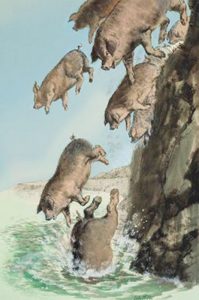
When Jesus came to the territory of the Gadarenes,
two demoniacs who were coming from the tombs met him.
They were so savage that no one could travel by that road.
They cried out, “What have you to do with us, Son of God?
Have you come here to torment us before the appointed time?”
Some distance away a herd of many swine was feeding.
The demons pleaded with him,
“If you drive us out, send us into the herd of swine.”
And he said to them, “Go then!”
They came out and entered the swine,
and the whole herd rushed down the steep bank into the sea
where they drowned.
The swineherds ran away,
and when they came to the town they reported everything,
including what had happened to the demoniacs.
Thereupon the whole town came out to meet Jesus,
and when they saw him they begged him to leave their district.
Commentary:
Mark’s account (Jan. 31) is much more graphic than Matthew’s. There are some marked differences; I mention just one. According to Matthew, there are two possessed men, not one. The very same difference between these two Gospels is found in other places. For example, in Mt 20:30 there are two blind men sitting by the road, but in Mark (10:46) there is only one, Bartimaeus. In Mt 26:60, two witnesses came forward to give evidence against Jesus, but in Mark (14:55ff), there is no such pair. All of this may be connected with the requirement of two witnesses in Jewish law. In always stressing pairs, Matthew may be trying very hard to make the point that what he is describing is objectively true, properly ‘witnessed’.
However, the Gospel text of today is difficult to understand unless we pay attention to the underlying theme of impurity. The outcasts from whom Jesus will exorcise demons live in an impure place, a cemetery; the demons are driven out into pigs, unclean animals for the Jews. The pagans of the region do not yet recognize Jesus and this seems to indicate that the story is symbolic of times still to come: evil is still rampant. But in any case the power of Jesus is already working.
Blessing
“Let justice flow like waters, and righteousness like an ever flowing stream.” If we can be just and good, the Lord will listen to us and accept our offering, for then it will be part of the sacrifice of Jesus. May God bless you, the Father, and the Son, and the Holy Spirit. Amen!