

What Is The Source of Your Happiness?
1. What Are We Living for?
2. What Brings Us Happiness That Lasts?
Introduction
1. What are we living for?
What do we consider most important in life? The message of today confronts us with this question. And it is basic for our Christian living. Are there more important things for us than money, goods and power? Do we find love of God and neighbour, friendship and affection and concern for each other greater and lasting and worthy of living for? What is the answer we give Jesus today?
2. What Brings Us Happiness That Lasts?
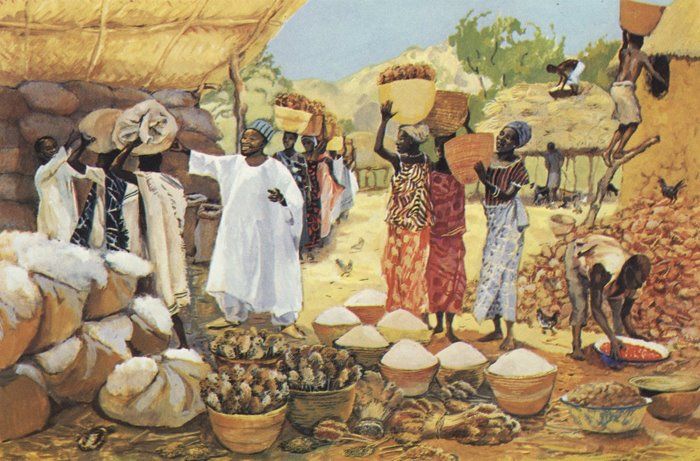
We all need the things that are necessary for life, but our human experience keeps reminding us again and again of what Jesus told us in the gospel long ago: accumulating riches does not bring happiness! The joy of living does not depend on full granaries or fat bank accounts. The quality of life and its joy depend rather on how much we love the Lord and one another and on how far we can share what we have. That is how we become rich in the sight of God. In this Eucharist we ask our Lord that he bring us joy and happiness along with his friendship.
First Reading: What Will Remain in the End?
The author of the first reading speaks from sad experience: possessions and human endeavours alone do not guarantee happiness. He does not give a solution, but poses the problem very poignantly.
1 Reading: Ecclesiastes 1:2; 2:21-23
Vanity of vanities, says Qoheleth, vanity of vanities! All things are vanity! Here is one who has laboured with wisdom and knowledge and skill, and yet to another who has not laboured over it, he must leave property. This also is vanity and a great misfortune. For what profit comes to man from all the toil and anxiety of heart with which he has laboured under the sun? All his days sorrow and grief are his occupation; even at night his mind is not at rest. This also is vanity.
Responsorial Psalm: Ps 90:3-4, 5-6, 12-13, 14 and 17
R. (1) If today you hear his voice, harden not your hearts.
You turn man back to dust,
saying, “Return, O children of men.”
For a thousand years in your sight
are as yesterday, now that it is past,
or as a watch of the night. R.
You make an end of them in their sleep;
the next morning they are like the changing grass,
Which at dawn springs up anew,
but by evening wilts and fades. R.
Teach us to number our days aright,
that we may gain wisdom of heart.
Return, O LORD! How long?
Have pity on your servants! R.
Fill us at daybreak with your kindness,
that we may shout for joy and gladness all our days.
And may the gracious care of the LORD our God be ours;
prosper the work of our hands for us!
Prosper the work of our hands! R.
2 Reading Colossians 3:1-5, 9-11
Brothers and sisters: If you were raised with Christ, seek what is above, where Christ is seated at the right hand of God. Think of what is above, not of what is on earth. For you have died, and your life is hidden with Christ in God. When Christ your life appears, then you too will appear with him in glory. Put to death, then, the parts of you that are earthly: immorality, impurity, passion, evil desire, and the greed that is idolatry. Stop lying to one another, since you have taken off the old self with its practices and have put on the new self, which is being renewed, for knowledge, in the image of its creator. Here there is not Greek and Jew, circumcision and uncircumcision, barbarian, Scythian, slave, free; but Christ is all and in all.
Alleluia: Matthew 5:3
R. Alleluia, alleluia.
Blessed are the poor in spirit,
for theirs is the kingdom of heaven.
R. Alleluia, alleluia.
Gospel: Our Riches Is God
Our riches are to be found in God; possessions give us no security, for only God can give lasting happiness.
Gospel: Luke 12:13-21
Someone in the crowd said to Jesus, “Teacher, tell my brother to share the inheritance with me.” He replied to him, “Friend, who appointed me as your judge and arbitrator?” Then he said to the crowd, “Take care to guard against all greed, for though one may be rich, one’s life does not consist of possessions.” Then he told them a parable. “There was a rich man whose land produced a bountiful harvest. He asked himself, ‘What shall I do, for I do not have space to store my harvest?’ And he said, ‘This is what I shall do: I shall tear down my barns and build larger ones. There I shall store all my grain and other goods and I shall say to myself, “Now as for you, you have so many good things stored up for many years, rest, eat, drink, be merry!”’ But God said to him, ‘You fool, this night your life will be demanded of you; and the things you have prepared, to whom will they belong?’ Thus will it be for all who store up treasure for themselves but are not rich in what matters to God.”
Commentary
The vision of Qoheleth the preacher (1st reading) is a particularly bleak one. It still appeals greatly to people with a pessimistic turn of mind. “I saw all the deeds that are done under the sun; and see, all is vanity and a chasing of the wind” (1:14). Scholars say it represents an era of crisis in biblical history, a period of self-questioning; and that through it came a deepening of the spirit. If so, then we can hope that the same may be true of our own times. Especially, in Nigeria where one needn’t any prophet to prevision the catastrophe in waiting. No one can deny that there is truth in what Qoheleth says. If only he had been around to advise Herod and Herodias! (yesterday’s reading). Like them don’t we all give ourselves (and others) a lot of agony about words and thoughts, privileges and possessions and appearances…? We are capable of ruining our health, our peace of mind and the peace of our homes for nothing. “Vanity of vanities!” Jesus takes up this theme in the gospel reading, expressing it typically as a story. But there is a difference. Qoheleth says the rich man is foolish because he “must leave all to someone who has not worked for it.” In other words, he is foolish to have worked, because he cannot enjoy all the fruits of it himself. Jesus said the rich man is foolish because he does not “amass for God.” That expression meant almsgiving (see Lk 12:33; 16:9), sharing with one another and recognizing God in success. Though these two readings are alike in subject and even in the direction of what they say, they are worlds apart. Two lines of T.S. Eliot’s come to mind, “The last temptation is the greatest treason: To do the right thing for the wrong reason.” It is, thus, futile to believe that wealth or material possessions could bring us everlasting happiness and satisfaction.
Blessing
It was good to reflect together
on the relative value of the things we have.
Yes, let us enjoy without scruple
the simple, God-given things of everyday life.
But let us always remain free,
as we are liberated by Jesus our Lord;
we are never again to be enslaved
to anyone or to anything.
And let us share with one another
our friendship, our joys, our goods,
with the blessing of almighty God,
the Father, and the Son, and the Holy Spirit. R/ Amen.
Let us go in the peace and security of Christ.
R/ Thanks be to God.