

Encountering Christ In Word And Sacrament
Introduction
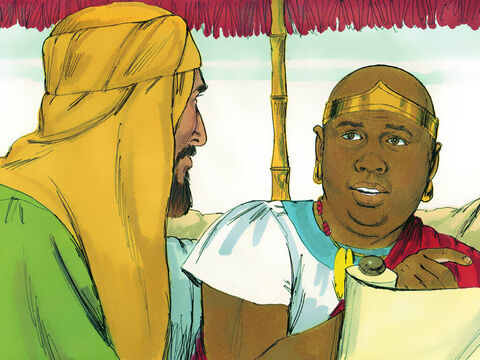
Luke presents the conversion of the treasurer of the queen of Ethiopia very much in parallel with that of the disciples of Emmaus. The latter had listened to Christ’s explanation of the Scriptures about himself, and then recognized and really encountered the living, Risen Lord in the breaking of bread, in the Eucharist. The Ethiopian had the Scriptures explained to him about the lamb that was slain and the good news of the resurrection. Then, he asked to be baptized so that he could encounter the Risen Lord.
In the Gospel, Christ speaks again of himself as the bread of life to be accepted in faith and promises to give the bread of his own flesh in the Eucharist for the life of the world, for eternal life.
Opening Prayer
Father,
you draw all people to you
who believe in your Son, Jesus Christ.
Faith Lord, faith it is that we need.
Give it to us, we pray you,
a living faith that we can encounter today
Jesus Christ, your Son,
in your Word that you speak to us,
in the bread that you offer us,
and in the food that we can give
and can be to one another,
in Jesus Christ, your Son and our Lord,
who lives with you and the Holy Spirit,
now and for ever. Amen!
1 Reading: ACTS 8:26-40
The angel of the Lord spoke to Philip, “Get up and head south on the road that goes down from Jerusalem to Gaza, the desert route.” So he got up and set out. Now there was an Ethiopian eunuch, a court official of the Candace, that is, the queen of the Ethiopians, in charge of her entire treasury, who had come to Jerusalem to worship, and was returning home. Seated in his chariot, he was reading the prophet Isaiah. The Spirit said to Philip, “Go and join up with that chariot.” Philip ran up and heard him reading Isaiah the prophet and said, “Do you understand what you are reading?” He replied, “How can I, unless someone instructs me?” So he invited Philip to get in and sit with him. This was the Scripture passage he was reading: Like a sheep he was led to the slaughter, and as a lamb before its shearer is silent, so he opened not his mouth. In his humiliation justice was denied him. Who will tell of his posterity? For his life is taken from the earth. Then the eunuch said to Philip in reply, “I beg you, about whom is the prophet saying this? About himself, or about someone else?” Then Philip opened his mouth and, beginning with this Scripture passage, he proclaimed Jesus to him. As they travelled along the road they came to some water, and the eunuch said, “Look, there is water. What is to prevent my being baptized?” Then he ordered the chariot to stop, and Philip and the eunuch both went down into the water, and he baptized him. When they came out of the water, the Spirit of the Lord snatched Philip away, and the eunuch saw him no more, but continued on his way rejoicing. Philip came to Azotus, and went about proclaiming the good news to all the towns until he reached Caesarea.
Responsorial Psalm 66:8-9, 16-17, 20
R. (1) Let all the earth cry out to God with joy. or: Alleluia.
Bless our God, you peoples,
loudly sound his praise;
He has given life to our souls,
and has not let our feet slip. R.
Hear now, all you who fear God, while I declare
what he has done for me.
When I appealed to him in words,
praise was on the tip of my tongue. R.
Blessed be God who refused me not
my prayer or his kindness! R.
Alleluia: JOHN 6:51
Alleluia, alleluia.
I am the living bread that came down from heaven,
says the Lord;
whoever eats this bread will live forever.
R. Alleluia, alleluia.
Gospel: JOHN 6:44-51
Jesus said to the crowds: “No one can come to me unless the Father who sent me draw him, and I will raise him on the last day. It is written in the prophets: They shall all be taught by God. Everyone who listens to my Father and learns from him comes to me. Not that anyone has seen the Father except the one who is from God; he has seen the Father. Amen, amen, I say to you, whoever believes has eternal life. I am the bread of life. Your ancestors ate the manna in the desert, but they died; this is the bread that comes down from heaven so that one may eat it and not die. I am the living bread that came down from heaven; whoever eats this bread will live forever; and the bread that I will give is my Flesh for the life of the world.”
Commentary
Teachability
How wonderful it is to be taught by God, if possible, every moment of our lives! But the truth is, God is indeed, teaching us every moment; only that we fail to learn. If only we nurture within us the trait of teachability can we recognize the teachings of God that come our way. This teachability is all about an attitude of openness, vulnerability, as defines John Maxwell, a leadership expert:
“Teachability is not so much about competence and mental capacity as it is about attitude. It is the desire to listen, learn, and apply. It is the hunger to discover and grow. It is the willingness to learn, unlearn, and relearn.”
In other words, for us, true believers in the Risen Lord, it is the vulnerable openness to the movements of Grace. Such teachability brings us to God as well.
Intercessions
– Lord, let your Word and your person be so much alive in us that we want to let all those around us share in them, we pray:
– Lord, let the Eucharist make our communities alive in the spirit of service and justice, we pray:
– Lord, let us become enthusiastic in love and sharing, like the early Christians, we pray:
Prayer over the Gifts
Lord God, we want to live,
live to the full
and without limits or boundaries.
Give us the bread of life, we pray you,
that we may know and love and live,
that we may give ourselves
with him who gave himself
as flesh for the life of the world,
and be raised up with him on the last day
to live with you, forever and ever. Amen!
Prayer after Communion
God of the living,
you have given us the bread of life,
that we may eat it and not die.
All thanks be given to you, Father,
but make our faith strong and deep
that your Son is with us,
that in him, the world can live,
a life worth living, a life of hope,
of justice and dignity and love,
a life that lasts, forever and ever. Amen!
Blessing
To live, to be alive, to be vibrant with life, that is how we and our communities should be if the Lord is really alive among us. Some early Christian communities called themselves “Hoi zõntes,” “those who are alive.” Shouldn’t we all be? May Almighty God bless you, the Father, and the Son, and the Holy Spirit. Amen!